Hinckley Talaria Buyer's Guide: Jetboat Heritage for Serious Owners
The Hinckley Talaria pairs Down East craftsmanship with waterjets, shallow draft and joystick docking. Here is what to know before you buy a 43, 48 or 55.
What Is a Hinckley Talaria, and Why Do Owners Keep Them?
The Hinckley Talaria is a family of Maine-built, jet-driven motor yachts, now offered in the 43, 48 and 55 foot range, and it is best understood as a Down East cruiser that trades a conventional propeller and keel for waterjets, a joystick and a draft measured in inches rather than feet. For owners who want to reach shallow anchorages at speed and dock a large boat without a crew, it remains one of the few genuinely distinctive answers in the market. This guide covers the heritage, the engineering, what a pre-owned example should be inspected for, and what the market is asking in 2026.
The Hinckley Legacy: From Manset to Talaria
Hinckley was founded in 1928 when Benjamin B. Hinckley bought a small boatyard in Southwest Harbor, Maine. His son Henry R. Hinckley took control in 1932, and the company was an early adopter of fiberglass, with the Bermuda 40 sailboat as its first fiberglass boat. Ownership has changed several times since. Henry sold the company to Richard Tucker in 1979, and his son Bob bought it back in 1982. Bain, Willard Companies acquired it in 1997 for a reported figure of roughly $20 million, and in 2001 a controlling interest passed to Monitor Clipper Partners. The company later added Hunt Yachts in 2014 and Morris Yachts in 2015.
The first Hinckley Talaria powerboat appeared in 1989. The Picnic Boat followed in 1994, and the same year the company first used jet propulsion. The JetStick control system that now defines the Talaria followed in 1998. Yachting magazine noted when the Talaria 43 launched that the model was designed to replace the Talaria 44, a design dating to 1997.
Which models exist? Hinckley's current Talaria range, per public references and brokerage listings, comprises the Talaria 43, 48 and 55, with 55 MKII motoryacht and flybridge versions listed. Earlier generations include the Talaria 44, a design dating to 1997, and smaller Talaria 34 JetBoats that still appear on the brokerage market. A second-generation (MKII) designation applies to the current 43, 48 and 55. Buyers should always confirm the exact hull generation, because engines, jet units and control software differ materially between eras.
Design DNA: Why Waterjets and Shallow Draft Define the Talaria
The signature claim is what Hinckley calls zero draft. Because a waterjet sits flush with the bottom of the hull, there are no propellers, shafts or rudders hanging below the keel line. Hinckley lists the Talaria 43 MKII at a draft of 2 feet 4 inches, and says the boat can run in as little as 36 inches of water, a marketing claim rather than a listed specification. For cruisers in the Bahamas, the Chesapeake or Maine, where lobster pots and shoals are a constant, that is a practical advantage rather than a marketing line.
The second pillar is JetStick, the joystick control system Hinckley introduced in 1998. Yachting described the later JetStick II on the Talaria 43 as linking a hydraulic bow thruster with a pair of Hamilton jet drives, letting the boat pivot within its own length and move in any direction. JetStick II added Hover Lock for station keeping and Heading Hold for hands-off tracking at low cruising speeds. For an owner-operator, that capability changes how a 43 to 55 foot yacht is lived with, since docking in a crosswind with one hand on a joystick is a very different experience from managing twin shafts.
The third pillar is construction. Hinckley reports that current Talarias use its DualGuard SCRIMP composite, a carbon and E-glass laminate infused with epoxy. SCRIMP is a resin infusion process that Hinckley adopted early. The practical result is a light, stiff hull with a deep-V bottom: the Talaria 43 carries 19 degrees of deadrise and was drawn by naval architect Michael Peters.
Specifications at a Glance
Builder figures for the Talaria 43 at launch were 43 feet 9 inches overall, a beam of 14 feet 6 inches, 500 US gallons of fuel and 100 gallons of water, with standard twin 550 horsepower Cummins diesels driving Hamilton 322 jets. The current 43 MKII uses twin Volvo Penta 550 horsepower diesels with Hamilton HTx jets, with a stated 34 knot cruise and 37 knot top speed on optional power. Treat all performance numbers as builder estimates that vary with load and sea state.
How Does the Talaria Compare With Its Peers?
Shortlists for a Talaria usually include other Maine and Down East builders, plus traditional trawler-style cruisers. The comparison below is qualitative by design, because specifications vary widely by year and configuration, and buyers should confirm each point against the specific hull under consideration.
| Builder / line | Propulsion approach | Character | Best fit |
|---|---|---|---|
| Hinckley Talaria | Waterjets with JetStick joystick control (IPS offered on some models) | Shallow draft, fast cruise, bespoke Down East finish | Owner-operators who value draft, speed and docking ease |
| Back Cove | Conventional shaft or pod drives, typically diesel | Down East styling, practical and more accessible entry point | Buyers who want the look at a lower acquisition cost |
| Sabre Motor Yachts | Conventional diesel or pod drives | Maine-built, strong reputation for finish and handling | Buyers cross-shopping on craftsmanship |
| Grand Banks | Displacement or semi-displacement diesel | Classic long-range trawler, slower and economical | Liveaboard cruisers who prioritize range over speed |
The honest summary is that the Talaria is the most specialized of the group. A buyer who rarely visits shallow water and prefers a conventional drivetrain may be better served elsewhere, and a buyer who wants low fuel burn at 8 knots will find a trawler more rational. The Talaria justifies itself when speed, draft and control are all priorities at once.
Consumption is the trade-off to understand before purchase. In Yachting's 2015 test of the Talaria 43 with twin 550 horsepower engines, the boat recorded roughly 24.8 knots at about 39.6 gallons per hour and 33.5 knots at about 56.4 gallons per hour, while at 9.6 knots it burned about 13.4 gallons per hour. Jets are generally less efficient at slow speeds than conventional propellers, so owners should budget fuel on the basis of how they will really cruise.
What Should You Inspect on a Pre-Owned Talaria?
A pre-owned Talaria deserves a survey by someone who understands jet-driven composite yachts, not a generalist. General brokerage practice for used yachts emphasizes maintenance records for engines, drives, generator and stabilization, the condition of teak and exterior joinery, electronics updates and a professional survey. The following checklist builds on that baseline. For a wider acquisition framework, see our comparison of new and used yacht buying and the complete yacht buying guide.
- Engines: request service logs, hours, oil analysis and any recall or software updates. Confirm which engines are fitted, since Cummins, Cat and Volvo Penta have all been used across generations.
- Waterjets and impellers: inspect impellers, wear rings, steering nozzles and reverse buckets for damage from debris or sand, which is a real exposure for a boat built to enter skinny water. Ask for a haul-out inspection and a sea trial at several loads.
- JetStick and bow thruster: test every docking mode, Hover Lock and Heading Hold where fitted, and confirm the software version and any history of control faults.
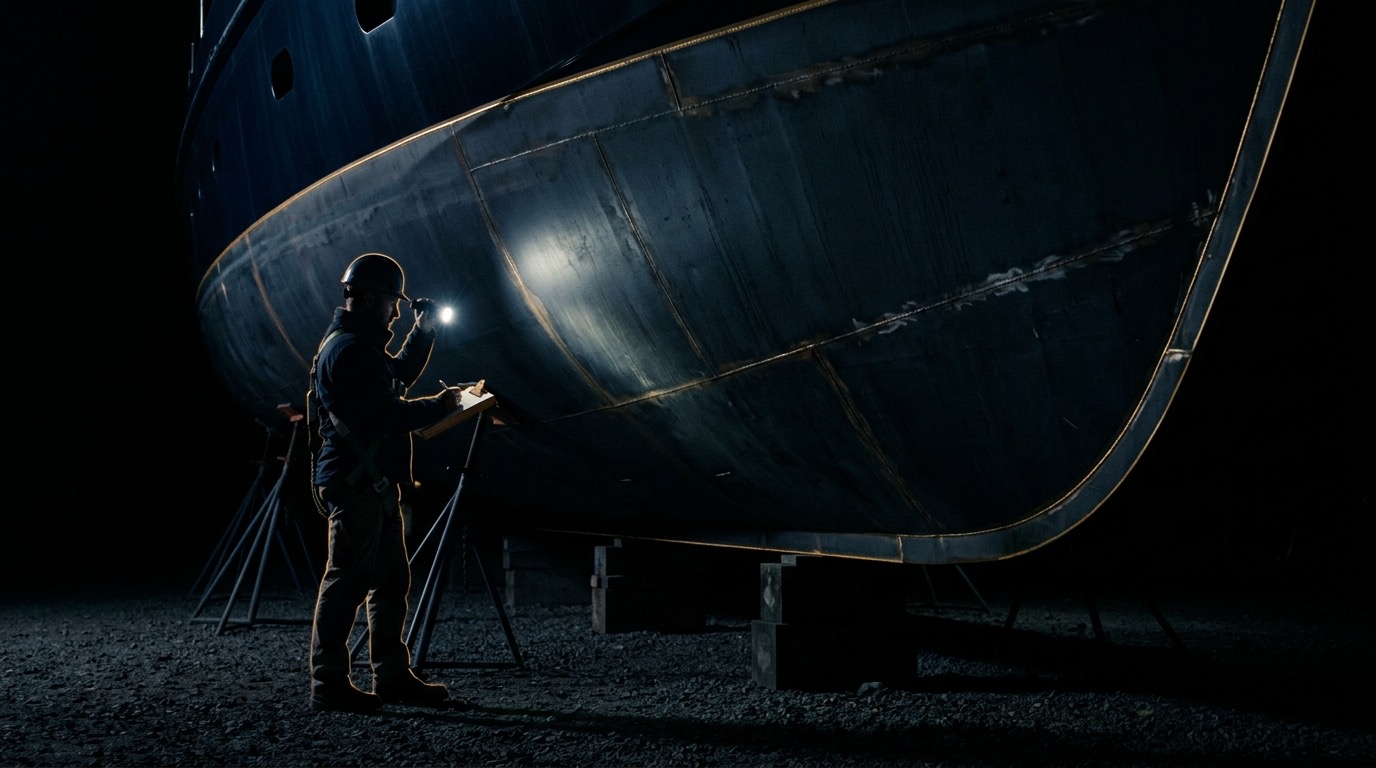
- Hull and deck: a composite hull calls for moisture readings, tapping and inspection of keel and chine areas, plus any past groundings. A boat designed to beach or approach shoals is more likely than most to have a contact history.
- Teak and joinery: examine cockpit and deck teak thickness, caulking and the varnished interior, which is expensive to restore.
- Generator, air conditioning and systems: check hours, raw-water pumps, heat exchangers and chilled-water or direct-expansion units, along with stabilization if fitted.
- Electronics and monitoring: confirm the age of displays, radar and autopilot. Remote-monitoring and software capability will differ between hull generations.
How Much Does a Used Hinckley Talaria Cost in 2026?
Asking prices as of 2026 span a wide band, driven mainly by model, age and refit currency. The figures below are asking prices seen in public search results and brokerage listings, which we could not verify directly or confirm as sold prices, and listings vary by the week. They should be read as indicative only.
| Model and year | Indicative asking price (USD, 2026) |
|---|---|
| Talaria 55 MKII, 2006 to 2019 hulls | roughly $1.6 million to $2.9 million across listings seen |
| Talaria 48 MKII, 2022 | about $3.4 million (one listing seen) |
For context, Yachting reported a base price of $1,587,000 for the Talaria 43 at its 2015 launch. We did not find reliable current asking prices for the Talaria 43, 34 or 44, and buyers should obtain recent comparable sales through a broker. Actual transaction prices often differ from asking prices, and condition, engine hours, options and storage history can move a hull materially within any band.
Budget beyond the purchase price. Annual running costs for a yacht of this class include insurance, storage, crew or captain if used, jet and engine servicing and electronics updates. Our yacht insurance cost guide and refit cost breakdown offer a useful framework for planning, even though a Talaria sits well below superyacht scale.
Who Is the Hinckley Talaria Right For?
The Talaria suits an experienced owner, often a couple, who cruises coastal waters and values arriving quickly, anchoring close to shore and docking without help. It tends to appeal to those leaving a larger, crewed yacht for something they can run themselves, and to principals who keep a boat on the East Coast, where Hinckley maintains service yards. Wikipedia describes Hinckley as running service yards on the U.S. East Coast, although its page gives conflicting location counts, so confirm coverage near your intended cruising ground.
It is a weaker fit for owners planning long ocean passages at displacement speeds, or for those who prioritize minimal fuel burn over speed. It is also a considered choice for buyers who want a conventionally serviced boat anywhere in the world, since jet drives and the JetStick system benefit from technicians who know them. Anyone weighing this against a classic trawler or a pod-driven alternative should sea trial each and ask the owner community about long-term experience.
Buying Through a Curated Network
Many pre-owned Hinckleys change hands through relationships rather than open listings, and the best examples, those with documented service histories and recent refits, are often the quietest sales. A curated network helps in three ways: sourcing hulls that match a precise specification, coordinating an independent survey with a jet-specialist inspector, and negotiating on the basis of the findings. Obsidian Helm's yacht and jet practice works with principals on that process, from defining the brief to closing and onward privacy planning. If you are comparing a Talaria with larger or different yachts, our overview of the most expensive yachts in 2026 shows where this class sits in the wider market.
Sources and Further Reading
- Wikipedia, Hinckley Yachts
- Yachting Magazine, Hinckley's Talaria 43 review
- Hinckley Yachts, Talaria 43 MKII
- Collection Yachts, Hinckley listings
Considering a Hinckley Talaria?
Obsidian Helm advises principals on sourcing, independent survey and negotiation for Down East and jet-driven yachts. Request a confidential conversation about your brief.
Request Your InvitationFrequently asked
Which Hinckley Talaria models exist?
Hinckley's current Talaria range is the 43, 48 and 55, with MKII designations on the current generation. Earlier models include the Talaria 44, a 1997 design that the 43 was designed to replace, and smaller Talaria 34 JetBoats still seen on the brokerage market. Always verify the exact hull generation, as engines and controls differ.
What is the JetStick on a Hinckley?
JetStick is Hinckley's joystick control system, introduced in 1998. It links the waterjets and a hydraulic bow thruster so the boat can pivot and move sideways at the dock. Yachting reported that JetStick II added Hover Lock for station keeping and Heading Hold for hands-off tracking at low speeds, which makes docking a large yacht far easier.
How shallow is the draft of a Talaria?
Hinckley lists the Talaria 43 MKII at a draft of 2 feet 4 inches, and Yachting's 2015 review gave the same figure. Because waterjets sit flush with the hull bottom, there are no propellers or shafts below the keel line. Draft differs by model and generation, so confirm the figure for the specific hull you are considering.
How much does a used Hinckley Talaria cost in 2026?
Asking prices seen in public search results and listings in 2026 ran from roughly $1.6 million to $2.9 million for Talaria 55 MKII hulls of various years, and about $3.4 million for a 2022 Talaria 48 MKII. These are asking prices, not sold prices, and listings vary, so obtain recent comparable sales from a broker.
What should I inspect on a used Talaria?
Focus on engine hours and service logs, waterjet impellers and wear rings, JetStick and bow thruster function, hull and keel condition after any groundings, teak decks and varnished joinery, generator and air conditioning, and electronics age. Use a surveyor experienced with jet-driven composite yachts and ask for a sea trial at several loads.
Is a Talaria fuel efficient?
Not at slow speeds. Yachting's 2015 test of the Talaria 43 recorded about 13.4 gallons per hour at 9.6 knots and about 39.6 gallons per hour at 24.8 knots, with roughly 56.4 gallons per hour at 33.5 knots. Waterjets favor speed, so fuel budgeting should reflect how you actually cruise.