Superyacht IT & Cybersecurity for Sydney Harbour
From Jones Bay to a mooring off Point Piper, the Australian summer season compresses a year of digital exposure into ten weeks. A private technology office — remote, under NDA — keeps the vessel, the owner and the family office invisible.
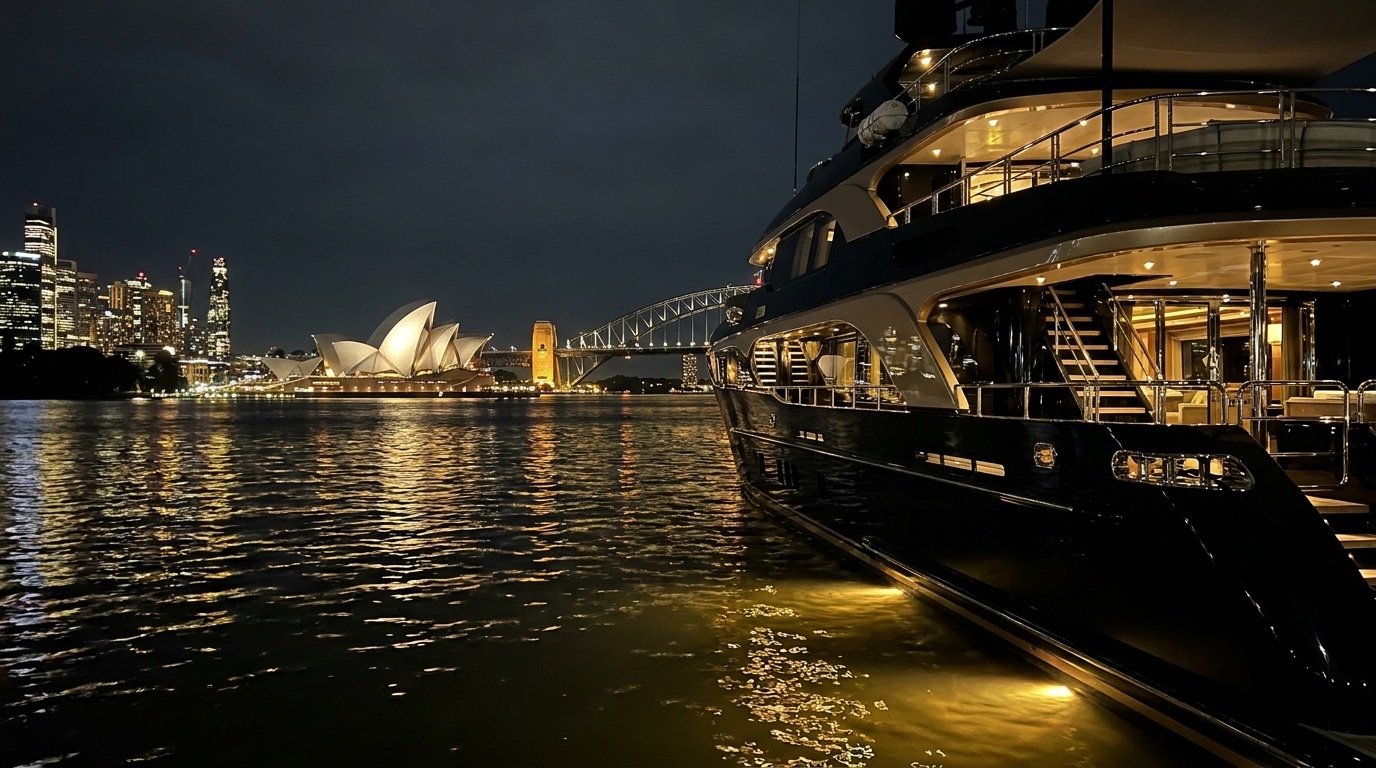
Sydney does not host superyachts quietly. When a vessel clears the Heads and passes beneath the Harbour Bridge — Jones Bay Superyacht Marina advertises 52 metres of air draft under the deck, enough for almost any rig afloat — it berths in the middle of a working capital city, in full view of two million harbourside residents. Jones Bay itself, a 1919 finger wharf rebuilt in 2003 and named Australian Marina of the Year in 2025, takes yachts past 100 metres a short walk from Darling Harbour. Across the water in Rozelle Bay, Sydney Superyacht Marina holds more than twenty berths to 74 metres, with a single coveted 60-metre alongside at Campbells Cove, directly beneath the Bridge. These are magnificent addresses. They are also, in network terms, some of the most hostile berths in the hemisphere.
The season is short and theatrical. From December to February the harbour fills for the austral summer, peaking on 26 December when the Rolex Sydney Hobart fleet — 142 yachts in the 2025 edition, the second-largest fleet this century — charges 628 nautical miles south while spectator vessels, helicopters and several hundred thousand phones crowd the foreshore. Every owner who brings a boat here does so to be seen. The task of a private technology office is to make sure that the vessel is the only thing on display.
The world’s most expensive postcode has a waterline
Sydney’s eastern harbour is unusual in that the wealth does not sit behind the marina — it surrounds the anchorage. Wolseley Road in Point Piper is Australia’s most expensive street, with a median house price of roughly A$45 million after a 36 per cent rise in a single year; Wentworth Road in Vaucluse follows at A$23.8 million. A yacht swinging off Rose Bay or Point Piper is anchored, quite literally, in the front garden of the country’s densest concentration of ultra-high-net-worth families. Tenders run guests to Double Bay for lunch; seaplanes lift off Rose Bay for the Hampton-style weekenders up the coast. The digital perimeter of the principal’s life — estate, family office, aircraft, vessel — collapses into a few square kilometres of water and sandstone.
That proximity is precisely the risk. Harbour anchorages are saturated with consumer Wi-Fi, charter traffic and hobbyist radio scanners. A yacht broadcasting its name as an SSID, running guest and crew devices on the owner’s VLAN, or bridging the AV network to the bridge systems is not a private residence; it is a beacon. The hardening playbook we apply worldwide — described in our superyacht and jet cybersecurity briefing — matters more in Sydney than almost anywhere, because the audience is closer.
Connectivity: superb in the harbour, brutal down the coast
Inside the Heads, bandwidth is rarely the problem — 5G blankets the eastern suburbs and marina fibre is mature. The problem is trust: shore networks at even excellent marinas are shared infrastructure, and harbour LTE is trivially intercepted by anyone motivated. The correct posture is to treat every shore connection as hostile transit. We architect vessels around low-earth-orbit primary links with disciplined failover — our Starlink at sea analysis covers the engineering — so that the yacht carries its own encrypted perimeter wherever it lies.
That discipline pays off the moment the vessel leaves the harbour. The east coast run — Pittwater, Port Stephens, the Whitsundays, or the December dash to Hobart — moves quickly out of reliable cellular coverage. A properly engineered stack of LEO primary, GEO VSAT backup and bonded cellular, with automatic failover that the owner never notices, is the difference between a working office at sea and a A$200 million dead zone. The fundamentals are set out in our yacht Wi-Fi and onboard network guide; the Sydney-specific work is tuning failover for the coastal gaps and hardening the network before the boat becomes a floating venue for New Year’s Eve on the harbour — the most photographed anchorage on earth that night.
Segmentation, monitoring and the ten-week problem
The Australian season concentrates exposure. In ten weeks a vessel might host three charter parties, a fireworks-night guest list of forty, contractor visits from local AV and provisioning firms, and a race-week media crew — every one of them carrying devices that touch the onboard network. Our standing architecture isolates owner, family, guest, crew, AV and operational-technology traffic on separate segments with deny-by-default routing between them; continuous monitoring watches for the anomalies that precede a breach — a crew device beaconing to an unfamiliar endpoint, a new MAC address on the bridge VLAN at 3 a.m.; and quarterly adversarial review keeps the configuration honest after a season of riders and refits.
The owner who anchors off Point Piper has already accepted being looked at. The unforgivable failure is being listened to.
A private office that follows the boat, not the berth
Obsidian Helm operates entirely remotely, under NDA, which suits the geography: when the vessel is alongside at Jones Bay in January and in Phuket by May — a routine repositioning we cover in our Singapore and Phuket briefing — the same engineers, the same monitoring and the same standards travel with her. We coordinate quietly with the captain and ETO, integrate the vessel into the family’s wider security posture alongside the residence and aircraft through our Yacht, Jet & Estate practice, and we never appear on the passerelle. For a harbour where everyone watches everything, that is the only acceptable arrangement.
Bring the vessel under the Helm before the season opens
Engagement begins with a $4,999 Private Strategy Session — a confidential, remote review of your vessel's connectivity, segmentation and exposure, fully credited toward membership should you proceed.
Request Your InvitationFrequently asked
Can superyacht IT and cybersecurity work really be done remotely for a vessel in Sydney?
Yes. Modern vessel networks are software-defined, so segmentation, firewall policy, VPN architecture, Starlink configuration and continuous monitoring are all managed remotely in coordination with the captain and ETO. Physical installs are handled by vetted local trades working to our specification, while design, oversight and incident response remain with one accountable office under NDA.
Is marina Wi-Fi at Sydney superyacht berths safe to use?
Treat it as hostile transit. Even excellent facilities like Jones Bay or Rozelle Bay provide shared shore infrastructure, and harbour anchorages are dense with consumer devices and interception risk. The correct posture is to route all vessel traffic through the yacht's own encrypted perimeter — LEO satellite primary with bonded cellular failover — and never trust shore networks directly.
What connectivity does a superyacht need for the Australian east coast?
Inside Sydney Harbour, 5G and marina fibre are strong, but coverage degrades quickly on coastal passages to Pittwater, the Whitsundays or Hobart. The standard architecture is Starlink or equivalent LEO as primary, GEO VSAT as backup, and bonded cellular near shore, with automatic failover engineered so the owner never notices a transition.
When should vessel cyber hardening be done for the Sydney season?
Before arrival, ideally during the repositioning passage or the preceding yard period. The December-to-February season compresses charters, guest events and New Year's Eve hosting into ten weeks, leaving no calm window for re-architecture. A pre-season review of segmentation, credentials, AV systems and crew devices prevents discovering problems mid-charter.