The Asia-Pacific Circuit: Superyacht IT Where the Chart Runs Out
Asia offers the last genuinely remote cruising on earth — and a fast-growing fleet to explore it. The yachts that do it well treat connectivity and cyber defence as seriously as fuel.

The geography of yachting is tilting east. Singapore’s ONE°15 Marina at Sentosa Cove — 272 wet berths, superyacht moorings to 200 feet, twice named International Marina of the Year — has just completed a multi-million-dollar reconfiguration that more than doubled its superyacht capacity, and now anchors a network of sister marinas in Jakarta, Nirup Island and Phuket. An hour and a half north by air, Phuket’s deep-water marinas — Yacht Haven on the island’s north shore, Ao Po Grand on Phang Nga Bay — have made Thailand the natural charter base of the Andaman Sea.
What draws owners east, though, is not the marinas. It is what lies beyond them: the limestone towers of Phang Nga, the Mergui Archipelago’s eight hundred barely visited islands, and Raja Ampat — more than 1,500 islands across the richest marine biodiversity on the planet. It is the last cruising ground where a 60-metre yacht can anchor for a week and see no other vessel. It is also where every assumption built into a Mediterranean yacht’s IT stack quietly fails.
Distance is the design constraint
In the western Mediterranean, a yacht is never far from a cell tower, a chandlery or an engineer who can fly in by morning. In eastern Indonesia, the nearest meaningful technical support may be a thousand nautical miles away, and the nearest LTE signal further still. A network fault off Saint-Tropez is an inconvenience; the same fault in Raja Ampat, with the owner aboard and a two-week itinerary, is a ruined season.
This is why the Asia-Pacific circuit is the strongest argument that exists for remotely operated yacht IT. A vessel instrumented before departure — every switch, firewall, access point and satellite terminal visible to engineers ashore — can be diagnosed, reconfigured and defended from the other side of the world, at any hour, under NDA, with no technician ever stepping aboard. The alternative is flying contractors into Sorong and hoping. We detail the architecture in our crew network and onboard IT briefing, and the philosophy across our Yacht & Jet practice.
Starlink changed Asia more than anywhere
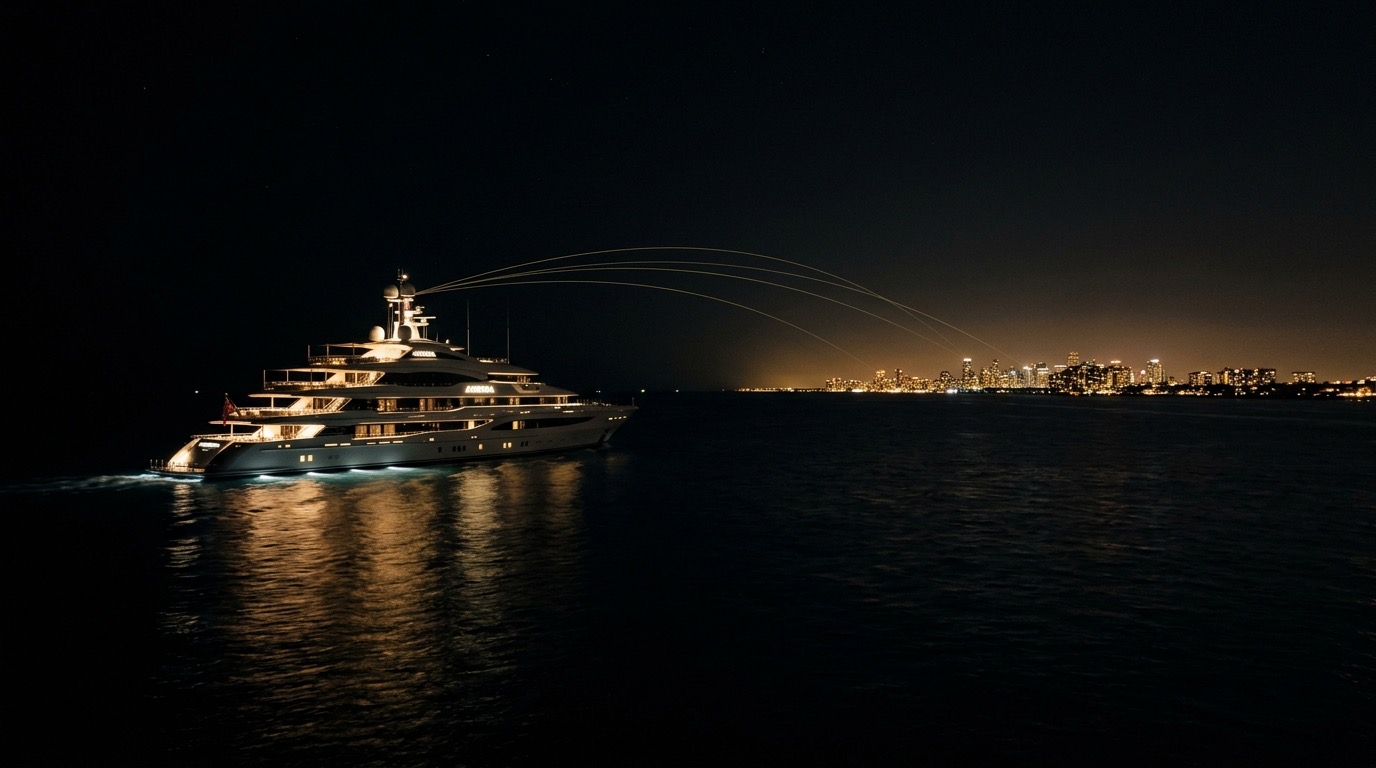
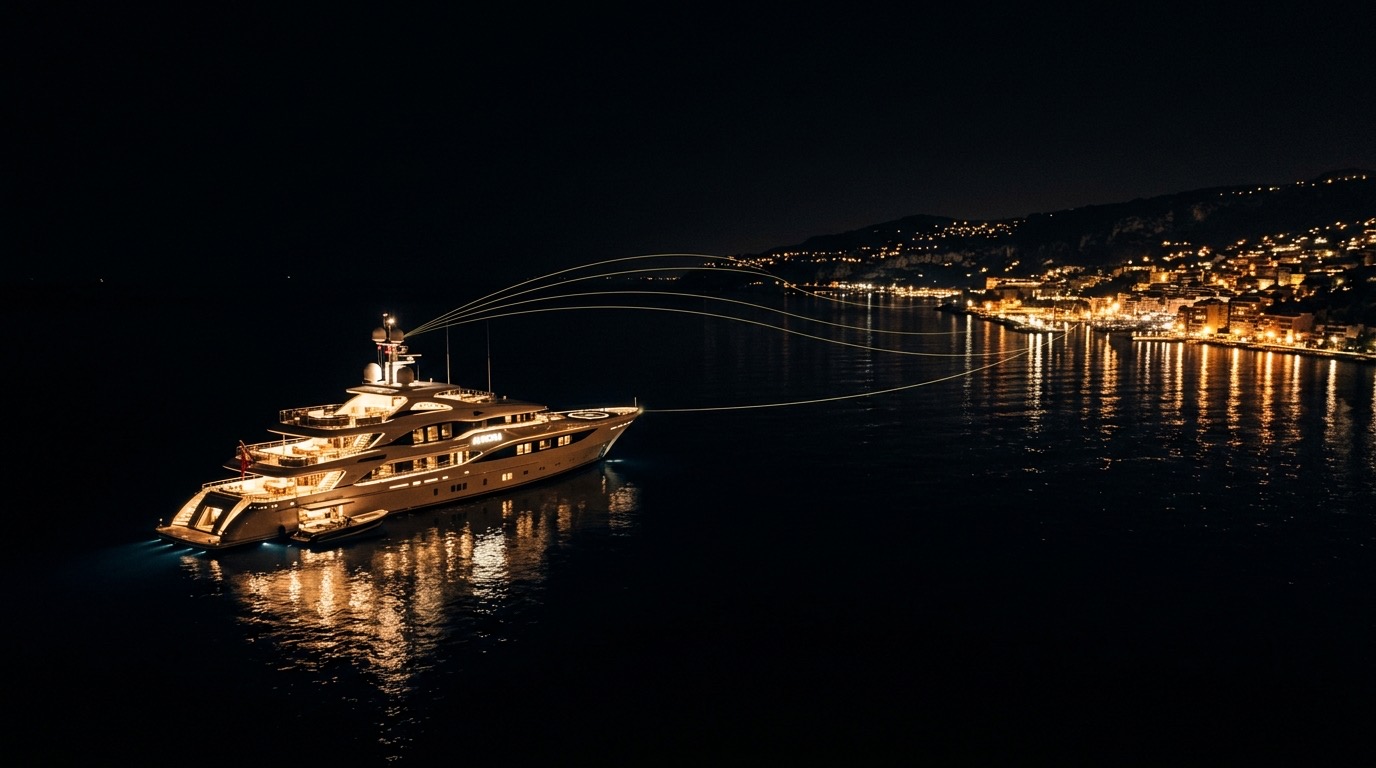
Low-earth-orbit connectivity has transformed every cruising ground, but nowhere more than this one. Anchorages that were, until recently, beyond all practical bandwidth now sustain video calls and full remote monitoring. Yet Starlink alone is not an architecture. Serious Asian itineraries layer it: LEO as the primary path, regional 4G/5G aggregation across Singaporean, Thai, Malaysian and Indonesian carriers near coastlines, and GEO VSAT retained as the deep-water fallback — with failover logic that moves traffic automatically and a watch desk that notices degradation before the owner does. Our Starlink at sea briefing and yacht Wi-Fi guide treat the engineering in depth.
Singapore: the most connected port, and the most scrutinised
Singapore is the region’s refit, finance and provisioning hub — and one of the most densely monitored radio environments on earth. A berth at Sentosa Cove places a yacht amid corporate towers, family offices and an electronic landscape where commercial espionage is a mature industry. Here the threat inverts: not isolation, but exposure. Owner, guest, crew and bridge networks must be strictly segmented; AV and IoT systems firewalled; crew devices governed; and traffic watched for the quiet anomalies that precede a breach. The discipline is the same one we apply from Monaco to the wider Mediterranean — the threat model simply travels with the flag.
In the Mediterranean, the test of a yacht’s systems is the crowd. In Asia, it is the silence.
Phuket and the charter question
Thailand’s charter market is maturing fast, and with it the rotation of unknown guest devices through yacht networks each season. Every embarkation imports phones, laptops and wearables of unknown hygiene; every disembarkation should trigger credential rotation and a guest-network purge. On charter yachts working the Andaman Sea, that discipline — enforced remotely, verified continuously — is the difference between hospitality and liability. It sits within the broader posture our cybersecurity office maintains for principals afloat and ashore.
Obsidian Helm is a private technology office, by invitation, operated by IT Cares Canada since 2014. We work entirely remotely, worldwide, under NDA — no visible team aboard, no branded presence on the dock at Sentosa or Yacht Haven. For owners pointing east, where the anchorages empty and the distances lengthen, that is precisely the point: the further you sail from everything, the more your systems must carry — and the more quietly we carry them.
Before you point the bow east
Begin with a Private Strategy Session — $4,999, fully credited toward membership. One confidential review of your vessel's connectivity and cyber posture, completed before the itinerary leaves Singapore.
Request Your InvitationFrequently asked
How do superyachts get reliable internet in remote parts of Asia?
The proven approach layers maritime Starlink as the primary link, multi-carrier 4G and 5G aggregation near coastlines in Thailand, Singapore, Malaysia and Indonesia, and GEO VSAT as a deep-water fallback. Automated failover moves traffic between paths in seconds, so remote anchorages like Raja Ampat or the Mergui Archipelago stay connected throughout the itinerary.
Why is remote IT support so important on the Asia-Pacific circuit?
Distances are vast and qualified marine IT engineers are scarce outside Singapore and Phuket. A properly instrumented yacht can be diagnosed, reconfigured and defended by engineers ashore from anywhere in the world, at any hour. Without that, a network fault in eastern Indonesia can mean days of downtime and flying contractors to remote airstrips.
Is Singapore a cybersecurity risk for visiting superyachts?
Singapore is exceptionally safe physically, but it is a dense, sophisticated electronic environment where commercial espionage is a real industry. Yachts berthed at Sentosa Cove should run strict network segmentation between owner, guest, crew and bridge systems, harden Wi-Fi against rogue access points, and monitor traffic continuously while in port.
What should a yacht prepare before chartering in Phuket or Indonesia?
Beyond licensing and provisioning, prepare the network: audit firmware and firewall rules, segment guest devices away from owner and bridge systems, establish credential rotation between charters, and verify satellite failover offshore. Indonesia's remote cruising grounds offer little fallback support, so connectivity and security must be proven before departure, not after.