Superyacht IT in St Barts: Private Networks for Gustavia's Fleet
Each December the world's most valuable fleet compresses itself into a harbour with sixty berths. The connectivity and security aboard deserve the same standard as the berth itself.
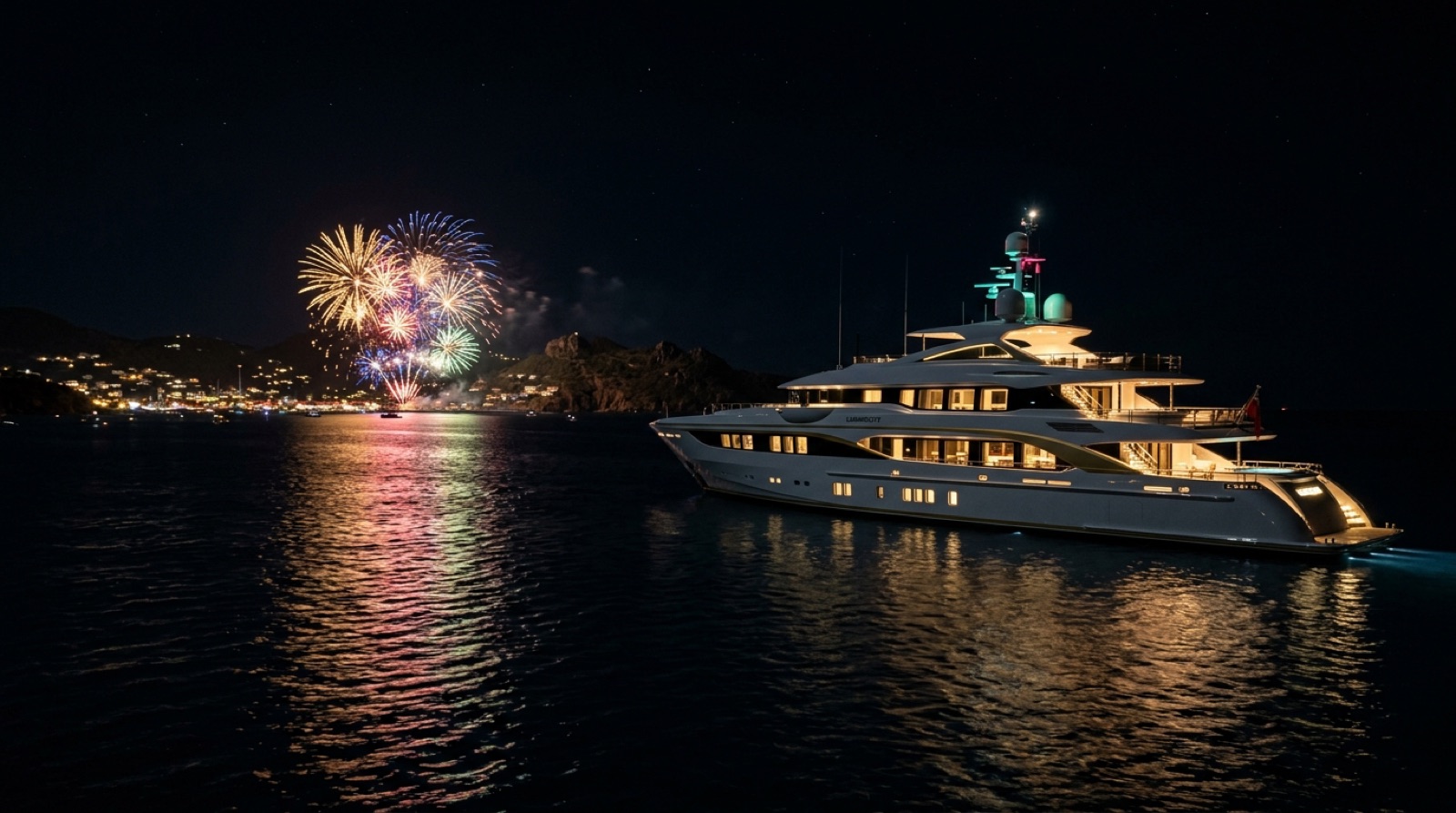
On the final night of 2025, MarineTraffic recorded 327 vessels in and around Gustavia — 158 of them arriving in the last hours before midnight. The fleet assembled for New Year’s Eve included a record 226 superyachts over 24 metres, all contending, one way or another, for an inner harbour that offers precisely 60 berths, claimed months in advance. There is no comparable concentration of private capital afloat anywhere on earth, and no week of the calendar that gathers it more densely than the last week of December in St Barts.
The photographs never show the other congestion. Every one of those hulls carries its own constellation of Starlink terminals, VSAT domes, cellular routers and onboard Wi-Fi — hundreds of overlapping private networks compressed into a harbour a few hundred metres across. For a principal aboard, the question in Gustavia is rarely whether connectivity exists. It is whether that connectivity is private, resilient and quietly supervised — or merely present.
The most crowded spectrum in the Caribbean
When several hundred vessels raise their terminals within a mile of one another, even the best constellation feels the strain. Satellite cells above Gustavia carry, for one week, a load they see nowhere else in the hemisphere; Wi-Fi channels collide across rafted hulls; cellular infrastructure built for an island of some ten thousand residents absorbs a transient population that arrives with more devices per head than any city on earth. The result, on the night that matters most, is the familiar paradox of the festive anchorage: everyone connected, nothing working.
The remedy is not more bandwidth but better engineering. Band planning across the vessel, traffic shaping that places the owner’s call above the crew mess’s streaming, and multiple independent paths held in reserve — Starlink-led, with cellular and VSAT failover, the discipline set out in our note on Starlink at sea — so that when the harbour saturates, the connection degrades gracefully and invisibly rather than suddenly and completely.
What the harbour sees
Gustavia in late December is also the most observed anchorage in the world. AIS transponders announce each yacht’s name and position to any smartphone application; the society pages publish the fleet list before the fireworks are cold. For an admirer, the harbour is a spectacle. For an adversary, it is a directory — a curated index of principals, vessels and dates, refreshed in real time.
The quieter risks are closer aboard. Lookalike Wi-Fi networks bloom along the quay during the festive week, waiting for a guest’s phone to join out of habit. Provisioners, florists, security details and day staff step on and off with devices of their own. None of this is sinister in isolation; together it forms an attack surface that deserves the same attention as the gangway watch — and gets it far less often.
Segmentation is the quiet rule
The defence is neither dramatic nor visible. It is architecture: four networks where there used to be one. Owner, guest, crew and bridge traffic are separated absolutely, so that a compromised tablet in a guest cabin can never reach navigation systems, and a crew member’s personal phone can never sit beside the owner’s correspondence. Done properly — the approach we describe in our yacht Wi-Fi guide — the segmentation is imperceptible to everyone aboard and impassable to everyone who matters.
To architecture, add attention. A device joining the network at two in the morning, an unfamiliar destination receiving traffic from the AV rack, a guest VLAN suddenly speaking to the engine-room switch: each is a small anomaly that means nothing to a busy crew and everything to someone whose only job is to watch.
The Bucket, and the weeks between
The season does not end at midnight. The St Barths Bucket — raced since 1995, scheduled for 12–15 March in 2026, with nearly 40 superyachts over 100 feet committed — brings a second tide of owners, race crews and shore teams to the island. Race weeks mean rotating personnel, borrowed shoreside connections and guest lists that change daily: precisely the conditions under which disciplined networks earn their keep, and undisciplined ones leak.
In Gustavia, the fireworks are meant to be seen. The network is not.
A quiet office, far from the quay
Obsidian Helm operates the way its clients prefer: remotely, worldwide and under NDA, run by a firm that has handled private infrastructure since 2014. There is no visible team aboard, no badge at the gangway, no contractor in the guest log. The vessel’s network is designed, hardened and watched from ashore — segmentation, continuous monitoring, encrypted failover — as one quiet element of a principal’s wider cybersecurity posture across yacht, jet & estate.
By the time the tenders are launched off Shell Beach, everything has already been tested: the failover, the guest network, the watch ashore. The owner notices nothing, which is the entire point. In St Barts, as in most matters of consequence, the standard is silence.
Arrive in Gustavia already protected
Begin with a $4,999 Private Strategy Session — a confidential review of your vessel's connectivity, segmentation and security posture, conducted remotely and under NDA, with the fee credited in full toward membership.
Request Your InvitationFrequently asked
Why is internet so slow on a yacht in St Barts during New Year's Eve?
Because hundreds of vessels concentrate in and around Gustavia at once, satellite cells, Wi-Fi channels and local cellular networks all saturate simultaneously. Well-prepared yachts mitigate this with traffic prioritisation, clean Wi-Fi band planning and multiple independent links, so essential connections keep working even when the anchorage itself is overloaded.
Is Starlink enough for a superyacht in St Barts?
Starlink is an excellent primary link, but in a congested festive anchorage its performance can dip exactly when demand peaks. The professional standard is Starlink-led connectivity with automatic failover to cellular and VSAT, plus routing that shifts traffic between paths invisibly, so guests never experience the moment a single link degrades.
How do you secure guest Wi-Fi on a superyacht?
Through strict network segmentation. Owner, guest, crew and bridge traffic live on separate networks, so a compromised guest device can never reach navigation systems or the owner's private data. Guest credentials are rotated regularly, unknown devices are flagged, and continuous monitoring from ashore catches anomalies the crew would never have time to notice.
When is superyacht season in St Barts?
The peak runs from mid-December through March. New Year's Eve in Gustavia is the headline event, drawing a record 226 superyachts over 24 metres for 2026, and the season closes with the St Barths Bucket Regatta each March, which gathers around 40 sailing superyachts over 100 feet for four days of racing.