The Smart Yacht: Automation Aboard, and the Layer It Demands
Bridge, entertainment, lighting and monitoring now share one nervous system. Elegance at the touch of a glass panel — and a single point of consequence the owner never sees.
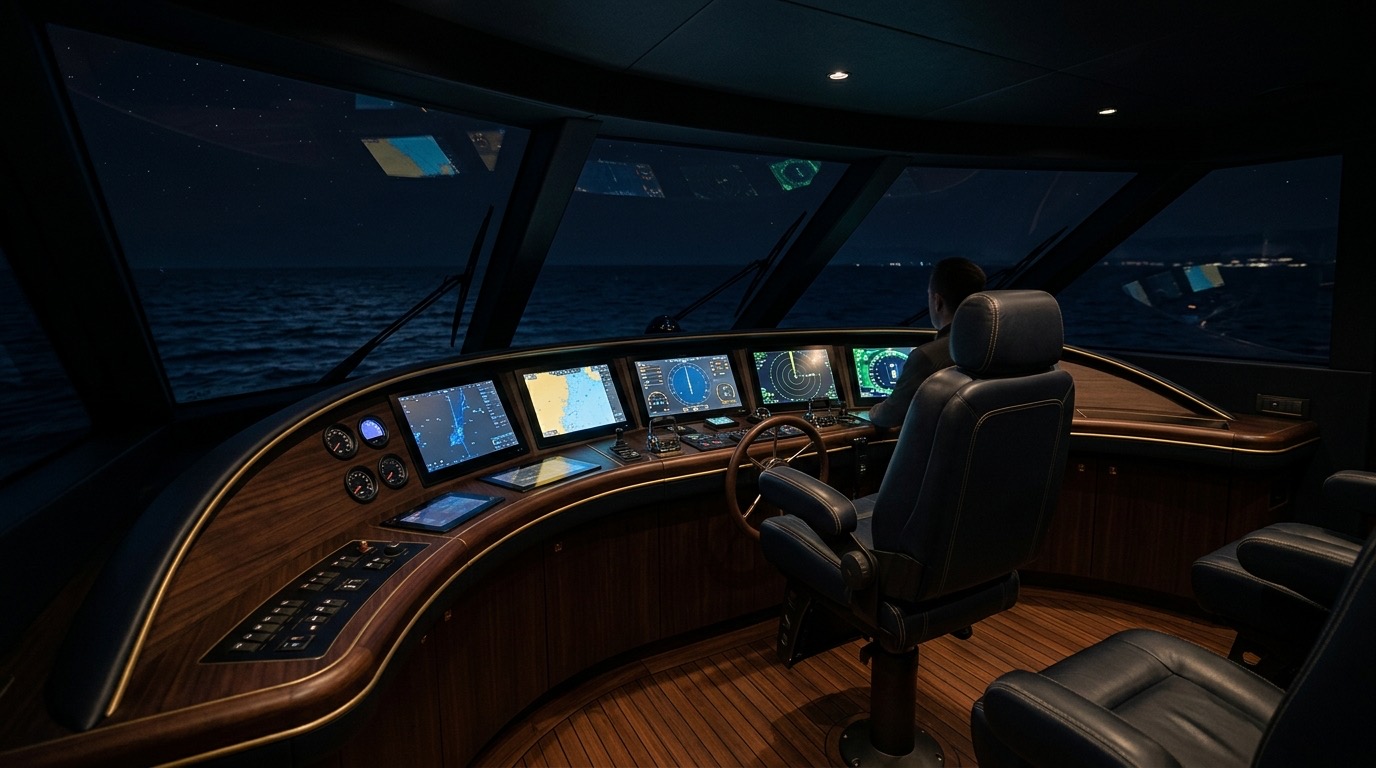
The modern superyacht is no longer a vessel with electronics aboard; it is software with a hull. On the bridge, integrated systems from Anschütz — whose SYNAPSIS platform received a fresh software release in summer 2026 — and mtu’s NautIQ Bridge fold navigation, alarm handling and vessel subsystems into a single glass cockpit. Böning touchscreen panels carry engine and alarm monitoring; Raymarine’s YachtSense brings digital switching to the vessel’s entire electrical plant. Feadship has already trialled augmented-reality situational awareness for the next generation of bridges.
Below deck, the same convergence wears silk. Integrators now deliver Crestron- and URC-anchored automation in which lighting scenes, blinds, climate, high-fidelity audio, cinema and surveillance answer to one interface — Miami’s Hemag, for one, outfitted a 135-foot Crescent as a fully URC-integrated smart yacht, every cabin and deck orchestrated from a handheld panel. The result is the experience owners actually want: the vessel anticipates, the crew disappears, nothing hums or blinks unless asked.
What “smart yacht” actually means
Strip the brochure language and five domains are converging onto a single IP backbone: the integrated bridge and navigation suite; engine, tank and alarm monitoring — the operational technology that keeps the vessel alive; audiovisual and entertainment distribution; lighting, shading and climate; and security, from CCTV to door access and tender tracking. A decade ago these were separate trades with separate cabling. Today they share switches, share uplinks and, too often, share passwords. Our survey of superyacht technology systems maps the full stack; the strategic point is that integration is no longer optional — new builds arrive converged, and refits converge whatever was left.
Done well, the effect is closer to hospitality than technology. A cabin recognises its occupant’s preferred temperature and lighting at dusk; the cinema rises out of the sundeck without a crew member appearing; the engineer watches every tank, pump and breaker from a single pane rather than a corridor of gauges. Charter guests increasingly judge a vessel by exactly this choreography, and brokers know it — which is why automation refits have moved from indulgence to valuation line in under a decade.
The quiet problem: everything became a computer
Convergence is what makes the experience seamless, and it is also what makes the vessel a target. Navigation buses that once spoke only NMEA now bridge onto Ethernet. Every automation vendor — bridge, AV, monitoring, HVAC — requests standing remote access for support, each through its own tunnel, rarely audited. Guest devices arrive by the dozen and join whatever network the deckhand last configured. On a flat network, the path from a smart cabin panel to the alarm and monitoring layer is shorter than any owner would tolerate if it were drawn on paper. A vessel that knows the owner’s location, schedule, guests and conversations is, in intelligence terms, a collection platform — the question is only who is collecting. We examine the threat picture in detail in superyacht & jet cybersecurity.
Automation centralises convenience. It centralises consequence with the same efficiency.
The security & privacy layer a smart yacht demands
The remedy is not less automation; it is architecture. First, segmentation: operational technology, crew, guests and the owner’s party each on their own enforced network, so a compromised tablet in a guest cabin can never see the monitoring bus. Second, a single broker for vendor access: every integrator’s remote tunnel replaced by one audited, time-limited gateway, switched on for a support session and off after it. Third, monitoring — not the engine-room kind, but continuous watch over the network itself, with someone accountable for noticing the anomaly at 03:00 in a foreign anchorage. Fourth, discipline at the human layer, where the crew network and IT regime matters more than any firewall: rotation is constant, devices are personal, and the ship’s Wi-Fi password has a way of outliving three captains.
None of this needs to be visible to the owner, and none of it needs an engineer berthed aboard. The architecture is designed once, during build or refit, while the integrators are still aboard and the drawings are still honest; thereafter it is operated remotely — access reviews, firmware discipline, alert triage, quarterly failover tests — with the captain receiving a one-page summary and the family office receiving the truth. The cost of that regime is a rounding error against the automation budget it protects, and several orders of magnitude below the cost of the incident it prevents.
Discretion as a design requirement
For a UHNW principal, the privacy layer is inseparable from the security one. Itineraries, guest manifests, CCTV archives and AIS behaviour all leak patterns; a properly designed vessel minimises what is recorded, encrypts what remains, and keeps the owner’s digital wake as quiet as the hull’s. This is specialist work, and it is precisely the work that should not be visible. Obsidian Helm operates it as a private office function — fully remote, worldwide, under NDA — designing the segmentation, brokering vendor access, monitoring continuously and standing behind tested failover, as part of our wider cybersecurity office for yachts, jets and estates.
The smart yacht has arrived; the era of treating its nervous system as an afterthought should now end. The owners who enjoy automation most are the ones who never have to think about what is underneath it — because someone discreet already has.
Put a quiet professional behind the glass panels
Engage a $4,999 Private Strategy Session — a confidential, remote review of your vessel’s automation, vendor access and privacy exposure, under NDA and credited in full toward membership.
Request Your InvitationFrequently asked
What is a smart yacht?
A smart yacht integrates its major systems — bridge and navigation, engine and alarm monitoring, audiovisual entertainment, lighting, climate and security — onto a unified digital backbone controlled from touch panels or handheld devices. Platforms from Anschutz, mtu, Boning, Raymarine, Crestron and URC let owners and crew orchestrate the entire vessel from a single interface.
What systems can be automated on a superyacht?
Virtually everything: navigation displays and alarm handling on the bridge, engine and tank monitoring, lighting scenes, blinds and shading, climate per cabin, cinema and multi-zone audio, CCTV and door access, even tender tracking. Modern builds arrive with these converged on one IP network, and refits increasingly bring older vessels to the same standard.
Are smart yacht automation systems a cybersecurity risk?
They can be. Convergence places guest devices, entertainment, vendor remote-access tunnels and operational systems on shared infrastructure, so one weak point can expose the rest. The accepted mitigations are strict network segmentation, a single audited gateway for vendor access, continuous monitoring and disciplined crew IT practice, ideally overseen by an independent specialist.
Who installs and manages yacht automation systems?
Installation is handled by marine integrators and shipyard electronics teams working with vendors such as Anschutz, Boning, Raymarine, Crestron and URC. Ongoing management is often neglected: each vendor supports only its own island. Owners increasingly retain an independent technology office to oversee the whole stack, vendor access and security continuously.