Motor Yacht or Sailing Yacht: Which Actually Fits How You'll Use It
Both categories can be extraordinary. Almost none of the disappointed owners we've spoken with bought the wrong boat on paper — they bought a hull that didn't match how they actually wanted to spend a week aboard.
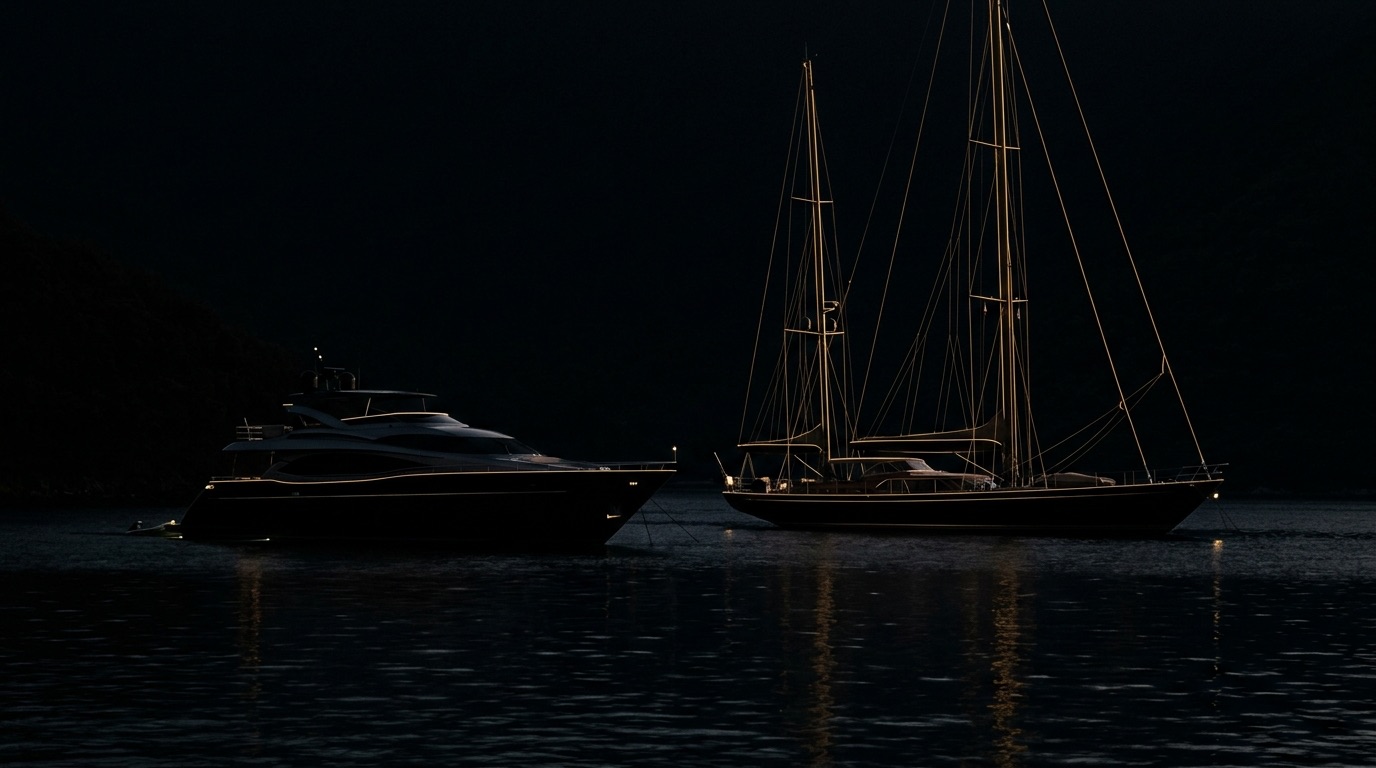
The brochures rarely say it plainly, but a motor yacht and a sailing yacht are not two versions of the same product — they are two different relationships with the sea, and the honest comparison has less to do with length or builder than with how you actually intend to use the weeks you spend aboard. Our yacht buying guide covers the purchase process end to end; this is the narrower, more consequential decision that has to happen before any of that process starts.
The running-cost divide
Fuel is where the categories diverge hardest, and the gap is larger than most first-time buyers expect. A planing motor yacht at cruise speed burns meaningfully more than a displacement sailing hull under sail, because one is fighting hydrodynamic drag at 20+ knots and the other is largely letting the wind do the work.
| Size class | Motor yacht — cruise speed (gph) | Sailing yacht — auxiliary engine, motoring (gph) |
|---|---|---|
| 60–80 ft | 60–90 gph at 20–24 knots | 4–8 gph at 7–8 knots (engine-on) |
| 90–120 ft | 120–220 gph at 18–22 knots | 8–15 gph at 8–9 knots (engine-on) |
| 130–180 ft | 250–450 gph at 16–20 knots | 15–25 gph at 9–10 knots (engine-on) |
Under actual sail in good wind, a sailing yacht's marginal fuel cost approaches zero for propulsion, though hotel loads — air conditioning, water making, galley, systems — still run off generators regardless of category. The honest comparison isn't sail versus power in isolation; it's how many hours per season you'll realistically spend under sail versus motoring to make a schedule, because most sailing yacht owners motor considerably more than they expected to when guests are aboard on fixed itineraries.
Crew size and skill requirements
The two categories draw from different crew skill pools, and this affects both cost and hiring difficulty. A motor yacht's crew is built around hospitality, engineering and maintenance of complex mechanical systems. A sailing yacht's crew needs everything a motor yacht's does, plus genuine sail-handling competence — a smaller, harder-to-source labor pool, particularly for larger rigs.
- 60–80 ft motor yacht: typically 3–5 crew (captain, engineer or mate, 1–2 stew, sometimes a chef)
- 60–80 ft sailing yacht: typically 4–6 crew — the same hospitality roles plus deckhands with sail-handling experience, and often a dedicated rigger-trained mate
- 100 ft+ motor yacht: 6–12 crew depending on tender and toy complement, stabilizer and generator redundancy, and guest capacity
- 100 ft+ sailing yacht: 8–14 crew, with rig maintenance, sail changes, and often carbon-rigging expertise adding a specialized (and higher-paid) tier absent on a comparable motor yacht
Captains with blue-water sail credentials command a premium over power-yacht captains at equivalent tonnage, and the qualified pool is smaller — a real constraint worth weighing before ordering a large sailing yacht in a competitive charter market.
Range, itinerary style and what a week actually looks like
This is the decision that should carry the most weight, and it's the one buyers most often skip. A motor yacht is built for point-to-point speed — leave the marina after breakfast, arrive at the next anchorage in time for lunch, prioritize guest comfort and stabilization over passage character. A sailing yacht is built for passage-making itself as the experience: the sound of water on the hull, sail trim as an activity rather than a means to an end, and a genuine dependency on weather windows that a motor yacht can often simply outrun.
If your real preference is arriving somewhere fast with minimal motion and maximum onboard amenity, a motor yacht delivers that reliably. If your real preference is the passage being part of the point — and you're comfortable with itineraries that bend to weather rather than a fixed schedule — a sailing yacht delivers something a motor yacht structurally cannot. Buyers who get this wrong tend to be the ones who bought a sailing yacht for the image and then charter it running the engine 80% of the time, or bought a motor yacht and quietly wished for more time on the water rather than at speed across it.
Refit and mechanical-systems complexity
Both categories carry real refit obligations, but the failure points differ. Motor yachts concentrate complexity in propulsion and hotel systems: twin or triple diesel engines, stabilizers (fin or gyro), multiple generators sized for genuinely heavy hotel loads, and hydraulic systems for tenders, passerelles and swim platforms. Sailing yachts concentrate complexity in the rig: standing and running rigging on inspection and replacement cycles, sail inventories that need periodic re-cutting or replacement, and on larger yachts, carbon spars and rod rigging that require specialized (and geographically limited) refit yards.
A useful rule of thumb: a motor yacht's major refit costs scale with engine hours and generator hours, both of which are precisely trackable. A sailing yacht's major refit costs scale partly with age-based rigging-replacement intervals regardless of how lightly the boat has been sailed, which can catch owners off guard at survey time on a yacht that otherwise looks immaculate.
Resale liquidity by category
Motor yachts are simply more liquid at resale across nearly every size class, because the buyer pool is larger and doesn't require sail-handling interest or experience to consider the boat seriously. Sailing yachts, particularly large performance or carbon-rigged builds, sell into a narrower, more specialized market — the eventual buyer is often already a sailing-yacht owner trading up, which slows the process and can pressure price on a forced or time-sensitive sale.
The boat that holds its value best is rarely the one that impresses at the dock. It's the one whose next owner is easy to find.
The connectivity and automation angle
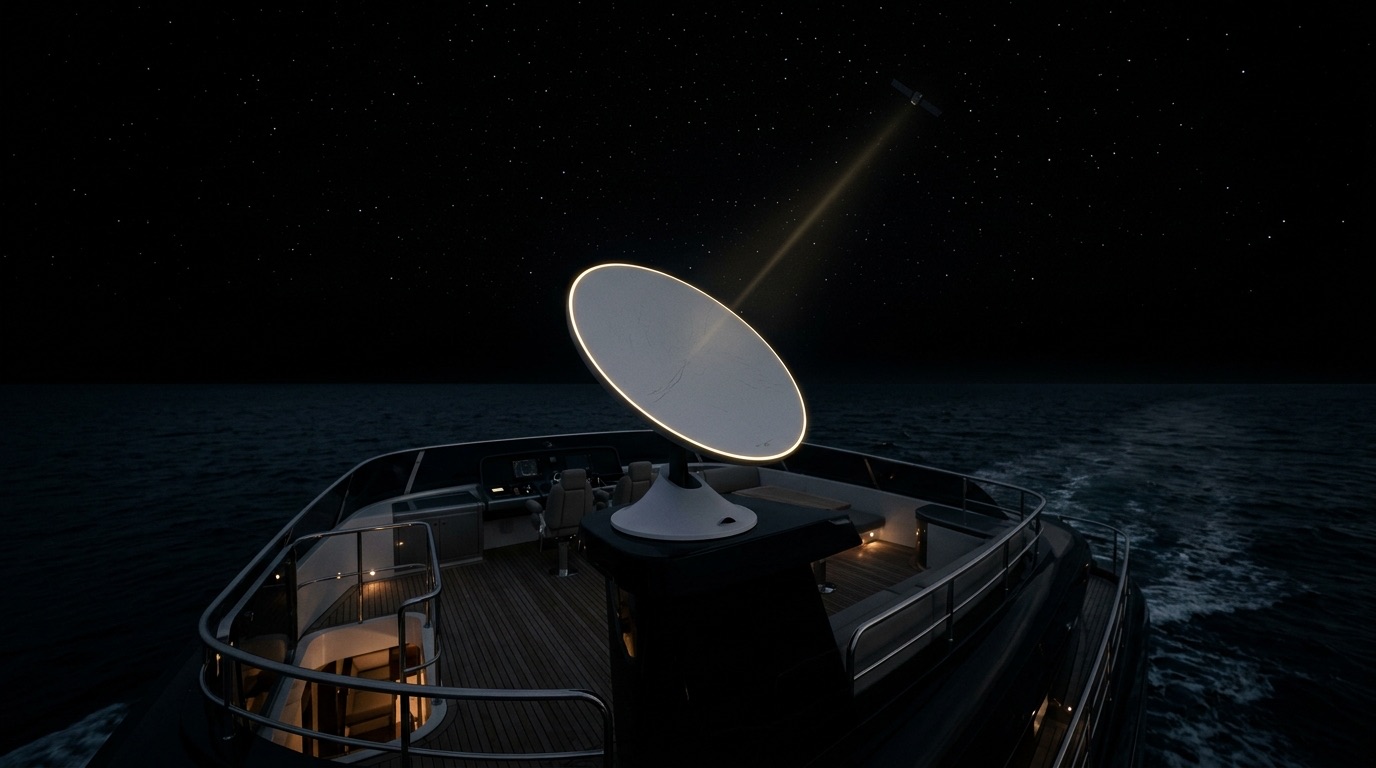
This is the part of the decision least discussed by brokers, and it matters more each year as onboard technology expectations rise. A motor yacht's genset-heavy power budget — already sized for stabilizers, air conditioning and hydraulics — makes always-on Starlink Maritime and full smart-yacht automation (lighting, climate, AV, access control, shading, all networked and monitored) close to a rounding error on total power draw. Running a second Maritime terminal for redundancy, or a battery of automation controllers and sensors throughout the vessel, rarely forces a hard tradeoff on a motor yacht sized to carry that load already.
A sailing yacht runs a tighter power and weight budget by design — every additional domed antenna, server rack, or automation panel is weight aloft or windage the naval architect had to account for, and battery capacity is sized for passage-making rather than for running hotel-grade systems continuously at anchor. This doesn't mean sailing yachts can't run excellent connectivity and automation; it means the hardware selection, mounting position, and power budgeting have to be considered from the design stage rather than added afterward, and Maritime redundancy in particular needs a deliberate power plan rather than an assumption of headroom. We cover the full systems picture, including how it differs by hull type, in superyacht technology systems.
A quick way to decide
- If guest comfort, speed to destination and hosting capacity are the priority, and running costs are secondary to your budget, a motor yacht fits how you'll actually use it.
- If the passage itself is part of what you're buying, and you're comfortable with weather-dependent scheduling and a smaller crew-hiring pool, a sailing yacht delivers an experience a motor yacht cannot replicate.
- If resale liquidity and predictable ownership costs matter more than category preference, the data favors motor yachts at nearly every size class.
- If always-on connectivity and full smart-yacht automation are non-negotiable, a motor yacht's power budget makes that straightforward; a sailing yacht can still get there, but only with deliberate early planning.
Obsidian Helm specifies the right connectivity and automation architecture for whichever hull type actually fits your use case — matched to the vessel's real power budget rather than a generic build sheet — as part of our Yacht & Jet practice, alongside the broader Concierge IT membership that covers the systems once you're aboard.
Get the Connectivity and Automation Build Specified Before You Commit
A $4,999 Private Strategy Session covers your hull type, power budget and cruising pattern, and delivers a Starlink and automation build that fits the boat you actually choose — credited toward membership.
Request Your InvitationFrequently asked
Is a motor yacht really more expensive to run than a sailing yacht?
For fuel specifically, yes, often substantially — a planing motor yacht at cruise speed burns far more than a sailing yacht under sail. But hotel loads, crew costs and refit obligations narrow the gap once you look at total annual running cost rather than fuel alone.
Do sailing yachts need a bigger crew than motor yachts?
Usually one to two more crew at a comparable size, because sail-handling roles are additive to the same hospitality and engineering positions a motor yacht requires — and qualified sail crew are a smaller, more competitive hiring pool.
Which category holds its value better at resale?
Motor yachts generally sell faster and to a wider buyer pool at most size classes. Sailing yachts, especially larger performance or carbon-rigged builds, sell into a narrower specialist market and typically take longer to move.
Can a sailing yacht run Starlink Maritime and full smart-yacht automation?
Yes, but the tighter power and weight budget means hardware selection, antenna placement and power planning need to happen at the design or refit stage, rather than being added on the assumption of spare capacity the way a genset-heavy motor yacht often has.
Are sailing yachts more mechanically complex than motor yachts?
Differently complex rather than simply more or less. Motor yachts concentrate complexity in propulsion, stabilization and hotel systems; sailing yachts concentrate it in the rig, with age-based rigging-replacement intervals that apply regardless of how lightly the boat has sailed.