
Starlink Maritime vs Roam: Which One Your Yacht Actually Needs
The names suggest a simple upgrade path. The reality is two different products, built for two different distances from shore, and picking the wrong one is an expensive way to find that out.
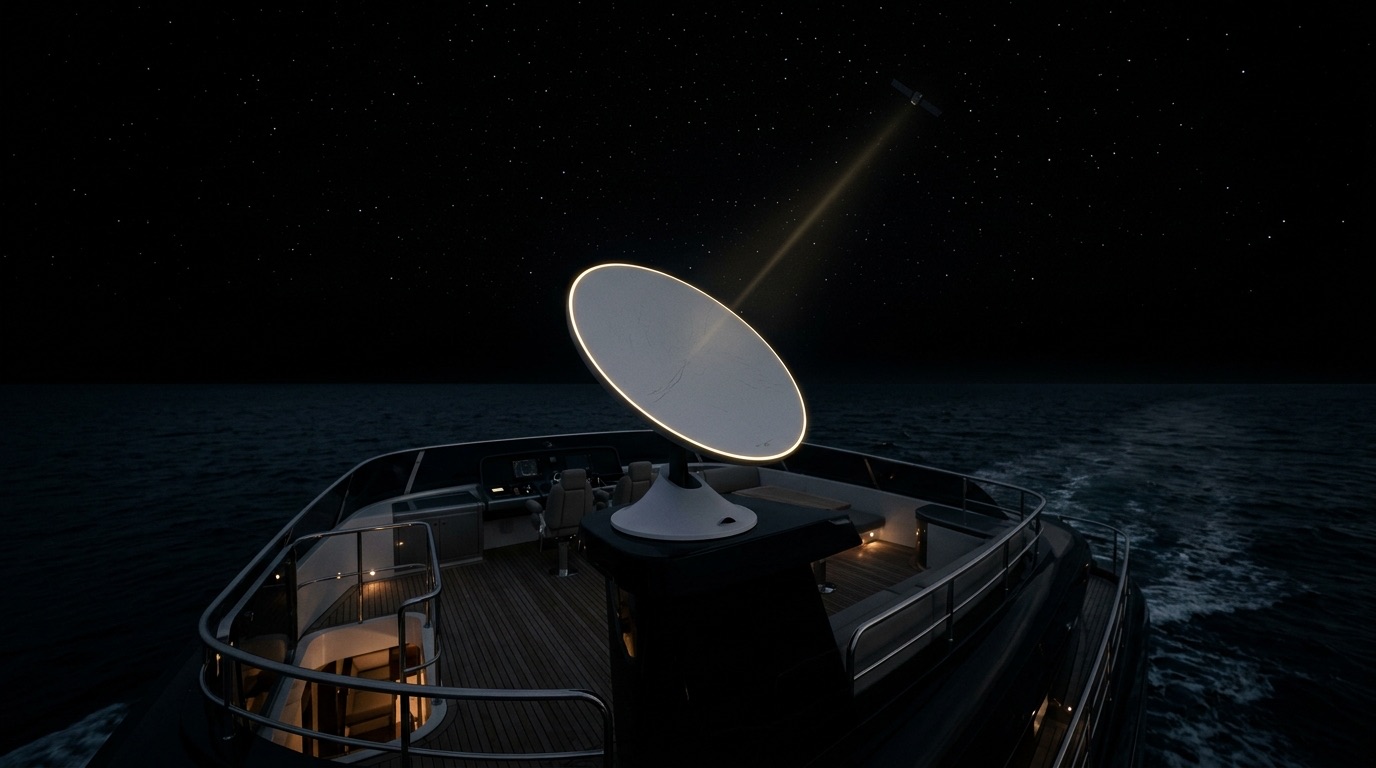
Starlink's marine terminology has genuinely confused a lot of experienced owners, and understandably so — "Roam" and "Maritime" sound like tiers of the same service rather than products engineered for different operating environments. They are not interchangeable, and the wrong choice shows up exactly when you need connectivity most: offshore, mid-passage, out of cell range.
The core difference
| Starlink Roam | Starlink Maritime | |
|---|---|---|
| Designed for | Coastal cruising, protected waters, occasional offshore hops | Blue-water passages, extended offshore operation, commercial-grade reliability |
| Hardware | Standard or High Performance flat/actuated dish, consumer-grade | Ruggedized flat high-performance dish rated for continuous marine exposure |
| Priority data | Best-effort, deprioritised versus fixed and Maritime plans in congested areas | Priority throughput, engineered for consistent offshore bandwidth |
| Coverage guarantee | Land and coastal ocean use; not warrantied for sustained open-ocean use | Global ocean coverage including open water far from shore |
| Typical monthly cost | Lower, scales with data tier | Substantially higher, reflecting priority bandwidth and coverage |
How to actually decide
- If you're coastal cruising, day-hopping, or rarely more than a few hours from a cell tower, Roam is usually sufficient and considerably cheaper — many owners run it successfully as their primary connection at anchor and underway near shore.
- If you cross oceans, run extended charters, or depend on connectivity for business, security systems or medical monitoring while genuinely offshore, Maritime is the correct product. The priority bandwidth and hardware rating exist precisely for that use case.
- If you're not sure which category you fall into, map your actual annual routing rather than your intended one — owners frequently under-estimate how much time is spent well offshore.
A quick way to sanity-check the decision
Pull up your last twelve months of actual routing — not your intended cruising, your real one — and count the nights spent more than a day's run from a coastline versus nights at anchor or in marinas within cell range. If the offshore nights are a small minority, Roam plus a sensible failover is very likely adequate. If offshore time is substantial, or if the vessel regularly hosts guests or crew who expect uninterrupted connectivity regardless of position, Maritime's premium buys a materially different, more consistent experience precisely when it matters most — mid-passage, with no cell tower in range as a fallback.
What owners actually get wrong
The most common mistake is provisioning Roam because the sales conversation focused on price, then discovering mid-Atlantic that throughput degrades sharply in busier satellite cells because Roam traffic is deprioritised behind Maritime and fixed subscriptions. The second most common mistake is the opposite — paying for Maritime on a boat that never leaves coastal cruising grounds, when Roam plus a cellular failover would have covered the same use case for a fraction of the cost. Getting this right requires an honest routing conversation before the hardware is ordered, not after.
The dish is never the hard part. Matching the plan to how the boat is actually used, is.
Hardware and plan selection is only the first decision. Mounting location, RF interference from other onboard electronics, failover design if the primary link drops, and integration with the vessel's broader network and security systems all matter as much as which Starlink tier you buy — we cover mounting specifically in Starlink dish marine mounting, and the full cost picture, including the plans consumer articles rarely detail accurately, in what yacht satellite internet actually costs.
Charter yachts face a different calculation entirely
A vessel in charter operates under a different set of expectations than a privately used yacht. Guests paying for a week aboard expect connectivity that simply works, without caveats about congestion or coastal-only coverage — and a slow or dropped connection during a charter week is a service failure guests will remember and mention. For any yacht in the charter market, Maritime's priority bandwidth is difficult to justify skipping, since the cost differential is small relative to charter revenue and the reputational cost of visibly poor connectivity is not.
There is also a business-use dimension increasingly common among charter guests: video calls, market access, and remote work conducted from the aft deck are now a normal expectation on higher-end charters, not an exception. This pushes further toward Maritime, and toward the properly distributed onboard network covered separately in our yacht WiFi guide — since even excellent incoming bandwidth is wasted if it doesn't reach the cabin a guest is working from.
Owner-only vessels have more room to optimise for cost
Without charter guests to satisfy, an owner can make a more purely economic decision — running Roam for genuinely coastal use, or a Roam-plus-Mini redundancy pairing, and accepting occasional congestion as a reasonable tradeoff for lower ongoing cost. The right answer genuinely differs by vessel and use case, which is why this decision deserves an actual routing conversation rather than a default to whichever product a broker mentioned first.
Obsidian Helm designs and provisions connectivity for the full range of vessels — from coastal motor yachts to blue-water passage-makers — specifying the right combination of Starlink tier, redundancy and onboard network architecture as part of our Yacht & Jet practice, so the decision is made once, correctly.
Have the Right System Specified Before You Buy Anything
A $4,999 Private Strategy Session covers your vessel, routing and use case, and delivers a connectivity plan that won't need redoing offshore — credited toward membership.
Request Your InvitationFrequently asked
Can I use Starlink Roam offshore instead of Maritime?
You can technically connect, but Roam traffic is deprioritised behind Maritime and fixed subscriptions, so throughput can degrade significantly in busier satellite cells, and the service isn't warrantied for sustained open-ocean use the way Maritime is.
Is Starlink Maritime worth the extra cost for a coastal cruiser?
For most coastal cruising within cell-tower range, no — Roam plus a cellular failover typically covers the same use case at a fraction of the cost. Maritime's premium is justified by genuine blue-water, extended-offshore operation.
Does Starlink Maritime require different hardware than Roam?
Yes — Maritime uses a ruggedized high-performance dish rated for continuous marine exposure, distinct from the standard or high-performance consumer hardware typically paired with Roam.
Can I switch between Roam and Maritime plans on the same hardware?
Plan eligibility depends on the specific hardware generation and its service-type registration; not every dish can freely switch between tiers, so it's worth confirming compatibility before assuming you can upgrade the plan alone.
What happens to my connection in a Starlink dead zone at sea?
Coverage gaps can occur in some remote ocean regions and are affected by satellite cell congestion; a properly designed system includes a cellular or secondary satellite failover so the vessel isn't left without connectivity in a gap.