No two yacht hubs are served the same way. One airport handles unlimited traffic minutes from the berth, another has a runway so short it turns away most of the world's jet fleet. Here is which airport actually serves each marina, how the FBOs and customs really work, and how long the transfer genuinely takes.
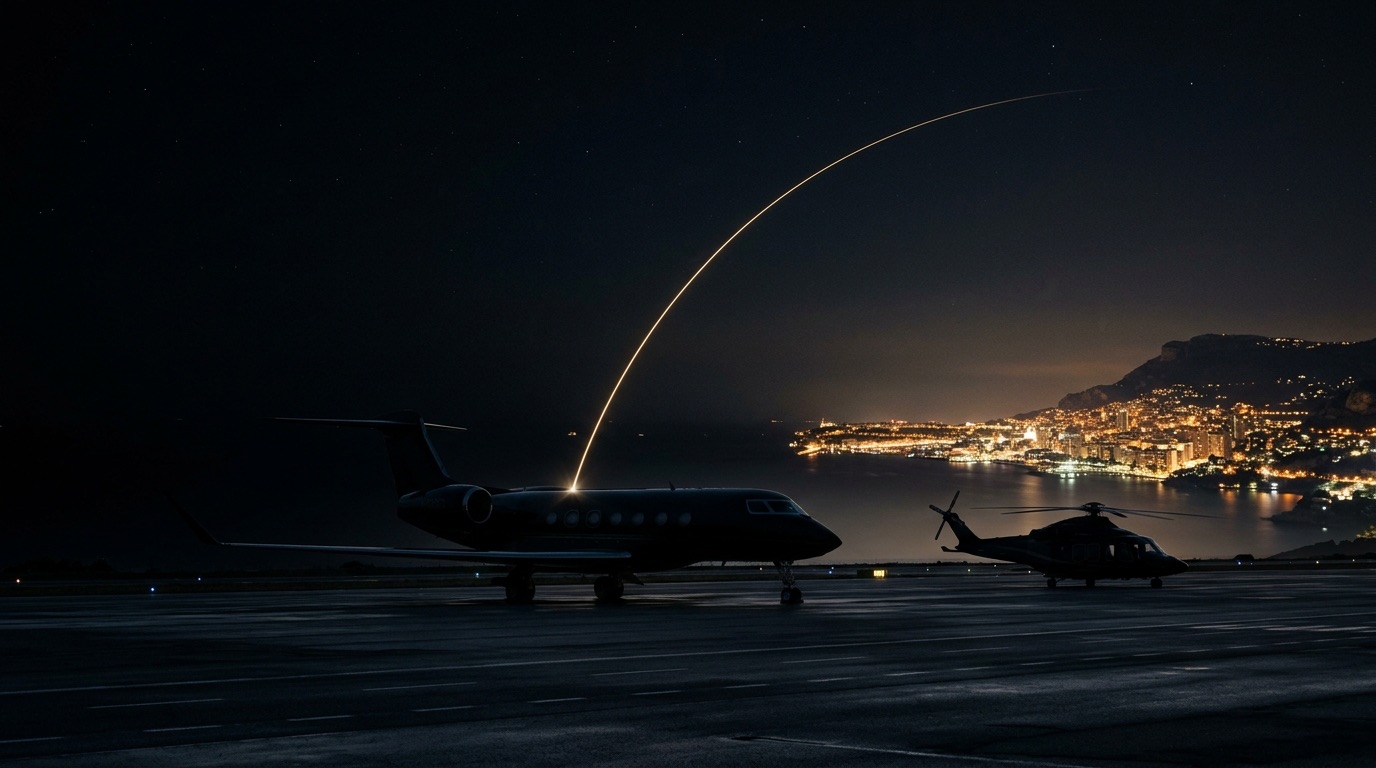
Every principal who runs a jet-and-yacht itinerary eventually learns the same lesson: the airport nearest the marina on a map is not always the airport that actually works. Some yacht hubs sit next to a full-size international airport with no restrictions at all. Others are served by a regional field with a genuine runway limit, a seasonal slot squeeze, or a second airport an hour away by helicopter that ends up being the faster real-world route.
This briefing walks through six of the world's defining yacht marinas — Monaco, Fort Lauderdale and Palm Beach, Palma de Mallorca, Porto Cervo, St Barts and the Antibes/Cannes coast — and covers, for each, which airport actually serves it, what the FBO and customs experience looks like, how long the transfer genuinely takes, and the quirks that catch owners and captains off guard.
Monaco has no airport of its own capable of handling fixed-wing traffic — the principality's own heliport takes helicopters only. Every jet arrival for Monaco lands at Nice Côte d'Azur (NCE), about 20 minutes down the coast, which puts the actual transfer decision entirely on how you cover that last stretch.
Most owners take the helicopter shuttle from NCE's dedicated heliport straight to Monaco's Fontvieille heliport, a flight of roughly seven minutes that lands you a short walk from Port Hercule. The road alternative, along the Basse Corniche, normally runs 45-60 minutes but stretches well past 90 during the Monaco Grand Prix and the Monaco Yacht Show in late September, when the coast road effectively seizes up. NCE's general aviation terminal is handled by established FBOs including Signature Flight Support and ExecuJet, with immigration and customs handled airside for non-Schengen arrivals — smooth for intra-EU flights, noticeably slower for anything arriving from outside Schengen.
Fort Lauderdale's marinas — Bahia Mar, Pier Sixty-Six, Lauderdale Marina — sit closest to Fort Lauderdale Executive Airport (FXE), a general-aviation field a 15-20 minute drive from the docks with none of the commercial congestion of the nearby international airport. FBOs here, notably Banyan Air Service and Signature, are built around exactly this traffic and are used to coordinating directly with yacht captains and provisioning schedules.
Palm Beach is a different equation. Palm Beach International (PBI) is the default for larger cabin jets, while Palm Beach County Park Airport in Lantana (LNA) is the quieter, closer-in option some operators prefer for its shorter taxi and lower fees. Both clear US Customs and Border Protection for international arrivals, provided the crew files eAPIS in advance — skip that step and expect the aircraft held on arrival regardless of how empty the ramp looks.
Palma de Mallorca Airport (PMI) is a full international hub with a proper dedicated general-aviation terminal, so unlike some of the smaller Mediterranean fields, capacity and aircraft size are simply not a constraint here. The drive from PMI to the marina cluster — STP Shipyard, Marina Port de Mallorca, Club de Mar, IGY Marina — runs a reliable 15-20 minutes, one of the shortest and most predictable transfers of any major yacht hub.
Customs is standard Schengen procedure for flights arriving from within the EU, but non-EU arrivals — increasingly common during the June-September charter season — go through a fuller immigration and customs process, and Palma's ramp gets genuinely busy in peak summer, so early slot confirmation with the handling FBO matters more here than the flight itself.
Olbia Costa Smeralda Airport (OLB) is the airport that actually serves Porto Cervo and the wider Costa Smeralda, a 20-25 minute drive from the marina. There is no runway or aircraft-size restriction at OLB itself — it takes anything from light jets to large-cabin aircraft — but the field is genuinely undersized for the volume it sees in July and August, when Sardinia's peak season pushes ramp space, FBO handling capacity and parking slots to their limit.
Porto Cervo's own marina berths are limited relative to demand, so a meaningful share of larger yachts anchor off the Costa Smeralda and tender guests ashore rather than berthing directly — worth factoring into the transfer plan alongside the flight itself. Aircraft and ground handling should be booked well ahead of the peak weeks; last-minute slot requests into OLB in August are a genuine risk, not a formality.
St Barts' Gustaf III Airport (SBH) is the airport every private aviation guide to the Caribbean eventually has to caveat. The runway measures roughly 650 meters, the approach clears a hill before dropping steeply to the threshold, and pilots need a specific type of certification just to fly the approach at all. The practical result: SBH takes light turboprops and a small handful of short-field-rated light jets, and nothing close to a large-cabin or long-range aircraft.
Most owners flying anything larger route into Princess Juliana International Airport (SXM) on neighboring St Maarten instead, then complete the trip to Gustavia harbor by helicopter — about ten minutes — or by private ferry across the channel. SXM has no aircraft-size limit and its own full customs and immigration facility, which for many operators makes it the actual gateway airport for a St Barts yacht trip even though the marina is on a different island entirely.
Antibes and Cannes share Nice Côte d'Azur (NCE) with Monaco, but the transfer arithmetic changes once you're past the airport gates. Antibes' Port Vauban — the largest marina in the Mediterranean and long the default winter berth for the region's biggest yachts — is a 20-25 minute drive from NCE. Cannes, home to the Vieux Port and Port Pierre Canto, typically runs 25-35 minutes, longer again during the Cannes Film Festival in May and the Cannes Yachting Festival in September, when the coast road between the two events is at its most congested.
Because it is the same airport infrastructure as the Monaco route, the FBO and customs picture is identical — same handlers, same Schengen/non-Schengen distinction, same seasonal congestion around the Riviera's headline events. The only real variable is which marina you're actually headed to and what the coast road looks like that week.
| Marina hub | Nearest airport | Transfer time | Aircraft size limit |
|---|---|---|---|
| Monaco | Nice Côte d'Azur (NCE) | ~20 min heli / 45-60 min road | None at NCE; Monaco heliport is helicopters only |
| Fort Lauderdale | Fort Lauderdale Executive (FXE) | 15-20 min road | None — handles up to large-cabin jets |
| Palm Beach | Palm Beach Intl (PBI) / Lantana (LNA) | 15-25 min road | None |
| Palma de Mallorca | Palma de Mallorca Airport (PMI) | 15-20 min road | None — full international hub |
| Porto Cervo | Olbia Costa Smeralda (OLB) | 20-25 min road | None, but slots constrained in Jul-Aug |
| St Barts | Gustaf III (SBH) or Princess Juliana, St Maarten (SXM) | SBH: 10 min to Gustavia · SXM: ~10 min heli + boat | SBH: light turboprops/light jets only · SXM: none |
| Antibes / Cannes | Nice Côte d'Azur (NCE) | 20-25 min (Antibes) / 25-35 min (Cannes) | None at NCE |
The single biggest variable in how fast an owner or crew clears an airport near a yacht marina isn't the airport itself — it's whether the paperwork was filed ahead of time. FBO handling agents need crew and passenger manifests, passport details and, on many routes, a General Declaration submitted 24-48 hours before landing so customs and immigration can pre-clear the arrival rather than working it cold on the ramp. Skip that step and even a routine EU or intra-Caribbean leg can sit waiting for an hour.
The distinction that trips people up most is Schengen versus non-Schengen, and separately EU versus non-EU. A flight from London to Nice or Palma clears fast under Schengen rules; a flight arriving from the US, the Gulf or offshore into any of these same airports goes through a fuller process, and that process takes measurably longer at a small regional field with one or two customs officers on duty than at a major international hub. The same logic applies at FXE and PBI, where eAPIS filing is mandatory for any international arrival into US airspace, and at SXM, where French- and Dutch-side procedures differ depending on the FBO used.
From FBO booking to marina berth to onboard connectivity, the Marketplace connects vetted operators who already work these exact routes — no cold-calling handlers on the day of departure.
Browse the MarketplaceIndependent guidance. Where we introduce partner operators or FBOs, an arrangement may exist — it never changes your service or our advice.
A jet or a yacht that lands with a dated onboard network or unmanaged crew devices is carrying risk across every border on the itinerary. Obsidian Helm is the private technology and cybersecurity office that gets aircraft and vessel systems into travel-ready condition — documented, current and discreet, under NDA.
Yacht, Jet & EstateThere is no jet-capable airport in Monaco itself. Every fixed-wing arrival lands at Nice Côte d'Azur (NCE), roughly 20 minutes by helicopter transfer to the Monaco heliport or 45-60 minutes by road along the Basse Corniche, longer during the Grand Prix or Monaco Yacht Show when coastal traffic backs up badly.
No. Gustaf III Airport's runway is only about 650 meters with a steep, curved approach over a hill, so it is limited to light turboprops and a handful of short-field-certified light jets flown by specially rated pilots. Most owners fly larger aircraft into Princess Juliana International (SXM) on St Maarten and transfer to St Barts by helicopter or private ferry.
Olbia Costa Smeralda (OLB) is the only realistic option, about 20-25 minutes by road from Porto Cervo. It has no size restriction, but slots and FBO parking get tight in the July-August peak, so aircraft need to be booked and permitted well in advance.
Crew lists, passports and often General Declaration paperwork have to be filed with the FBO handling agent before landing so customs and immigration can clear the aircraft on arrival rather than holding it. Non-Schengen or non-EU arrivals into Mediterranean airports, and international arrivals into the US, take noticeably longer than intra-EU or domestic legs, so this should be confirmed with the handler 24-48 hours ahead, not on the day.