
Private Jet IT & Cybersecurity for Monaco
Monte Carlo, Fontvieille, La Rousse and Larvotto hold an estimated 8,900 UHNW residents and 12 billionaires within roughly two square kilometres — the highest concentration of UHNW density on earth. Monaco itself has no airport; principals arrive via Nice Côte d'Azur (NCE) and complete the final leg by Monacair helicopter, a journey of roughly seven minutes that carries its own, often overlooked, security profile.
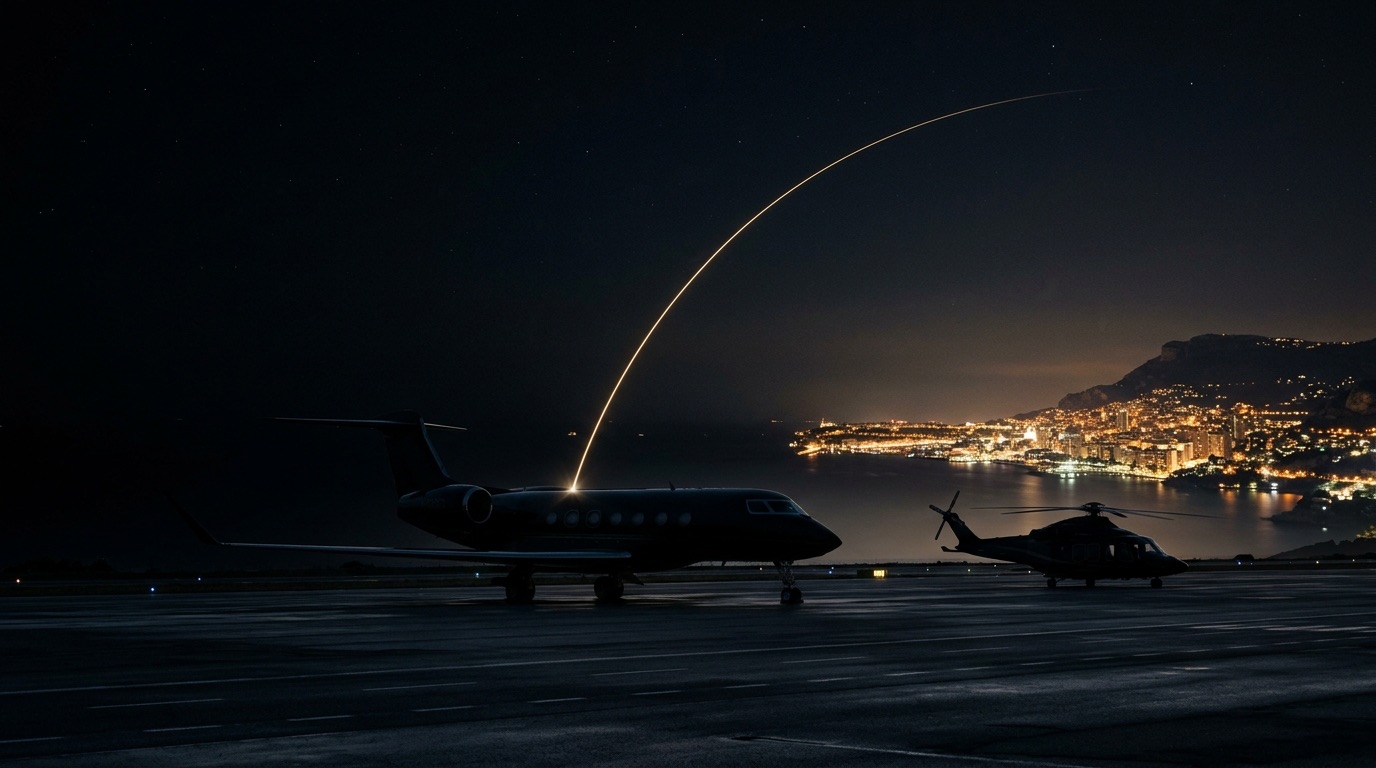
Monaco packs an estimated 8,900 ultra-high-net-worth residents and 12 billionaires into roughly two square kilometres, the highest density of private wealth anywhere on earth. Monte Carlo, Fontvieille, La Rousse and Larvotto form a principality small enough to cross on foot in under an hour, yet it moves a volume of private aviation traffic disproportionate to any city many times its size — almost none of which touches Monaco's own soil, because Monaco has no airport.
Every principal flying into Monaco arrives first at Nice Côte d'Azur Airport (NCE), roughly 20 kilometres up the coast, and completes the journey by Monacair helicopter — a flight of approximately seven minutes that lands at Monaco's own heliport in Fontvieille. This two-leg structure is worth stating plainly rather than treating as a gap: it is a genuinely distinctive feature of Monaco travel, and it creates a security profile unlike any single-airport city on this list. There are, in effect, two separate transitions to secure — the fixed-wing arrival at NCE, and the helicopter transfer — each with its own connectivity, tracking and handling exposure.
Where the actual exposure sits
The fixed-wing leg into NCE carries the same cabin-network weaknesses common to most large-cabin aircraft: satellite connectivity installed once at delivery or refit, rarely revisited, with principal, family, guest and crew devices commonly sharing a single flat network behind consumer-grade routing hardware. NCE itself is one of Europe's busier business aviation airports, particularly during the Monaco Grand Prix and Yacht Show weeks, which means both ADS-B visibility and FBO-level congestion peak at exactly the moments Monaco's population is most concentrated and most newsworthy.
- Segmented cabin networking — isolated VLANs for principal, family, guest and crew traffic on the fixed-wing aircraft, replacing whatever stock router the connectivity installer left behind.
- ADS-B and flight-plan exposure audit covering both legs — a technical review of what the fixed-wing tail and, separately, the Monacair helicopter movement broadcast publicly, since tracking either leg alone gives an incomplete picture of the actual exposure.
- Executive device hardening — travel-mode configuration for phones, laptops and tablets, calibrated for a transfer sequence with more handling touchpoints than a single-airport arrival.
- Named incident response team — a defined SLA reachable across both the NCE arrival and the Fontvieille heliport transfer, not a generic support ticket that only covers one leg.
Typical cost ranges
The ranges below reflect what is typical for large-cabin aircraft transiting NCE with a Monacair connection, presented as industry-representative figures rather than fixed quotes:
| Service | Typical annual range (US$) | Notes |
|---|---|---|
| Satellite connectivity (Ka-band, high-allowance plan) | 55,000 – 210,000 | Aircraft flying frequent transatlantic legs into NCE trend to the top end |
| Cabin network segmentation & firewall rebuild | 24,000 – 55,000 | Higher where legacy connectivity hardware requires full replacement |
| Two-leg ADS-B / flight-plan exposure audit | 9,500 – 21,000 | Covers both the NCE fixed-wing arrival and the Monacair helicopter transfer |
| Executive device & travel-mode program | 15,000 – 34,000 | Covers principal, family and senior staff devices across both transfer legs |
| 24/7 incident response retainer | 21,000 – 60,000 | Response SLA typically 10–20 minutes, extended to cover the Fontvieille heliport window |
Monaco's UHNW population overlaps almost completely with Mediterranean yacht ownership, and the two-leg jet arrival typically feeds directly into a vessel berthed in Port Hercule or nearby — making the aircraft, helicopter and yacht a single practical system rather than three separate assets. Our yacht, jet and estate technology & security page covers how we design that system as one engagement.
The helicopter transfer window
The seven-minute Monacair leg is short, but it is not a security afterthought. Helicopter movements between NCE and Fontvieille are visible on public tracking services just as fixed-wing flights are, and the transfer point itself — where a principal moves from one aircraft to another, often with a change of ground crew and handling staff — is a natural pinch point for both physical security and device handling. Principals and staff sometimes assume the short duration of the transfer makes it low-risk; in practice it is the moment identity, luggage and device custody change hands most frequently in the entire journey.
Grand Prix week and the Monaco Yacht Show compress this further: NCE's business aviation ramp reaches its highest movement volume of the year exactly when Monaco's resident and visiting UHNW population is at its most concentrated and most publicly documented by media covering the events. Flight departments serving Monaco-based principals should treat these weeks as elevated-risk windows requiring tighter verification on both legs, not routine operations at higher volume.
One system, not three vendors
Our private jet hub covers aviation cost and charter structures for the Mediterranean in depth, while yacht, jet and estate technology & security sets out how we design the aircraft, helicopter transfer, any vessel, and the residence together under one incident response team. The personal cybersecurity discipline underlying every engagement is described on our cybersecurity page. For Monaco's uniquely two-leg journey, that integrated approach is not optional — a plan that only covers the fixed-wing arrival leaves the transfer itself unaddressed.
A confidential assessment before your next departure
Obsidian Helm advises a limited number of Monaco principals and family offices on aircraft, helicopter transfer, vessel, estate and personal cybersecurity, entirely under NDA. Engagements begin with a $4,999 Private Strategy Session.
Request Your InvitationFrequently asked
Why doesn't Monaco have its own airport?
Monaco's roughly two square kilometres of territory has no room for a fixed-wing runway. Principals fly into Nice Côte d'Azur (NCE), roughly 20 kilometres up the coast, then complete the journey by Monacair helicopter, a transfer of approximately seven minutes to Monaco's heliport in Fontvieille.
Does the two-leg journey mean two separate security assessments?
It means one assessment covering two legs, not two disconnected efforts. We review the fixed-wing tail's cabin network and ADS-B exposure at NCE, then extend the same review and incident response coverage through the Monacair transfer to Fontvieille, since tracking either leg alone gives an incomplete picture.
What does a full assessment cost for a Monaco-bound aircraft?
A full assessment covering cabin network segmentation, two-leg ADS-B exposure review and executive device hardening typically runs $9,500 to $55,000 depending on aircraft size and existing hardware. Ongoing connectivity management and incident response retainers are priced separately, usually $21,000 to $60,000 a year. Exact scope is set during the initial Private Strategy Session.
Is Grand Prix week a higher-risk period?
Yes. NCE's business aviation ramp reaches its highest annual volume during Grand Prix week and the Monaco Yacht Show, exactly when Monaco's population is most concentrated and most publicly documented by media. We treat these as elevated-risk windows requiring tighter verification on both the fixed-wing and helicopter legs.
Should the jet, helicopter transfer and any yacht be secured together?
Yes. Monaco's UHNW population overlaps almost completely with Mediterranean yacht ownership, and the aircraft-to-helicopter-to-vessel sequence functions as one practical system. We design cabin, transfer and vessel network policy as a single engagement under one incident response retainer.