What "fully crewed" actually buys you, what a week really costs by yacht size, and the two line items — APA and gratuity — that first-time charterers underestimate every season.
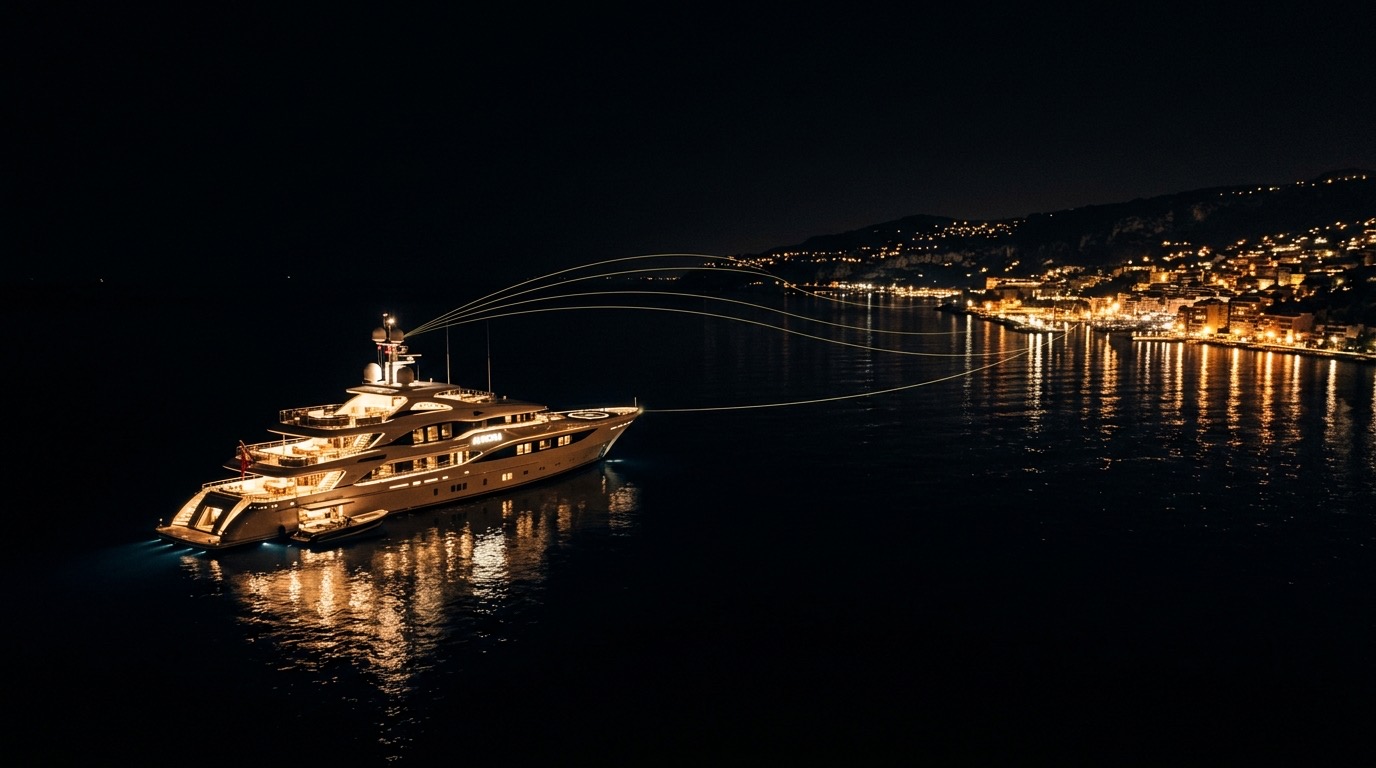
"Crewed yacht charter" is a specific product, not a vague upgrade on a bareboat rental. You are chartering a vessel that arrives with its own professional crew, provisioned and run for you for the week — the yacht equivalent of a private villa with full staff, rather than a self-catering apartment. That distinction is the entire reason the Mediterranean charter market exists, and it is also where most of the confusion for first-time charterers starts: what exactly is included in the crew, what the charter fee does and does not cover, and how the true weekly cost compares once the extras are added.
Most charter marketing stops at the glossy brochure — sundeck renders, a vague price range, the same stock phrases repeated across a hundred listings. The operating detail that actually decides a good charter from a disappointing one lives one level down: the guest-to-crew ratio on the specific hull, how the provisioning fund is drawn against day to day, and which weeks on the calendar are genuinely worth paying peak rates for versus which shoulder weeks deliver the same water for meaningfully less.
This guide sets out the real numbers — crew sizes by yacht length, weekly rate bands specific to the Mediterranean high season, and the two costs almost every first-timer underbudgets: the Advance Provisioning Allowance and crew gratuity. None of it is generic "luxury yacht charter" marketing; it is the operating detail that decides whether a quote you receive is complete or missing a third of the real cost.
A fully crewed charter yacht carries a professional team whose sole job for the week is the vessel and its guests. On a private yacht the same crew work year-round for one owner; on a charter yacht they work for a new set of guests every week or two through the season, which is why experienced charter crews tend to be sharper on service than owner-only crews — hospitality is their day-to-day discipline, not a side function of running the boat.
Crew size scales directly with yacht length, not guest count — a larger hull simply needs more hands to run its systems, tenders and service standard. As a rough guide: a 30m yacht typically carries around 4 crew, a 55m yacht around 14, and a 94m-plus yacht can carry 30 or more, including dedicated engineering, deck and interior departments running in parallel.
What that means in practice is the guest-to-crew ratio, which is the more useful number when comparing two yachts of similar length. A 30m carrying 8-10 guests with a crew of 4 runs a leaner ratio than a 40m carrying the same number of guests with a crew of 7 — the second yacht simply has more hands available for water sports, split meal sittings and turning the boat around between excursions without guests noticing the effort behind it. Brokers and marketplace listings state crew count precisely for this reason; it is one of the more reliable proxies for service level before you have stepped aboard.
The Mediterranean is not one season — it is five overlapping ones, each tied to a base with its own weather window, event calendar and pricing curve. Booking against the wrong window is the single most common way charterers overpay or end up fighting crowded anchorages.
A charter booked in late May or early October in Greece can run meaningfully cheaper than the same itinerary in August — with warmer water than most guests expect and a fraction of the anchorage traffic. The French Riviera and Sardinia compress their premium into a narrower window than the Greek Islands do, which is why a Cannes or Porto Cervo charter booked even two weeks either side of peak August can look like a different market entirely on price, while a Mykonos charter shoulder-seasons more gracefully because its season already spans a longer May-to-October arc.
The other variable worth planning around is the event calendar layered on top of the weather window. Cannes fills around the Film Festival in May, Monaco around its Grand Prix, Porto Cervo around its regatta weeks in late August, and St Barts and St Tropez each carry their own peak social weeks. Chartering a base during its marquee event delivers a livelier atmosphere and denser superyacht traffic to look at from the deck — at a price premium and with marinas booked out well in advance. Chartering the same base a fortnight later delivers a quieter, cheaper week with essentially the same weather.
| Yacht length | Typical weekly rate | Approx. crew |
|---|---|---|
| 30m | €78,000 | ~4 |
| 40m | €175,000 | ~7 |
| 55m | €345,000 | ~14 |
| 72m | €690,000 | ~22 |
| 94m+ | €1,250,000 | 30+ |
These bands reflect peak Mediterranean pricing — broadly July and August across the Riviera, Amalfi Coast, Ibiza and especially Sardinia. Shoulder-season weeks in May or October, particularly in the Greek Islands, commonly run 20-30% below the peak-August figure for the same yacht. Rates also vary by builder, age, refit condition and the specific week's demand, so treat these as planning bands rather than fixed quotes — every yacht listed on the Obsidian Helm Marketplace carries its own current weekly rate rather than a generic range.
Charter quotes are conventionally advertised as the base weekly rate alone, which is exactly why so many first-time charterers are surprised at settlement. Taking the illustrative 40m band above as a worked example, and applying the typical ranges described below, a single week looks like this once every line item is included:
| Line item | Basis | Illustrative amount |
|---|---|---|
| Base charter fee | Weekly rate, 40m yacht | €175,000 |
| APA | 27% of charter fee | €47,250 |
| Crew gratuity | 15% of charter fee | €26,250 |
| Illustrative total | — | €248,500 |
That is roughly 42% above the headline figure — a gap most charterers only discover when they receive a quote broken down in full, or worse, when the settlement invoice arrives at the end of the week. Any quote that quietly omits APA and gratuity from the initial conversation is not a cheaper yacht; it is an incomplete number.
"Yacht charter" covers three genuinely different arrangements, and confusing them is the fastest way to book the wrong one. A bareboat charter hands over a sailing yacht with no crew at all — the charterer must hold the relevant sailing qualifications and runs the boat themselves, which suits experienced sailors on a modest budget far more than it suits a first Mediterranean trip. A skippered charter adds a single professional skipper to navigate and handle the vessel, with guests still largely self-catering and managing their own itinerary day to day.
A fully crewed charter is the category this guide covers: a complete professional team — captain, deck, interior and often a dedicated chef — running the yacht as a serviced experience from boarding to disembarkation. It is the only one of the three built around hospitality rather than seamanship alone, and it is the standard model for the motor superyachts most commonly associated with the Mediterranean's headline charter bases.
The Advance Provisioning Allowance, universally shortened to APA, is a separate fund — typically 25-30% of the base charter fee — paid in advance and held by the captain to cover the running costs of the week: fuel, food and beverages, dockage and marina fees, and other consumables. It is not a fee to the yacht owner or the broker; it is a working float that the captain spends against and accounts for.
At the end of the charter, the captain provides an itemized reconciliation of what was actually spent, and any unused balance is refunded. If fuel-heavy days or a particularly ambitious wine list push spending past the APA, the difference is billed; if the week runs efficiently, money comes back. Either way, a charter quote that only shows the base weekly rate is showing roughly 70-75% of the real cost of the week — the APA is not optional and should be budgeted from day one, not treated as a surprise add-on at settlement.
Crew gratuity in the crewed charter market typically runs 10-20% of the base charter fee, distributed among the crew at the captain's discretion, usually weighted toward service quality and effort across the week. It is not written into most charter contracts as a mandatory charge, but it is such an established norm across the Mediterranean charter fleet that crews plan around receiving it, and it is one of the few remaining variables a charterer controls directly based on how the week actually went.
Between the charter fee, APA and gratuity, a realistic all-in budget for a Mediterranean week runs roughly 35-50% above the headline weekly rate quoted for the yacht. Building that into the planning conversation early avoids the least pleasant part of any charter: a settlement invoice that comes as a surprise.
No "price on application," no vague estimate ranges — the marketplace lists live weekly rates by yacht, so you can compare charter bases, sizes and seasons against actual figures before you ever request a quote.
Browse Live Charter ListingsIndependent guidance. Where we introduce partner operators or brokers, an arrangement may exist — it never changes your price or our advice.
A chartered superyacht runs Starlink or Ka-band connectivity, crew devices, guest wifi and payment systems for a rotating set of guests every week — a genuine cybersecurity surface most charterers never think about until it fails at the worst moment. Obsidian Helm is the private technology & cybersecurity office that secures the vessel, the owner's other assets and the ventures behind them. Remote, discreet, under NDA.
Yacht, Jet & EstateA crewed charter includes the yacht and its full working crew — captain, deckhands, engineer where applicable, chef and stewardess/steward — who run the vessel, prepare meals and service the cabins for the length of the charter. The weekly charter fee covers the yacht and crew wages; fuel, food, dockage and drinks are billed separately through the APA.
Plan for roughly 25-30% of the base charter fee as an Advance Provisioning Allowance. It is paid upfront to the captain, who draws from it for fuel, food, dockage, drinks and incidentals, then reconciles receipts and refunds any unspent balance at the end of the charter.
June and September offer the best balance of warm weather, calmer marinas and lower rates than peak August. July and August command the highest prices and busiest anchorages, especially in the French Riviera, Sardinia and the Amalfi Coast. Shoulder months of May and October can run 20-30% below peak-August pricing in the Greek Islands.
The customary range is 10-20% of the charter fee, split among the crew by the captain, usually based on service quality over the week. It is not contractually mandatory but is a well-established norm in the crewed charter market and is expected by most crews.