Trawler Yacht Buying Guide: What Long-Range Cruising Actually Requires
A trawler yacht isn't a compromise version of a motor yacht — it's a different answer to a different question: how far can this boat go without stopping, and can it keep going when the weather turns.
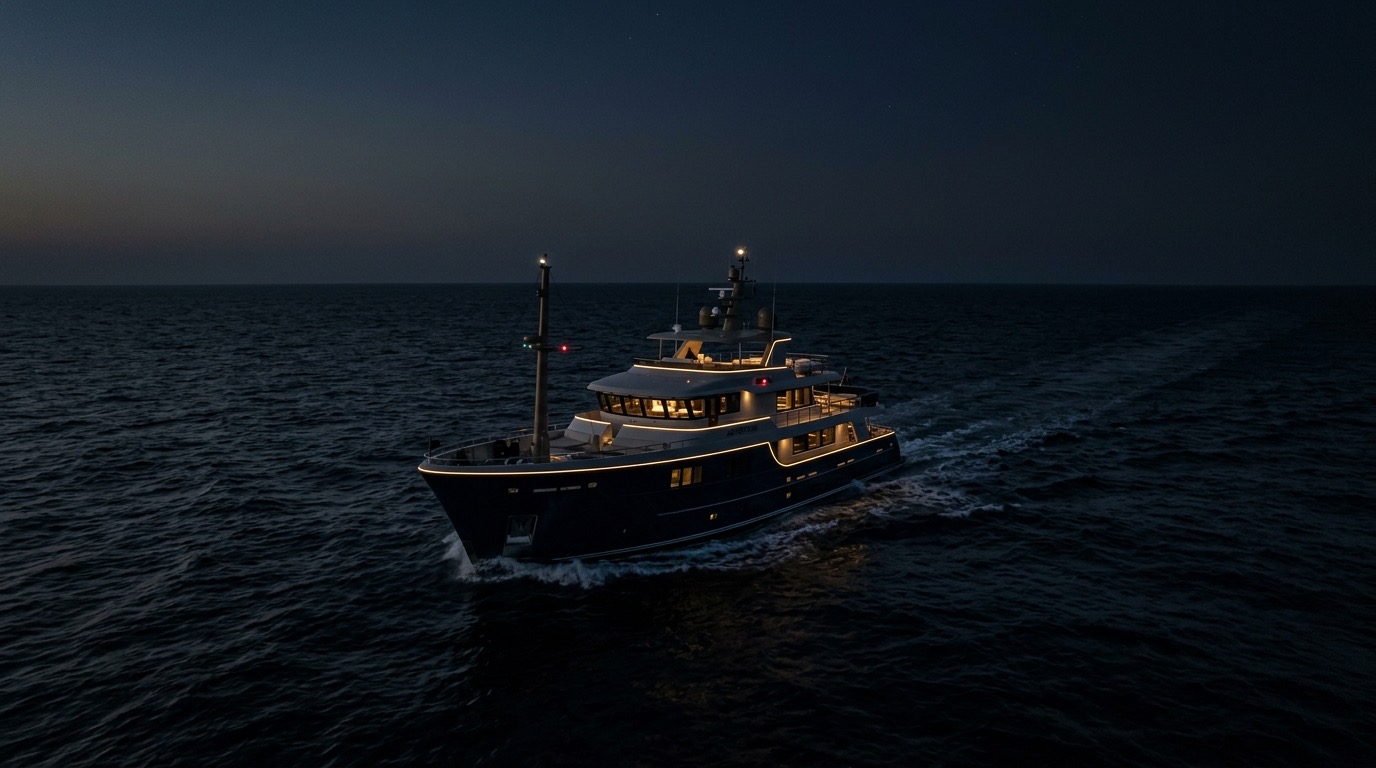
A trawler yacht doesn't try to be fast, and that's precisely the point. Where a planing motor yacht is built to get on top of the water and outrun bad weather, a trawler is built to push through it — a full-displacement or semi-displacement hull moving through the water rather than over it, burning a fraction of the fuel a comparable motor yacht needs at cruise speed, in exchange for a cruising speed most owners describe as unhurried rather than slow. For buyers weighing the full yacht buying process against a specific hull type, the trawler decision usually comes down to one question: do you want to arrive fast, or do you want a boat capable of crossing an ocean without refueling every few hundred miles?
What Makes a Trawler a Trawler
The defining feature of any trawler boat is the hull form, not the styling. A true trawler runs a full-displacement hull — round-bilged, heavy, and designed to sit in the water rather than climb onto it — which caps top speed low (typically 8–12 knots) but delivers dramatically better fuel economy at that speed than a planing hull ever achieves motoring flat out. Many boats marketed as "trawlers for sale" are actually semi-displacement designs, which trade some of that efficiency for a wider speed range, including a faster cruise when conditions allow. Neither is wrong, but they solve different problems, and confusing the two is one of the most common mistakes we see buyers make at the brokerage stage.
Long range cruising yacht buyers specifically — owners planning genuine ocean passages or extended coastal cruising far from fuel docks — should treat hull form as the first filter, before builder, layout or even budget. A trawler's range advantage isn't marginal; at displacement speed a well-built trawler can often cross 3,000–4,000 nautical miles on a single fuel load, a distance that would require multiple fuel stops on almost any comparable-length motor yacht.
Trawler vs Motor Yacht: The Real Numbers
| Trawler (displacement) | Planing Motor Yacht | |
|---|---|---|
| Typical cruise speed | 8–12 knots | 18–25 knots |
| Range at cruise speed | 2,500–4,000+ nm | 300–600 nm |
| Fuel burn at cruise | 4–12 gph | 60–150+ gph |
| Typical owner profile | Ocean-crossing, extended-passage, live-aboard cruisers | Coastal, marina-to-marina, guest-hosting cruisers |
The gap in the fuel-burn column is the entire story. A trawler owner planning a genuine long range cruising yacht itinerary — the Great Loop, an Atlantic circuit, or extended Pacific island-hopping — is optimizing for range and self-sufficiency. A motor yacht owner is optimizing for speed to the next marina and onboard comfort at anchor. Both are legitimate goals; they just point toward different hulls, different engine rooms and, as we cover below, different systems planning entirely.
Who Genuinely Benefits From a Trawler
The owners who end up happiest with a trawler are rarely the ones drawn in only by the lower purchase price relative to a similarly sized motor yacht — though that's real. They're the owners whose actual cruising pattern involves multi-week passages, remote anchorages far from services, or a genuine ambition to cross an ocean under the boat's own power rather than on a transport ship. If your real pattern is island-hopping on weekends and being back at the dock for guests by Friday, a trawler's low cruise speed will feel like a constraint rather than a feature, and a fast coastal cruiser or planing motor yacht will serve you better.
Where Buyers Actually Get It Wrong
The most expensive mistake in trawler buying isn't the hull choice — it's undersizing the tankage and systems that make long range cruising actually livable. Buyers comparing "trawlers for sale" on price and layout alone routinely underestimate two things: fuel and water capacity for the passages they say they want to make, and the systems redundancy a genuine ocean crossing demands once you're days from the nearest port.
Fuel tankage gets undersized because brochure range figures assume flat calm water and a single engine running efficiently — real passages burn more in a head sea, running a generator continuously, or making an unplanned diversion. Water tankage suffers the same optimism, especially on boats without a watermaker, where a week-long passage with guests aboard can drain tanks faster than owners expect. Both are fixable at the survey and refit stage, but far cheaper to specify correctly before purchase than to retrofit afterward.
The systems-redundancy mistake is less visible but arguably more consequential. A trawler genuinely crossing oceans is, by definition, going to spend real time beyond reliable coastal cellular coverage — which means satellite communications, weather routing and systems monitoring aren't optional extras, they're the difference between a comfortable passage and a genuinely risky one if a single system fails mid-ocean. We cover the connectivity side of this in detail in our satellite internet cost breakdown, but the short version is that a trawler's lower power budget and longer time away from shore both argue for redundant systems — not a single antenna and a hope.
The boats that get stranded aren't usually the ones with the wrong engine. They're the ones with the right engine and no plan for what happens when everything else on board needs to keep working for three weeks without a marina in sight.
New vs Used, and What to Actually Inspect
Trawlers hold value differently than planing motor yachts, and the used market is deep enough that most buyers should seriously weigh a well-maintained used hull against a new build — a decision we walk through more broadly in our new versus used yacht guide. For trawlers specifically, engine hours matter less than maintenance history, because displacement-hull diesels are built to run continuously at modest loads for tens of thousands of hours when properly serviced. What actually predicts a good trawler purchase is stabilizer condition, fuel tank integrity (steel tanks corrode from the inside in ways surveys can miss), and whether the previous owner actually used the boat for the long passages it was built for, or kept it dockside — a boat that's done real ocean miles with disciplined maintenance is usually a better bet than a pristine-looking boat that's never left the marina.
A Quick Way to Decide
- If your real cruising pattern is multi-week passages or an eventual ocean crossing, a trawler's range and fuel efficiency solve a problem a motor yacht structurally can't.
- If your real pattern is weekend and coastal cruising with guests aboard on a schedule, a planing motor yacht's speed will serve you better than a trawler's efficiency.
- If you're comparing trawlers for sale on price alone, verify tankage and stabilizer condition before layout — they matter more to how the boat actually performs offshore.
- If long passages are the plan, treat satellite communications and systems redundancy as part of the purchase decision, not an afterthought once you're aboard.
Obsidian Helm specifies the connectivity, monitoring and systems redundancy a genuine long range cruising yacht needs for real ocean passages — sized to the vessel's actual power budget and passage plans, not a generic build sheet — as part of our Yacht & Jet practice.
Specify Your Long-Range Systems Before You Buy
A $4,999 Private Strategy Session covers your trawler's passage plans, power budget and communications needs, and delivers a systems and connectivity plan built for real ocean crossings — credited toward membership.
Request Your InvitationFrequently asked
What is a trawler yacht, exactly?
A trawler is a yacht built around a full-displacement or semi-displacement hull designed to move efficiently through the water at low speed rather than plane on top of it, trading top-end speed for dramatically better range and fuel economy on long passages.
How much fuel does a trawler actually save compared to a motor yacht?
A displacement-hull trawler typically burns 70-80% less fuel at its cruise speed than a planing motor yacht burns at its own cruise speed, because it isn't fighting the drag of climbing onto plane.
Are trawlers good for crossing oceans?
Yes, that's their core purpose. A well-tanked long range cruising yacht can often cover 3,000-4,000 nautical miles on a single fuel load, which is why trawlers are the preferred platform for genuine ocean-crossing owners rather than coastal cruisers.
What should I check when buying a used trawler?
Prioritize stabilizer condition, fuel tank integrity (steel tanks can corrode from the inside in ways a standard survey misses), and actual usage history over cosmetic condition or engine hours alone — displacement diesels are built for very high hour counts when properly maintained.
Do trawlers need satellite internet for long passages?
Effectively yes. A trawler making genuine long-range passages spends real time beyond coastal cellular coverage, so satellite communications and redundant systems monitoring become safety and comfort essentials rather than optional upgrades.