Catamaran vs Monohull Yacht: What Owners Should Actually Weigh Before Buying
Every broker's showroom now has a catamaran boat parked next to the monohulls, and most buyers walk the two decks and decide on feel. The decision that actually holds up over five years of ownership runs on different numbers entirely.
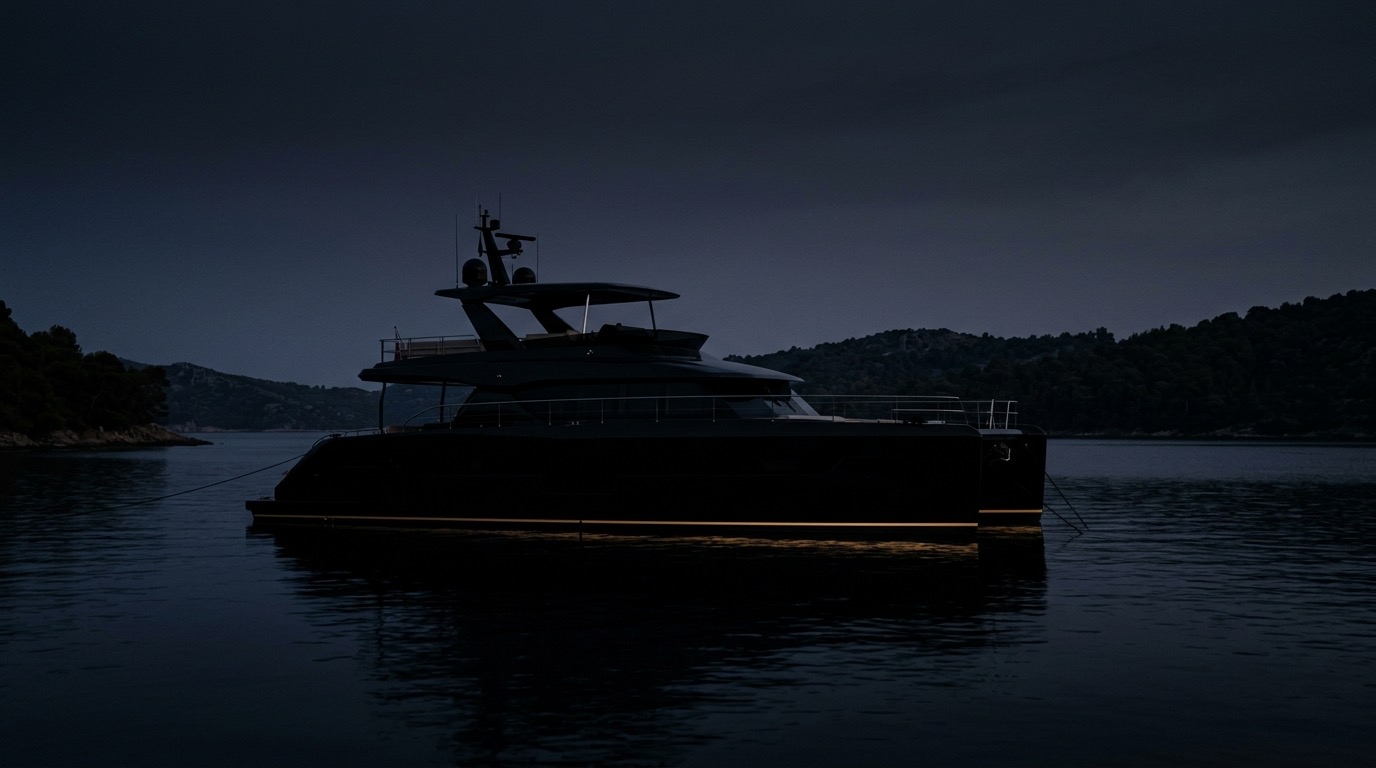
Search "catamaran for sale" today and the listings have multiplied faster than almost any other category on the market — Lagoon catamaran production alone has scaled to meet demand that barely existed two decades ago, and power catamaran for sale listings now sit next to sailing catamaran and monohull inventory at every serious brokerage. The interest is real and mostly deserved. But the buyers who end up satisfied five years in are rarely the ones who chose on first impression at the dock — they're the ones who ran the actual numbers on stability, volume, sailing character and berth cost before signing.
Stability: the difference you feel before you understand it
A catamaran's twin-hull design delivers dramatically less heel and roll than a monohull of comparable length, both underway and at anchor. There's no ballast keel fighting to right the boat against a wave; the beam itself does the work, spreading buoyancy across two widely separated hulls instead of concentrating it under one. For owners who get seasick, host guests who don't sail regularly, or simply want a fixed-position swimming pool feel at anchor rather than a gentle rock, this single trait often decides the purchase before any other factor is weighed.
The tradeoff is motion character rather than motion amount. A monohull heels progressively and predictably as wind builds, telegraphing what's coming. A catamaran stays flatter for longer and then reacts more abruptly if a hull lifts clear of the water in a steep sea — a different kind of unpredictability that experienced sailors weigh against the comfort gained at anchor and in moderate conditions, which is where most ownership hours are actually spent.
Interior volume and the charter-yield case
This is where the catamaran boat argument becomes an economic one rather than a comfort one. Spreading the same footprint across two hulls plus a bridge deck creates usable interior volume a monohull of equal length simply cannot match — wider saloons, four or five genuinely private cabins instead of three, and deck space that turns into real living area rather than just walking-around room.
| Size class (45–50 ft) | Catamaran | Monohull |
|---|---|---|
| Typical cabin count | 4–5 (near-equal size, high privacy) | 3 (owner's cabin dominant, guest cabins smaller) |
| Usable saloon/deck volume | Significantly larger — bridge deck plus two hull volumes | Compact by comparison, single hull volume |
| Typical weekly charter rate | Often 20–35% higher than a comparable monohull | Baseline for the size class |
| Charter guest capacity | Higher, at similar or better per-guest comfort | Lower, tighter per-guest space |
For owners running a yacht through a charter program to offset ownership cost, that volume difference converts directly into rate premium and booking demand — charter guests increasingly search for a catamaran specifically, expecting the flat ride and cabin privacy, and will pay for it. Buyers evaluating purely on purchase price per foot miss this; the more relevant number is revenue per charter week, and there a well-specified catamaran usually wins outright against a monohull of the same length.
Sailing performance tradeoffs
Here the comparison genuinely favors the monohull, and no amount of charter-yield math changes it. A sailing catamaran points less efficiently to windward than a comparable monohull — the wide beam and twin hulls that deliver stability also increase wetted surface and reduce the boat's ability to carve upwind the way a deep, ballasted keel can. Off the wind and reaching, a lightly loaded performance catamaran can be genuinely fast, sometimes faster than a monohull of equal length. But the all-round sailing character — feel through the helm, pointing ability, the sensation of the boat working with the wind rather than around it — remains a monohull strength that a catamaran does not replicate, regardless of builder or price point.
Owners who bought a boat primarily to sail well, rather than to live aboard comfortably or charter profitably, are consistently the ones who end up wishing they'd chosen the monohull. Owners who bought primarily for at-anchor living, guest hosting or charter income are consistently the ones who don't look back.
Maintenance and marina-berth costs
The beam that makes a catamaran so livable is also the reason it costs more to keep. Marinas price berths by footprint, and a catamaran's beam frequently runs close to double a monohull's at the same length — many marinas charge a beam surcharge outright, and in the most congested ports (Monaco, the Balearics in peak season, parts of the Caribbean) catamaran berths are both scarcer and priced at a real premium over an equivalent-length monohull slip.
Mechanically, most catamarans — sail or power — carry two of nearly everything: two engines, two drivetrains, sometimes two generators, doubling routine service intervals and parts cost even though total engine hours per system may be similar to a monohull's single, larger unit. A power catamaran for sale at a given length will typically show higher annual maintenance line items than a comparable single-engine monohull, offset for charter owners by the higher achievable weekly rate, but a real cost buyers need to model rather than discover at the first haul-out.
The catamaran doesn't cost more to own because it's a worse design. It costs more because it's asking for two of everything a monohull only needs one of — and charging a premium for the extra room that makes that trade worth it.
Who genuinely benefits from a catamaran
- Charter-program owners chasing revenue per week over pure sailing performance — the volume and privacy translate directly into rate and occupancy.
- Families and multi-generational groups who value four to five genuinely private, similarly sized cabins over three cabins with one dominant suite.
- Owners and guests prone to seasickness, or anyone prioritizing a stable at-anchor platform for swimming, water toys and entertaining over sailing feel.
- Shallow-draft cruisers — the Bahamas, parts of Croatia, and other thin-water destinations where a catamaran's shoal draft opens anchorages a deep-keeled monohull simply can't reach.
Monohulls remain the better call for owners prioritizing genuine sailing performance and windward ability, buyers working with tighter marina budgets in beam-surcharge ports, and anyone who wants a single, simpler mechanical footprint rather than a doubled one. Our broader yacht buying guide covers the purchase process end to end regardless of hull type, and the related question of motor yacht vs sailing yacht is worth reading alongside this one if propulsion type is still an open question too.
A quick way to decide
- If charter yield, guest capacity and at-anchor stability matter most, a catamaran boat — sail or power — is the stronger economic and lifestyle choice.
- If sailing performance and windward ability are the priority, and you're comfortable with less interior volume for the length, a monohull remains genuinely better at the thing it's built for.
- If marina budget is tight and you'll spend most of your time in beam-priced ports, weigh the berthing surcharge into total cost of ownership before comparing purchase price alone.
- If you're chartering seriously, pull actual weekly rate comparisons for a lagoon catamaran or equivalent builder against a same-length monohull in your target cruising ground — the revenue gap is usually the number that settles the decision.
Whichever hull type ends up right for how you'll actually use the boat, the connectivity, automation and cybersecurity build needs to be specified around its real power budget and layout — a catamaran's twin-hull electrical architecture and a monohull's single-hull run are not the same wiring problem. Obsidian Helm specifies that build correctly the first time as part of our Yacht & Jet practice.
Get the Right Vessel and Systems Specified Before You Buy
A $4,999 Private Strategy Session covers hull type, charter ambitions and cruising ground, and delivers a vessel and technology specification that fits the boat you actually choose — credited toward membership.
Request Your InvitationFrequently asked
Is a catamaran really more stable than a monohull?
Yes, at anchor and in most cruising conditions — the twin-hull design spreads buoyancy across a wide beam instead of relying on a ballasted keel, producing noticeably less heel and roll. In steep seas a catamaran can react more abruptly if a hull lifts clear of the water, which is a different kind of motion rather than simply more or less stability.
Do catamarans really cost more to berth than monohulls?
Often, yes. Marinas typically price berths by beam, and a catamaran's beam can run close to double a monohull's at the same length. In congested ports with beam surcharges, expect a real annual premium over an equivalent-length monohull slip, and scarcer availability in peak season.
Why do catamarans charter for more money than monohulls?
Interior volume and cabin privacy. Spreading the same length across two hulls plus a bridge deck creates more usable living space and more equally sized private cabins than a monohull of the same length, and charter guests increasingly search for a catamaran specifically and pay a premium for it — often 20 to 35% more per week for a comparable size class.
Are catamarans slower or worse to sail than monohulls?
Upwind, generally yes — a sailing catamaran points less efficiently than a monohull with a deep ballasted keel. Reaching and off the wind, a lightly loaded performance catamaran can be genuinely quick, sometimes faster than an equivalent monohull. All-round sailing feel and windward ability remain a monohull strength a catamaran doesn't replicate.
Is a power catamaran for sale worth considering over a monohull motor yacht?
It depends on priorities. A power catamaran typically carries two engines and often two generators, raising routine maintenance cost versus a comparable single-engine monohull, but delivers a flatter ride, more interior volume, and shallower draft for thin-water cruising grounds — a real tradeoff to model rather than a clear win either way.