Cabin Cruiser vs Motor Yacht: What's Actually the Difference
Brokers use the terms almost interchangeably, and that's part of the problem. A cabin cruiser and a motor yacht aren't the same category at different price points — they're different ownership models, and the line between them is drawn by systems and crew, not by how the hull looks in photos.
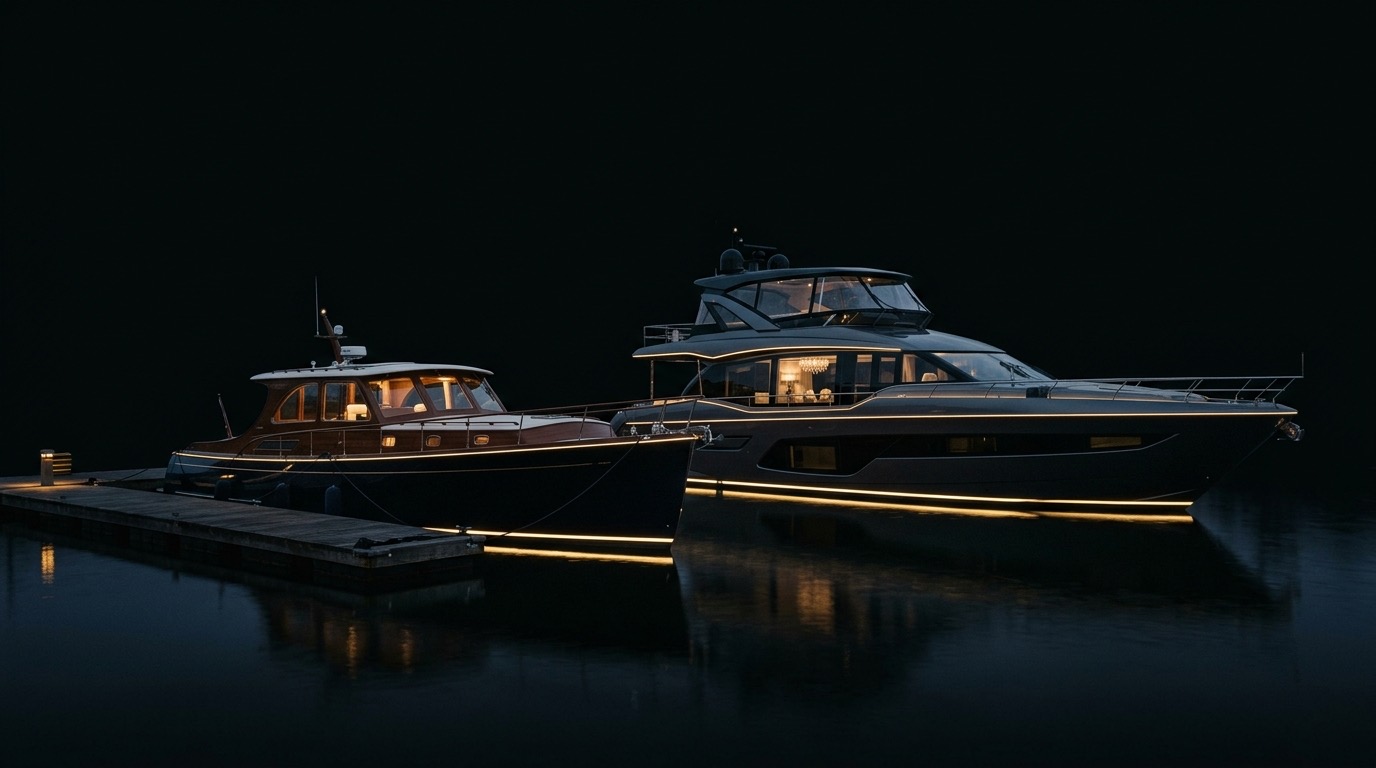
Ask three brokers where a cabin cruiser ends and a motor yacht begins, and you'll often get three different length figures. That's not because the category is meaningless — it's because most people are trying to answer the question with a tape measure when the real answer is written in the systems list and the crew contract. A cabin cruiser and a motor yacht are not the same product at different sizes; they're two different relationships with ownership, and the confusion costs buyers real money when they order the wrong tier of complexity for what they actually intended to own.
Where the size line actually falls
As a rough industry convention, "cabin cruiser" describes a cruiser boat generally under 40 feet — trailerable or close to it at the smaller end, single or twin outboard or sterndrive power, and designed to be run and maintained by the owner. "Motor yacht" describes something built around a different assumption entirely: professional crew, redundant systems, and a hull in the 50-foot-plus range where self-maintenance stops being realistic. The 40–50 foot band in between is where the category genuinely blurs, and it's exactly where buyers most often misjudge what they're signing up for.
| Attribute | Cabin cruiser (typically <40 ft) | Motor yacht (typically 50 ft+) |
|---|---|---|
| Crew model | Owner-operated, no standing crew | 1–2 minimum, scaling to 6–12+ at larger sizes |
| Systems redundancy | Single engine or twin outboards, one generator or none | Twin+ diesels, stabilizers, redundant generators, hydraulics |
| Typical dockage | Marina slip, often trailer-storage off-season | Dedicated berth, often with shore-power and crew-quarters needs |
| Insurance underwriting | Standard recreational marine policy | Agreed-value hull policy, often requires licensed captain on file |
| Owner maintenance role | Owner or local mechanic handles most work | Full-time engineer or outside yard, contracted maintenance schedule |
Length is the visible marker, but it's a proxy for the thing that actually matters: at what point does the vessel require systems and people that the owner can no longer reasonably manage alone. That threshold moves a little by builder and hull type, but it clusters tightly enough around the high-40s to low-50s that the industry convention isn't arbitrary.
What actually changes at each tier
The jump from cabin cruiser to motor yacht isn't gradual. A handful of things change close to all at once, and each one carries its own cost and commitment:
- Crew requirement — below 40 feet, most owners run the boat themselves. Above roughly 50 feet, USCG-licensed captain requirements, insurance mandates, or simple practicality (twin diesels, stabilizers, tender davits) make standing crew close to unavoidable.
- Systems redundancy — a cabin cruiser typically has one path to power and propulsion. A motor yacht is built around backup: dual generators, redundant bilge and fire-suppression systems, and stabilization that a smaller cruiser simply doesn't carry.
- Insurance structure — recreational policies price a cabin cruiser much like a large car. Motor yachts move to agreed-value marine hull policies, often with named-captain clauses and higher minimum liability limits.
- Dockage and logistics — a cabin cruiser fits a standard marina slip and can often be trailered between seasons. A motor yacht needs a dedicated berth sized for its beam and draft, frequently with crew-quarters and shore-power capacity most standard slips don't offer.
Insurance and dockage, in practice
The insurance shift is often the first place buyers feel the category change in real terms. A cabin cruiser insures like a well-equipped powerboat — actual cash value or stated value, a standard liability tier, and no requirement around who's at the helm. Cross into motor yacht territory and underwriters typically want an agreed-value hull policy, meaningfully higher liability coverage, and in many cases a named, licensed captain on the policy before they'll bind it at all. Dockage follows the same pattern: a cabin cruiser fits into general marina inventory, while a motor yacht's beam, draft and crew needs often restrict it to a smaller set of marinas actually equipped to berth it.
The hull doesn't tell you which category you're buying. The crew contract, the insurance binder and the maintenance schedule do.
A quick way to tell which one you're actually looking at
- If you plan to run it yourself, without hiring a captain or engineer, you're almost certainly shopping in cabin cruiser territory regardless of the listing's marketing language.
- If the listing assumes standing crew, or the systems list includes stabilizers and redundant generators, you're evaluating a motor yacht — and the ownership cost structure follows accordingly.
- If you're in the 40–50 foot band, read the systems and insurance requirements line by line rather than trusting the category label; this is exactly where listings blur the two.
- If resale and financing matter, lenders and insurers already draw this line whether or not the listing does, so it's worth confirming before you make an offer, not after.
None of this makes a cabin cruiser a lesser choice — for a huge number of owners, an owner-operated cruiser boat under 40 feet is the entire point, and adding crew and complexity would work against how they actually want to use it. The mistake isn't buying a cabin cruiser or a motor yacht; it's buying one while budgeting and staffing for the other. Our yacht buying guide covers the wider purchase process, and if the decision is closer to hull type than size tier, motor yacht vs sailing yacht covers that adjacent question in the same depth.
Whichever tier you land in, the connectivity, monitoring and systems architecture should match the crew model you're actually running — not a generic build sheet sized for a different category of boat. Obsidian Helm specifies that architecture correctly the first time as part of our Yacht & Jet practice.
Know Which Tier You're Actually Buying Into Before You Sign
A $4,999 Private Strategy Session reviews your size range, crew model and how you actually intend to use the vessel, and delivers a systems and staffing plan matched to the real tier — credited toward membership.
Request Your InvitationFrequently asked
What size is a cabin cruiser versus a motor yacht?
There's no single legal cutoff, but industry convention places cabin cruisers roughly under 40 feet and motor yachts from around 50 feet up. The 40-to-50-foot range is a genuine gray zone where the two labels overlap and the systems list matters more than the length figure.
Do I need crew for a cabin cruiser?
Almost never as a requirement, and rarely as a practical necessity. Cabin cruisers are built to be owner-operated. Standing crew becomes close to unavoidable once you're into motor yacht territory, both for practical operation and often as an insurance condition.
Is a motor yacht always more expensive to insure than a cabin cruiser?
Yes, structurally. Cabin cruisers typically insure under standard recreational marine policies. Motor yachts generally move to agreed-value hull policies with higher liability limits and often a named-captain requirement, which raises both premiums and underwriting complexity.
Can a cruiser boat around 40 feet be crewed?
It can, and some owners choose to hire a captain or mate at that size for convenience. But it's a choice rather than a practical requirement the way it typically is above 50 feet, where systems complexity and insurance conditions make crew close to mandatory.
What actually changes when you move from a cabin cruiser to a motor yacht?
Four things shift together: crew requirement, systems redundancy (stabilizers, redundant generators, hydraulics), insurance structure, and dockage logistics. These tend to change close to all at once around the 50-foot mark, rather than gradually with length.