
Private Jet IT & Cybersecurity for St Barts
Gustavia, St Jean, Flamands and Gouverneur hold an estimated 1,200 UHNW residents and 2 billionaires in the French Caribbean's most exclusive winter-season enclave. St Barts' own airport, Gustaf III (SBH), has a 400-metre runway and a steep hillside approach that only small, specially certified aircraft can fly — which is why most owners actually land at St Maarten (SXM) and complete the journey by helicopter or boat.
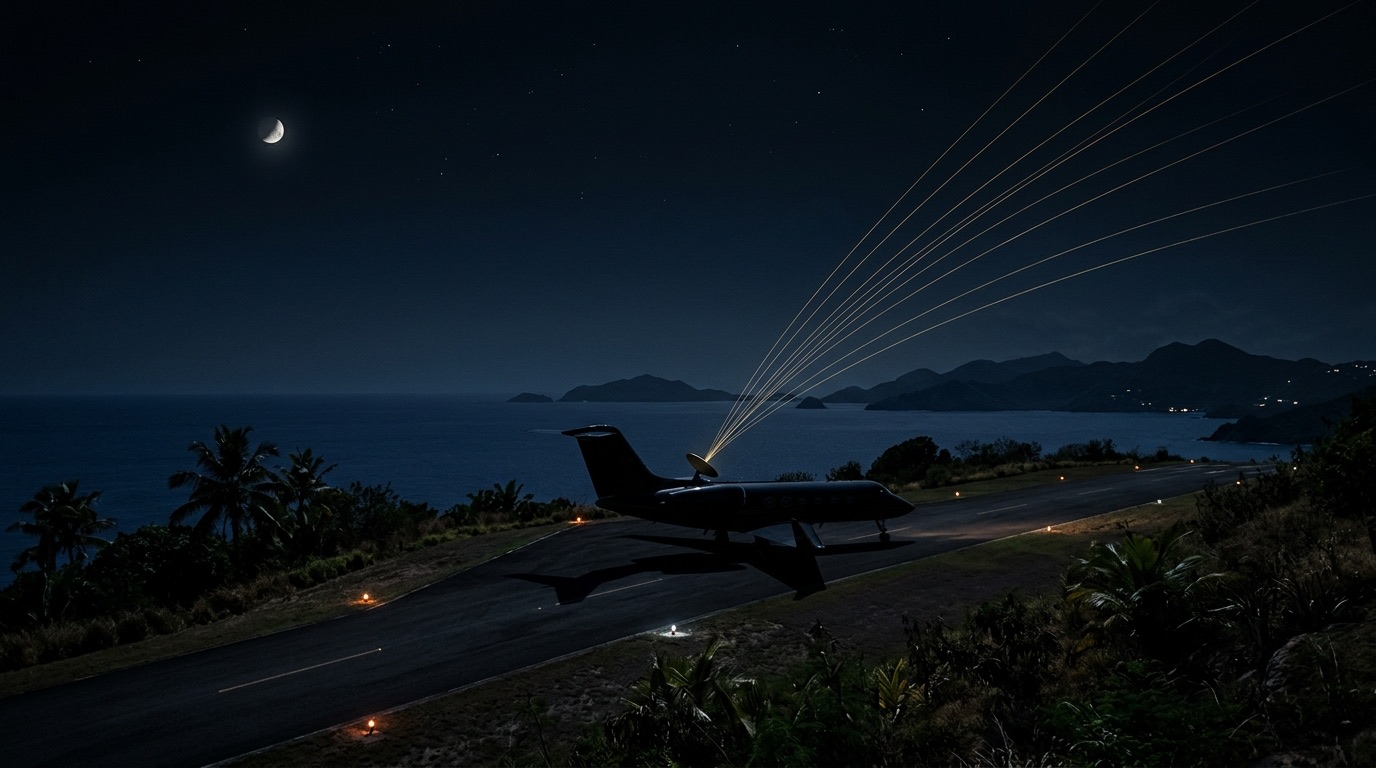
St Barts holds an estimated 1,200 ultra-high-net-worth residents and 2 billionaires across Gustavia, St Jean, Flamands and Gouverneur, a compact French Caribbean island whose winter season draws considerably more wealth in transit than its year-round population suggests. The island's own airport, Gustaf III (SBH), is worth describing honestly rather than glossed over, because it is one of the genuinely famous extreme airports in the world: a 400-metre runway, a steep hillside approach immediately preceded by a low pass over a public beach, and a certification requirement so specific that only a small number of pilots and a narrow range of small aircraft are permitted to fly it at all.
That reality shapes how nearly every UHNW principal actually reaches St Barts. Larger private jets cannot use SBH's runway under any circumstances, and even the small aircraft types that can are subject to weather, wind and daylight restrictions tight enough that many owners choose not to rely on SBH as the primary arrival point at all. Instead, most private aviation traffic serving St Barts lands at Princess Juliana International Airport (SXM) on St Maarten, roughly 15 nautical miles away, and completes the journey by helicopter transfer or by private boat — both well-established, routine options, and both, like Monaco's helicopter leg, genuinely interesting logistics rather than something to hide.
Where the actual exposure sits
For the larger aircraft landing at SXM before transferring onward, the cabin network carries the same weaknesses common to most large-cabin fleets serving Caribbean winter-season markets — satellite connectivity installed once at delivery or refit, rarely revisited, with principal, family, guest and crew devices commonly sharing a single flat network behind consumer-grade routing hardware. The SXM-to-St Barts transfer leg, whether by helicopter or boat, is an additional pinch point for device handling and physical security that a plan covering only the fixed-wing arrival would miss.
- Segmented cabin networking — isolated VLANs for principal, family, guest and crew traffic on the SXM-arriving aircraft, replacing whatever stock router the connectivity installer left behind.
- Two-leg ADS-B and flight-plan exposure audit — a technical review of what both the fixed-wing tail at SXM and, separately, any onward helicopter movement broadcast publicly.
- Executive device hardening — travel-mode configuration for phones, laptops and tablets, calibrated for a journey with more handling touchpoints and transfer operators than a direct single-airport arrival.
- Named incident response team — a defined SLA covering both the SXM arrival and the onward St Barts transfer, not a generic support ticket that only covers one leg.
Typical cost ranges
The ranges below reflect what is typical for large-cabin aircraft serving St Barts via SXM, presented as industry-representative figures rather than fixed quotes:
| Service | Typical annual range (US$) | Notes |
|---|---|---|
| Satellite connectivity (Ka-band, high-allowance plan) | 42,000 – 168,000 | Aircraft flying frequent US East Coast or transatlantic legs trend to the top end |
| Cabin network segmentation & firewall rebuild | 19,500 – 46,000 | Higher where legacy connectivity hardware requires full replacement |
| Two-leg ADS-B / flight-plan exposure audit | 8,000 – 18,000 | Covers the SXM fixed-wing arrival and the onward helicopter or boat transfer |
| Executive device & travel-mode program | 13,500 – 31,000 | Covers principal, family and senior staff devices across both transfer legs |
| 24/7 incident response retainer | 16,000 – 48,000 | Response SLA typically 15–25 minutes, extended to cover the transfer window |
St Barts' winter-season population overlaps substantially with Caribbean yacht ownership, and the aircraft, transfer, and vessel typically function as one practical travel system. Our yacht, jet and estate technology & security page covers how we design that system as a single engagement.
Why the SXM transfer matters as much as the flight itself
The helicopter and boat operators serving the SXM-to-St Barts route form a small, specialized community, which cuts both ways for security: less anonymity for anyone attempting to impersonate a legitimate operator, but also a genuine pinch point where identity, luggage and device custody change hands, often more than once between the fixed-wing arrival and final arrival at a Gustavia or St Jean residence. Families and staff sometimes treat this short transfer as a routine formality; in practice it is where the journey's actual physical security handoffs concentrate.
SXM itself is a busy, mixed commercial and general aviation airport serving the wider Caribbean, which means the FBO environment there carries the more familiar risks of invoice fraud and spoofed handler communications common to any high-traffic hub. Flight departments should apply full verification discipline to the SXM leg specifically, rather than assuming the eventual short hop to St Barts reduces the stakes of that first arrival.
One system, not three vendors
Our private jet hub covers aviation cost and Caribbean seasonal-access planning for St Barts in depth, while yacht, jet and estate technology & security sets out how we design the aircraft, transfer, and vessel together under one incident response team. The personal cybersecurity discipline underlying every engagement is described on our cybersecurity page. For St Barts' genuinely two-leg journey, a plan covering only the SXM arrival leaves the transfer — and often the more exposed part of the trip — unaddressed.
A confidential assessment before your next departure
Obsidian Helm advises a limited number of St Barts principals and family offices on aircraft, transfer, vessel, estate and personal cybersecurity, entirely under NDA. Engagements begin with a $4,999 Private Strategy Session.
Request Your InvitationFrequently asked
Can a private jet land directly at St Barts?
Only a small number of specially certified small aircraft, flown by pilots specifically trained for Gustaf III's runway, can land there at all. The runway is 400 metres with a steep hillside approach immediately preceded by a low pass over a public beach. Most private aviation traffic instead lands at St Maarten (SXM) and transfers by helicopter or boat.
Does the SXM transfer create additional security exposure?
Yes. The helicopter or boat transfer is a genuine pinch point where identity, luggage and device custody change hands, sometimes more than once, between the fixed-wing arrival and the final residence. A security plan that only covers the SXM leg leaves this transfer window unaddressed.
What does a full assessment cost for a St Barts-bound aircraft?
A full assessment covering cabin network segmentation, two-leg ADS-B exposure review and executive device hardening typically runs $8,000 to $46,000 depending on aircraft size and existing hardware. Ongoing incident response retainers run $16,000 to $48,000 a year. Exact scope is set during the initial Private Strategy Session.
How long does implementation take?
A technical audit and hardening plan typically takes 10 to 15 business days once we have access to the tail. Full network rebuild, device program rollout and transfer-leg planning usually takes four to six weeks, ideally completed before the winter season begins.
Should the jet, transfer and any yacht be secured together?
Together, wherever practical. St Barts' winter-season population overlaps substantially with Caribbean yacht ownership, and the aircraft, transfer and vessel typically function as one practical travel system best secured under a single incident response retainer.