
Private Jet IT & Cybersecurity for Mykonos
Aleomandra, Agios Lazaros, Psarou and Ornos hold an estimated 1,800 UHNW residents and 4 billionaires during Mykonos's intensely compressed summer season. Mykonos National Airport (JMK) is the gateway for nearly all of it — and by July and August, one of the most congested small business-aviation airports in the Mediterranean.
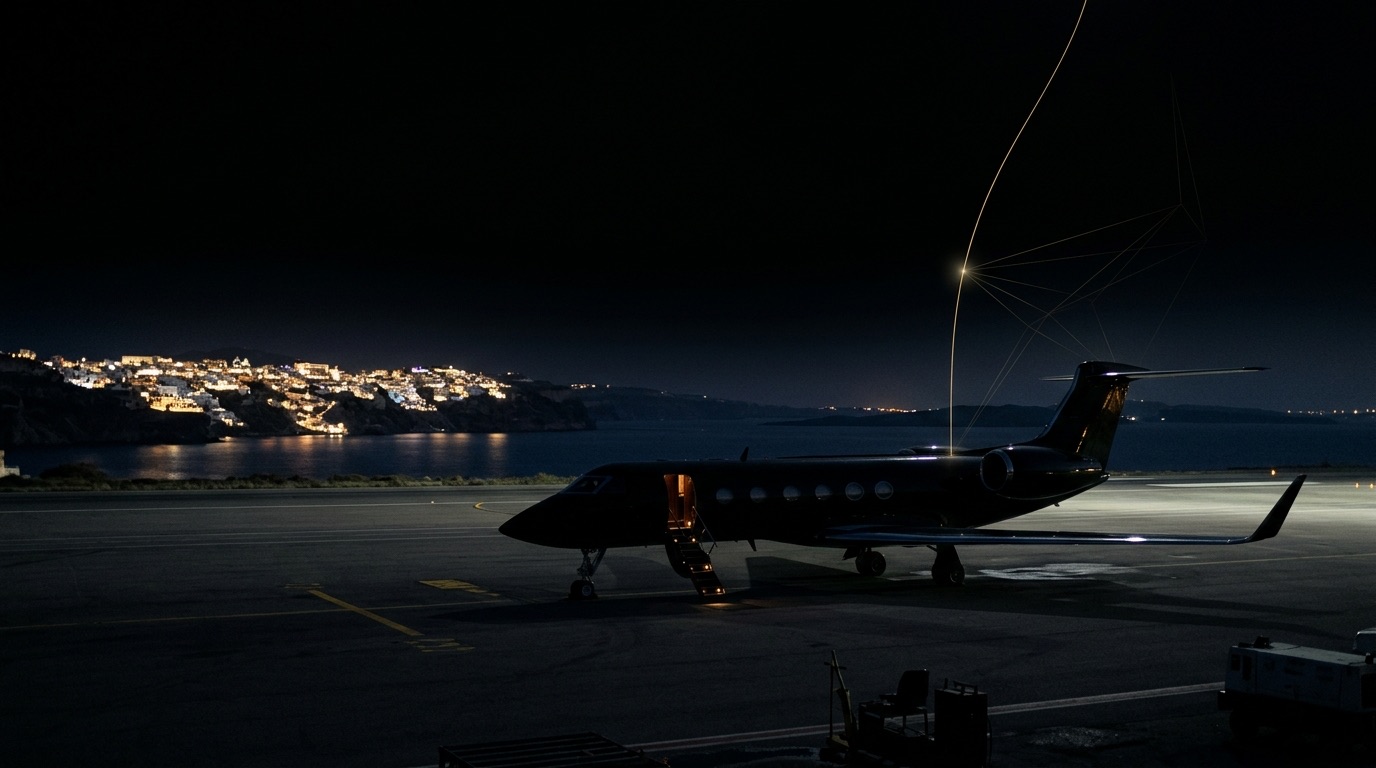
Mykonos compresses an entire year's UHNW activity into roughly ten summer weeks. Aleomandra, Agios Lazaros, Psarou and Ornos together hold an estimated 1,800 ultra-high-net-worth residents and 4 billionaires during peak season, a population that swells the small island's private aviation traffic far beyond what its single runway was designed to comfortably absorb. Mykonos National Airport (JMK) is the gateway for nearly all of it, and by July and August it becomes, by reputation among flight departments across the Mediterranean, one of the most congested small business-aviation fields in the region.
This congestion is worth naming as the defining operational fact of a Mykonos arrival, because it shapes the security conversation as directly as it shapes flight planning. JMK's limited apron space and slot capacity mean aircraft frequently hold, divert, or wait extended periods on the ground during peak weeks, and the FBO and ground-handling ecosystem serving the field is stretched thin exactly when demand — and the value of the traffic passing through — is highest. A small field under sustained peak-season pressure is a different risk environment than the same field in the shoulder season, and flight departments need to plan for both.
Where the actual exposure sits
As with most seasonal Mediterranean markets, the cabin network is the weakest point, not the airframe or the ground handling. Aircraft based at or regularly through JMK typically carry satellite connectivity installed once at delivery or during a refit and rarely revisited. Principal, family, guest and crew devices commonly share a single flat network behind consumer-grade routing hardware, meaning a compromised guest laptop or a targeted phishing attempt against a known associate can reach the principal's own systems mid-flight.
- Segmented cabin networking — isolated VLANs for principal, family, guest and crew traffic, replacing whatever stock router the connectivity installer left behind.
- ADS-B and flight-plan exposure audit — a technical review of what each tail broadcasts publicly, particularly relevant given how predictable JMK's ten-week peak-season traffic pattern is to anyone watching.
- Slot-congestion contingency planning — a defined protocol for extended ground holds and diversions to alternate fields, with the same security posture applied automatically rather than improvised under time and heat pressure.
- Named incident response team — a defined SLA reachable before wheels-up at JMK and throughout the flight, not a generic support ticket.
Typical cost ranges
The ranges below reflect what is typical for large-cabin aircraft transiting JMK during peak season, presented as industry-representative figures rather than fixed quotes:
| Service | Typical annual range (US$) | Notes |
|---|---|---|
| Satellite connectivity (Ka-band, high-allowance plan) | 45,000 – 175,000 | Aircraft flying frequent transatlantic or Gulf legs trend to the top end |
| Cabin network segmentation & firewall rebuild | 20,000 – 48,000 | Higher where legacy connectivity hardware requires full replacement |
| ADS-B / flight-plan exposure audit | 7,000 – 16,000 | Calibrated to JMK's tightly compressed, highly predictable peak-season pattern |
| Slot-congestion contingency & alternate-field plan | 5,500 – 13,000 | Covers Athens or Santorini as pre-vetted alternates with onward transfer planning |
| 24/7 incident response retainer | 17,000 – 50,000 | Response SLA typically 15–25 minutes given JMK's peak-season slot pressure |
Mykonos's peak-season families overwhelmingly overlap with Aegean and wider Mediterranean yacht ownership, and the aircraft, transfer, and vessel typically function as one practical travel system. Our yacht, jet and estate technology & security page covers how we design that system as a single engagement.
Why congestion is a security issue, not just an inconvenience
A congested FBO environment is a more permissive environment for social engineering and fraud attempts. When ground staff are managing an unusually high volume of aircraft, handling requests, and fuel releases in a short window, a spoofed invoice or a fraudulent authorization request sent through a compromised handler channel is more likely to slip through without the verification it would receive on a quieter day. Flight departments serving Mykonos during peak weeks should treat July and August specifically as elevated-risk periods requiring more, not less, verification discipline — precisely because operational tempo pushes in the opposite direction.
Extended ground holds themselves also extend the window during which an aircraft's cabin network, if not properly segmented, is accessible to anyone within range on the apron. Combined with JMK's own limited on-field security infrastructure relative to a major hub, this is a genuine reason to prioritize network segmentation and access control ahead of, or at minimum alongside, connectivity upgrades focused purely on bandwidth.
One system, not three vendors
Our private jet hub covers aviation cost and Aegean seasonal-access planning in depth, while yacht, jet and estate technology & security sets out how we design the aircraft, any vessel, and the residence together under one incident response team. The personal cybersecurity discipline underlying every engagement is described on our cybersecurity page. For Mykonos's peak-season congestion, that integrated, contingency-aware approach is what keeps a stretched FBO environment from becoming a security gap.
A confidential assessment before your next departure
Obsidian Helm advises a limited number of Mykonos principals and family offices on aircraft, vessel, estate and personal cybersecurity, entirely under NDA. Engagements begin with a $4,999 Private Strategy Session.
Request Your InvitationFrequently asked
Why is JMK so congested in peak season?
Mykonos National Airport has limited apron space and slot capacity relative to the volume of demand it attracts during the roughly ten-week July-August peak, causing frequent ground holds, diversions and a stretched FBO and ground-handling ecosystem exactly when traffic value is highest.
Does congestion actually increase cybersecurity risk?
Yes. A congested FBO environment is more permissive for fraud attempts, since ground staff managing an unusually high volume of requests are more likely to miss a spoofed invoice or fraudulent fuel-release request than they would on a quieter day. Extended ground holds also extend the window an unsegmented cabin network is exposed on the apron.
What does a private jet cybersecurity assessment cost for a Mykonos-bound aircraft?
A full assessment covering cabin network segmentation, ADS-B exposure review, slot-congestion contingency planning and executive device hardening typically runs $7,000 to $48,000 depending on aircraft size and existing hardware. Ongoing incident response retainers run $17,000 to $50,000 a year. Exact scope is set during the initial Private Strategy Session.
What happens if my aircraft can't get a slot at JMK?
We build a pre-vetted alternate-field protocol into every Mykonos engagement, typically covering Athens or Santorini with onward transfer planning, so security posture doesn't lapse if the primary field is unavailable during peak weeks.
Should the jet and any yacht be secured together?
Together, wherever practical. Mykonos's peak-season UHNW population overlaps heavily with Aegean and wider Mediterranean yacht ownership, and the aircraft, transfer and vessel typically function as one practical travel system best secured as a single engagement.