Most private-aviation advice for families is about comfort — bassinets, ground transport for strollers, wheelchair access. The real exposure for UHNW families is different: flight-tracking sites publishing your tail number and itinerary, unsecured devices in the hands of kids and staff, and the unprotected minutes between the jet and a secured door. Here is how owners actually plan for it.
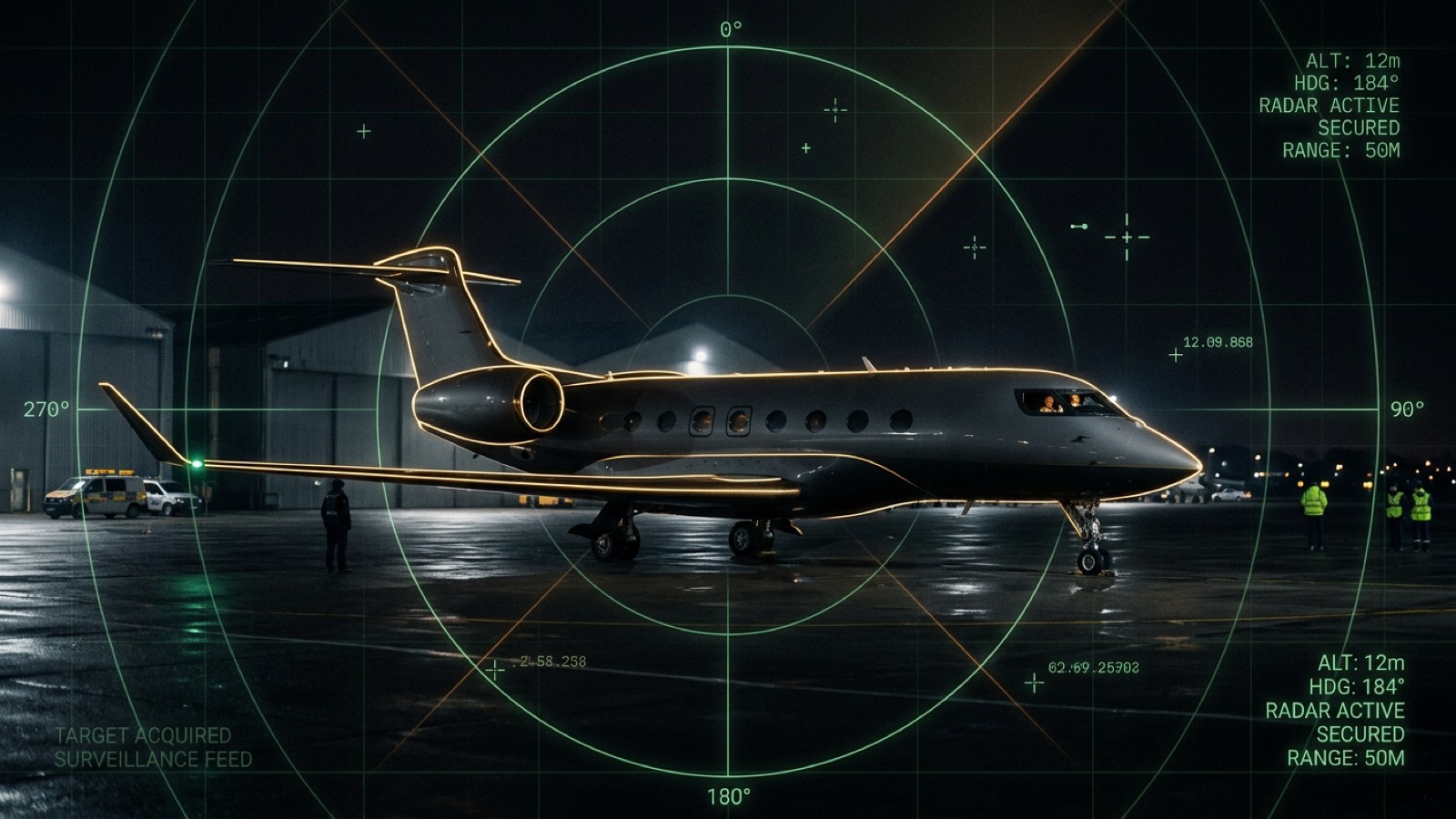
Search "flying private with family" and almost everything that comes back is written for comfort — how to get a bassinet on a Gulfstream, whether the cabin can fit a wheelchair, which jet cards are best for a family of six. That content is useful, and none of it is wrong. It is also not the part of family air travel that actually puts a principal's household at risk.
The families we work with are not worried about legroom. They are worried about a tail number search on a public flight tracker revealing exactly when their children land at a given airport, a nanny's personal phone syncing a child's location to an account with no security on it, or the ninety seconds between the aircraft door and a waiting car being the one part of the trip nobody actually planned. This briefing covers the security and privacy planning layer that sits underneath the comfort logistics — pre-flight OPSEC, coordinating with FBO staff, securing the devices that travel with a family, comms in the air, and the ground handoff on both ends.
Every private aircraft broadcasts its position via ADS-B (Automatic Dependent Surveillance-Broadcast), and sites like Flightradar24, FlightAware and ADS-B Exchange republish that signal in real time, free, to anyone. A single tail number search shows departure airport, arrival airport, altitude, speed and, cross-referenced against a public aircraft registry, the owning entity. Dedicated "tail spotters" — hobbyists and occasionally worse — track specific aircraft for sport, and a family that flies the same jet regularly on a predictable school-break pattern is trivially easy to profile from public data alone.
Owners with real privacy needs use a layered approach rather than any single fix. Civil aviation authorities in most major jurisdictions offer a tail number blocking program — the FAA's Limiting Aircraft Data Displayed (LADD) in the US is the best known — which suppresses registration-linked identity from the major public trackers. It does not stop the raw ADS-B broadcast itself from being received by a dedicated antenna, but it removes the easy, one-search identification that causes most real-world exposure. Registering the aircraft under a trust or LLC rather than a personal name adds a second layer, and working with an operator who defaults to discreet flight-plan handling — rather than publishing full passenger manifests to ground handlers who don't need them — closes a third.
None of this needs to happen the day of travel. It is a one-time setup with your aviation department or management company, and it should be revisited any time the aircraft is re-registered, sold, or chartered to a new operator.
Fixed-base operators handle high-profile passengers constantly, and most maintain private terminals, discreet curbside pickup and separate lounges precisely because they are used to it. The mistake families make is not under-using this infrastructure — it's over-sharing to get it. A logistics email that lists full names, ages, passport numbers, medical needs and a hotel address in one document, sent unencrypted to a shared FBO inbox, is a bigger security failure than almost anything that happens in the air.
The better pattern: route coordination through a single point of contact — a security lead, family office staffer, or trusted charter broker — who tells the FBO only what staff operationally need. Arrival window, number of passengers, number of vehicles, whether a private terminal or side-gate access is required. Names, ages and full itineraries stay off that channel entirely. If your detail needs to walk the tarmac route or confirm sightlines in advance, that request goes through the same single contact, not through a family member's personal phone or a group text that eventually includes people who don't need to be on it.
Where a family travels with an executive protection team, brief them and the FBO's own security staff separately in advance so vehicle staging, walking routes and hold points are agreed before the aircraft lands — not improvised on the ramp while a principal and children are standing in the open.
Cabin connectivity gets a lot of attention and, on modern jets, is usually reasonably secure by default. The actual gap is almost always a device carried by someone other than the principal: a child's tablet with location sharing set to public rather than a private family circle, a nanny's or tutor's personal phone with no passcode and a synced photo library that geotags every stop, or a bodyguard's device running consumer apps with none of the family's device policy applied to it.
Treat every device that boards the aircraft — not just the ones issued by the family office — as part of the family's attack surface. That means a documented device policy that actually covers staff and older children, not just the principal: location sharing restricted to private circles, no autoposting to social media, app permissions locked down, and separate profiles or managed devices for anyone under 18 rather than a hand-me-down adult phone with full access. Staff phones, ideally, should be family-office-issued and centrally managed rather than personal devices doing double duty — a personal phone with weak security is not covered by any policy the family has, no matter how strong that policy is on paper.
Most cabin Wi-Fi on private jets runs through Ka- or Ku-band satellite links or, increasingly, Starlink, and the connection itself is generally fine for ordinary browsing. The risk is what travels over it unencrypted and who else is on the same network segment. Business calls discussing sensitive family matters, staff coordinating security logistics for the ground leg, or a child's device backing up photos with embedded location data — all of it should default to an encrypted messaging app rather than SMS, and a VPN should be standard on any device used for anything beyond entertainment.
Families with a standing security or family office relationship typically have a dedicated, monitored comms channel for anything operationally sensitive — confirming ground transport, updating arrival timing, flagging a change in the detail's plan — that stays separate from the general family group chat. That separation matters more than it sounds: a group chat that mixes "what movie should we watch" with "confirm the second car is staged at gate 4" is one leaked or lost phone away from exposing real operational detail.
The aircraft's own security and the residence's security systems both stop at their respective doors. Everything between deplaning and a locked vehicle, and between that vehicle and a secured entrance, is a gap that no system covers automatically — it has to be planned like its own leg of the trip. This is also, statistically, when families are most exposed: visible, stationary or slow-moving, often tired, and surrounded by luggage and staff rather than a tight, briefed formation.
A properly planned handoff has the vehicle staged and confirmed before the aircraft doors open, a fixed walking route from stairs to car agreed in advance rather than decided on the ramp, and the same discipline repeated at the residence end — gate open, interior team aware of arrival time, and no gap where the family is standing outside a door waiting for someone to unlock it. Where a residence has smart-home and camera systems, arrival should be a scheduled, expected event in that system, not something the security team discovers after the fact on a motion alert.
| Risk area | Common mistake | Better practice |
|---|---|---|
| Flight tracking | Flying under a personal-name registration with no tracker blocking | LADD-style blocking plus trust/LLC registration, revisited on any re-registration |
| FBO coordination | Full itinerary and passenger details sent by unencrypted email to a shared inbox | Single security point of contact shares only operational details staff need |
| Kids' devices | Hand-me-down adult phone with public location sharing and open app permissions | Managed device or locked-down profile, private-circle location sharing only |
| Staff phones | Personal phone used for security logistics with no family device policy applied | Family-office-issued, centrally managed device for any operational role |
| In-flight comms | Sensitive logistics discussed in the general family group chat over SMS | Separate encrypted channel for operational detail, VPN on connected devices |
| Ground handoff | Vehicle and route improvised after the aircraft doors open | Route and vehicle staging confirmed and briefed before landing |
We coordinate the pieces most families plan in isolation — tail number privacy, device policy for kids and staff, encrypted comms, and the ground handoff on both ends — as one standing arrangement with your aviation and security teams, not a one-time briefing.
Personal CybersecurityIndependent guidance. Where we coordinate with your FBO, broker or security detail, it never changes how your family's information is handled.
Obsidian Helm's Concierge IT team manages devices for principals, children and household staff under one policy — provisioning, monitoring and incident response, remote and discreet, under NDA.
Concierge ITYes, unless you take specific steps. Public ADS-B trackers like Flightradar24 and FlightAware broadcast tail number, departure and arrival airport and real-time position for almost every private aircraft in the air. Tail number blocking programs (such as the FAA's LADD in the US, or equivalent privacy filters with other civil aviation authorities) suppress your registration from public display on these sites, though the raw ADS-B signal itself is still broadcast and can be picked up by dedicated spotters. Combining LADD-style blocking with a trust or LLC-registered tail number is the standard practice for owners who do not want departure times and destinations trivially linkable to their family.
It depends on age and how the devices are configured, not a blanket yes or no. Any device that travels with a minor should have location sharing restricted to a private family circle (not public-facing apps), app permissions locked down, and no autoposting to social media enabled. The bigger risk is usually not the child's own phone but a nanny's, tutor's or bodyguard's personal phone, which often has weaker security and is rarely covered by the family's device policy at all.
Route the logistics through your security lead or a trusted broker, not directly through family members or open email threads. FBOs handle high-profile arrivals routinely and most maintain private terminal access, but the request should specify only what staff need operationally (arrival window, vehicle count, number of passengers) and should never be sent by unencrypted email listing full names, ages or itinerary details in one document.
The handoff moments, not the flight itself. The minutes between deplaning and reaching a secured vehicle, and between the vehicle and a secured residence, are when a family is most exposed and least protected by aircraft or property security systems. These gaps are frequently under-planned because attention goes to the flight logistics rather than the transitions on either end of it.