
Monaco Superyacht Berthing Cost Per Night: What Port Hercule Really Charges in 2026
There is no single Monaco berthing price. We decode the four markets behind the nightly rate — from the summer transient tariff to the multi-million-euro permanent berth — and where the credible alternatives actually sit.
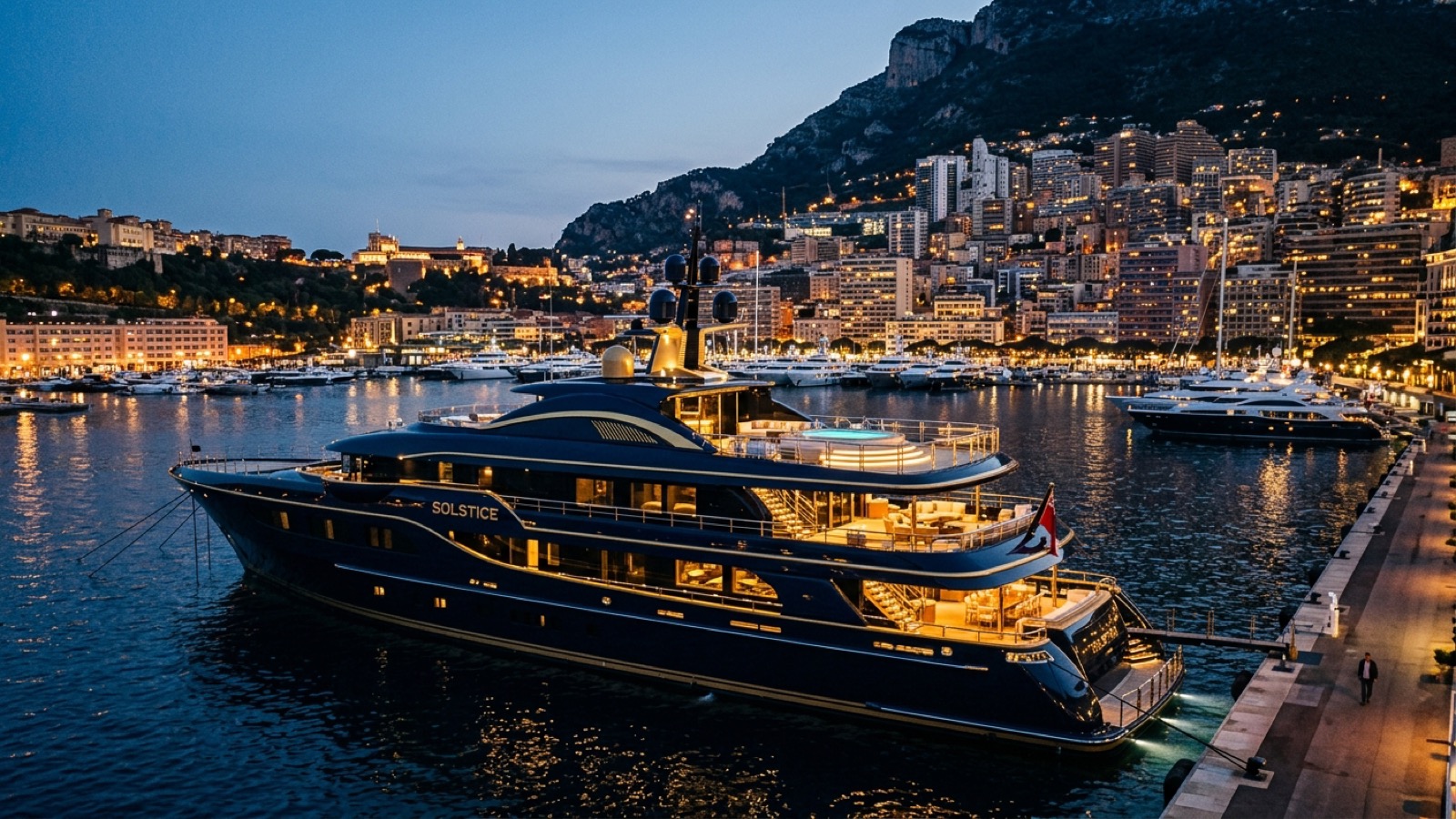
Few line items in a yacht's annual budget provoke as much quiet astonishment as the cost of keeping it still in Monaco. The Principality occupies roughly two square kilometres of the Côte d'Azur, and its waterfront is the most valuable maritime real estate on earth. To berth a superyacht here is not simply to rent a length of quay; it is to buy a position inside a closed economy where supply is fixed by geography, demand is global, and price is set by scarcity rather than by the cost of the service rendered.
This briefing sets out what berthing a superyacht in Monaco actually costs per night in 2026, how those figures move between low season, high season and the two events that distort the entire Riviera calendar, and why the headline nightly rate is the least interesting number in the conversation. For owners and their offices, the meaningful questions are structural: who controls allocation, what a permanent berth is worth on the secondary market, and where the genuinely viable alternatives sit when Port Hercule is full or simply not worth the premium.
The short answer, and why it is misleading
A transient superyacht berth in Port Hercule, taken for a handful of nights in the summer season, typically runs from roughly €1,400 per night for a vessel in the 30-metre class to well over €15,000 per night for a 70-metre-plus yacht in a prime position. At the official tariff, a 100-to-110-metre vessel pays in the region of €1,400 for a single low-season day on the published rate card; in practice, prime summer transient rates for large yachts are quoted by brokers in the €300 to €600 per foot per night range, which moves a 50-metre yacht into €15,000 to €30,000 a night and a 100-metre yacht into €30,000 to €60,000 a night for premium quay positions.
That spread—from under two thousand euros to over fifty thousand for what is nominally the same activity—is the first thing to understand. There is no single Monaco berthing price. There is a published municipal tariff, a transient market that sits well above it, a long-lease private-holder economy that sits below it, and two annual events during which the ordinary rules are suspended entirely. The number that applies to any given yacht depends less on the vessel than on which of these four markets the owner is operating in.
How Monaco's ports are actually structured
The Principality has two working harbours, both administered by the Société d'Exploitation des Ports de Monaco (SEPM), the state-controlled operator that holds the concession over the waterfront. Understanding the split between them clarifies almost everything about pricing.
Port Hercule
Port Hercule is the deepwater showpiece on the eastern side, beneath Monte-Carlo. It is the harbour the cameras find during the Grand Prix and the Monaco Yacht Show, and it is the only one of the two that comfortably accommodates the largest superyachts, with a small number of stern-to positions capable of taking vessels approaching and exceeding 100 metres. It is also the most expensive, the most visible, and the hardest to enter. Allocation of its prime large-yacht berths is, in practice, a closed circle.
Port de Fontvieille
Port de Fontvieille, on the western side beneath the Rock, is the quieter, residential harbour. It holds around 275 berths for vessels up to roughly 40 metres, with a maximum draft near three metres, and it is favoured by full-time residents rather than by the international charter and show circuit. Fontvieille is where Monegasque citizens and official residents keep their boats; the harbour master gives them strict priority, and the waiting list for an annual berth runs to years. It matters to superyacht owners chiefly as evidence of how completely the local berth supply is spoken for before any outside money arrives.
Nightly and seasonal rates by length
The table below sets out indicative transient berthing costs in Port Hercule for ordinary, non-event periods in 2026. These are blended figures drawn from the official SEPM tariff at the lower end and from broker-quoted prime-position summer rates at the upper end. They should be read as planning ranges, not as fixed quotes: the actual price depends on the exact berth, the services drawn (shore power for a large yacht is a material cost in its own right), the length of stay, and the season.
| Yacht length | Low season / night | High season (summer) / night | Indicative monthly contract |
|---|---|---|---|
| 20–25 m | €350–€700 | €900–€1,800 | €4,000–€7,000 |
| 30–35 m | €700–€1,400 | €2,500–€6,000 | €7,000–€12,000 |
| 40–50 m | €1,200–€2,500 | €8,000–€18,000 | €15,000–€30,000 |
| 50–70 m | €2,000–€4,500 | €15,000–€30,000 | €30,000–€55,000 |
| 70–100 m | €3,500–€7,000 | €25,000–€45,000 | €55,000–€90,000 |
| 100 m + | €1,400 (official tariff floor) –€8,000 | €30,000–€60,000 | €90,000 + |
Two features of this table deserve emphasis. First, the seasonal swing is violent. A 40-to-50-metre yacht might pay under €2,500 a night in February and ten times that in August for a comparable position. Monaco's value is almost entirely a summer-and-events phenomenon; in winter the harbour is, by its own standards, cheap. Second, transient rates run materially above the equivalent monthly contract on a per-night basis—commonly thirty to fifty per cent higher per day—because the port reserves its flexibility, and its best short-stay positions, for those willing to pay for spontaneity.
What the nightly rate does not include
The berth fee is the entry ticket, not the bill. Shore power for a large yacht can add hundreds of euros a day; water, waste collection, and harbour services are metered or charged separately; and most owners of vessels above roughly 40 metres are not docking themselves. Berthing in Port Hercule stern-to, in a crowded harbour, in front of an audience, is a job for professional shore assistance and, frequently, divers and line handlers. A serious office budgets for the berth, the services, the agent, and the contingency of a position change at the harbour master's discretion. The quay rate alone understates the true nightly cost by a meaningful margin.
What actually moves the price
Within any given length class, two yachts of identical size can pay wildly different rates for the same week. The variables that decide where a vessel lands inside the range are worth setting out plainly, because they are where an experienced office finds its leverage.
Position within the harbour. Not all quay is equal. A berth on the principal stern-to face, in full view of the Monte-Carlo terraces, carries a premium over a position tucked along a less prominent mole. During events this is formalised into pricing zones; outside events it is a matter of negotiation and availability, but the principle holds—visibility is part of what is being sold, and the most photographed positions cost the most.
Length and beam. Pricing is driven primarily by length overall, but beam matters at the margin because a wide-bodied yacht consumes more of the harbour's scarce water than its length alone suggests. Vessels with unusual dimensions, very deep draft, or non-standard mooring requirements can find their options narrowed to a handful of berths, which removes the owner's negotiating room entirely.
Season and timing. The single largest lever is when you arrive. The same position can differ by a factor of ten between February and August. Shoulder-season weeks in May and October offer much of the summer scene at a meaningful discount, and owners with flexibility in their cruising calendar capture most of Monaco's value at a fraction of its peak cost.
Services drawn. Shore power for a large yacht is a substantial daily charge, particularly for vessels running significant hotel loads at the quay. Water, waste, and harbour services are metered or billed separately. For the biggest yachts these ancillary costs are not rounding errors; they form a real and sometimes underestimated portion of the total stay.
Length of stay and relationship. The port reserves its flexibility, and its highest per-night rates, for short transient calls. Longer commitments, and a track record with the harbour office, soften both price and the risk of being asked to move. Monaco rewards continuity; the casual one-off pays the most.
The mechanics of securing a berth
For a visiting yacht, a Port Hercule berth is not booked through a public portal in the way a marina elsewhere might be. Large-yacht positions are arranged through the harbour office and, in practice, through a yacht agent or the captain's established relationships, well in advance for any period of real demand. Walk-up availability for a 50-metre yacht in August does not meaningfully exist; the harbour is allocated long before the season opens.
This is why the agent matters. A competent Monaco agent does more than reserve a length of quay: they manage the allocation politics, secure the best available position for the budget, coordinate shore assistance for a demanding stern-to berthing, and absorb the risk that the harbour master will reallocate positions as larger or more favoured vessels arrive. For an owner's office, the cost of the agent is trivial against the cost of arriving without a confirmed, suitable berth. The same logic applies, with far greater force, during the two events.
The two weeks that rewrite the rules
For most of the year Monaco berthing is expensive but legible. Twice a year it becomes something else entirely. The Formula 1 Grand Prix in late May and the Monaco Yacht Show in late September are not priced as berthing at all; they are priced as access to two of the most concentrated gatherings of capital in the world, with the yacht as the price of admission.
Grand Prix week
During the Grand Prix, Port Hercule is divided into pricing zones determined by proximity to the circuit, which runs along the harbour's edge. The trackside positions—Zone 1—command the extraordinary figures. A 50-to-59-metre superyacht in the best trackside position has been quoted at around €110,000 for the week; a 90-metre yacht at roughly €120,000; and a vessel approaching 150 metres at around €153,000 for the week in a prime location. These are berth fees alone, before charter, crew, provisioning, hospitality, or the cost of the yacht itself.
At the smaller end, the inflation is just as stark in relative terms. A berth for a yacht under 19.5 metres that cost roughly €10,900 for the Grand Prix in 2019 now sits above €22,000. Across the fleet, event berthing has roughly doubled in well under a decade—a rate of increase that has nothing to do with the cost of providing a quay and everything to do with the willingness of the market to pay for a position from which to watch the race over a glass of something cold.
For owners who do not own a berth, the practical route into Grand Prix week is a charter that includes a confirmed berth, and here the numbers compound. A mid-size superyacht of 35 to 40 metres chartered for the week starts around €100,000 to €130,000 as a base rate before expenses, with the berth folded in or charged on top. The all-in cost of a credible Grand Prix yacht weekend—charter, berth, fuel, provisioning, crew gratuities, and hospitality—routinely runs into several hundred thousand euros, and into seven figures for the larger vessels in the best positions.
The Monaco Yacht Show
The September show is a different animal: a trade event where Port Hercule is given over almost entirely to exhibiting yachts, and ordinary transient berthing effectively disappears for the duration. Berths during the show are allocated through the event rather than the harbour office, and the cost is bound up with exhibiting rather than simply mooring. For an owner who wants to be in Monaco that week without exhibiting, the realistic answer is to be elsewhere on the coast and to arrive by tender or car—which is precisely why the alternative ports matter.
The annual berth, and the economy beneath the surface
Everything above concerns visitors. The deeper structure of Monaco berthing is the permanent berth, and it operates on entirely different logic. A permanent annual berth in Monaco is not really a service you rent; it is a right you hold, and rights of that kind change hands at prices that dwarf the mooring fees attached to them.
The annual mooring tariff itself is, by Monaco standards, almost modest. An annual berth for a 20-metre yacht runs in the region of €25,000 to €35,000, and superyacht annual rates exceed €100,000. But these figures are available almost exclusively to those who already hold the berth. Acquiring one means either joining a waiting list measured in years, with strict priority to residents and Monegasque citizens, or buying a berth licence on the secondary market from an existing holder.
That secondary market is where Monaco's true berthing economics live. Berth licences for the larger positions are valued, in effect, per metre of length, and the figures cited for prime positions run to the order of €50,000 to €150,000 per metre—an amount entirely separate from, and many multiples of, the annual mooring fee. A long position in Port Hercule is, on this basis, a multi-million-euro asset in its own right, traded much as one would trade a piece of prime real estate, and held for the same reasons: it is scarce, it does not depreciate, and there is always a buyer.
For an owner's office, the implication is straightforward. If Monaco is to be a home port rather than an occasional stop, the relevant cost is not the nightly rate but the capital cost of securing a permanent position—either through patient placement on a list or through acquisition of a licence at market. The nightly tariff is what you pay when you have not yet made that decision.
The alternatives: staying close without paying Monaco
The most useful thing to understand about Monaco berthing is that, for a large part of the year, you do not need to be inside the Principality to enjoy it. A cluster of ports within easy reach offers the same waters, much of the same scene, and a fraction of the friction. For owners willing to be fifteen minutes away rather than at the centre of the stage, the economics improve dramatically.
Cala del Forte, Ventimiglia
The most significant development in Riviera berthing of the last decade sits just across the Italian border. Cala del Forte in Ventimiglia is a modern marina owned, in effect, by the same Monaco port interests, with 178 berths for vessels from 6.5 metres to over 70 metres, including a quay built to take a 100-metre yacht. It lies 7.9 nautical miles from Monaco—about fifteen minutes by the high-speed shuttle that connects the two—and it was conceived explicitly as a release valve for the saturated Monaco harbours.
Cala del Forte offers daily, monthly and seasonal rates, and a long-lease purchase structure over a 40-year term that allows owners to draw rental income from the berth when they are not using it themselves. For an owner who wants a secure, modern, large-yacht position with a genuine connection to Monaco but without Port Hercule's pricing or its waiting list, it is now the most credible single answer on the coast. It is, increasingly, where the overflow of serious tonnage actually sits.
Cap-d'Ail, Fontvieille's western neighbour
Immediately west of the Principality, the Port de Cap-d'Ail in France sits within walking distance of Fontvieille and offers berthing for vessels into the 40-metre-plus range at French rather than Monegasque rates. It lacks Monaco's prestige and its deepwater capacity for the very largest yachts, but for vessels in the 30-to-45-metre band it provides a position quite literally adjacent to the Principality at a meaningful discount, and it is a long-standing choice for owners who want proximity without the premium.
The wider Riviera
Beyond the immediate neighbours, the established French ports—Beaulieu-sur-Mer, Villefranche's anchorage, and further along the coast Antibes' Port Vauban with its dedicated superyacht quay—form the natural cruising hinterland. Port Vauban, in particular, remains one of the few Mediterranean harbours with genuine capacity for the largest vessels, and its rates, while premium, sit below Monaco's for comparable length. The strategic point holds across all of them: Monaco is best understood as a destination to visit deliberately, not as a base to occupy by default, unless an owner has both the capital and the patience to secure a permanent position.
Reading the market: where prices are heading
The direction of travel is unambiguous. Monaco berthing costs, and Riviera berthing costs more broadly, have risen faster than almost any comparable luxury index over the past several years, and the structural reasons for that are not going away. The global superyacht fleet has grown, and continues to grow, faster than the supply of berths capable of taking it; deepwater large-yacht positions cannot be manufactured on a coast as constrained as the Côte d'Azur; and Monaco's two flagship events have only deepened the concentration of demand into specific weeks.
The Grand Prix figures tell the story most clearly: a doubling of berth costs in well under a decade, with the steepest increases at the prime trackside positions where demand is least elastic. There is no obvious ceiling, because the buyers for those positions are precisely the cohort least sensitive to price. The arrival of Cala del Forte has absorbed some of the pressure on capacity, but it has done so by extending the Monaco berthing market across the border rather than by undercutting it. The net effect is a larger, more expensive, more tightly held market—not a cheaper one.
For owners planning into 2027 and beyond, the prudent assumption is continued real-terms appreciation of both transient rates and, more sharply, permanent berth licences. The berth that looks expensive today will, on every available indication, look inexpensive in retrospect.
What this means for an owner's office
The discipline Monaco demands is the separation of three quite different decisions. The first is the visit: a few nights in summer, priced at the transient rate, justified by occasion rather than economics, and entirely rational as an occasional expense. The second is the event: the Grand Prix or the Show, which is not a berthing decision at all but a hospitality and access decision, to be budgeted as such, with the berth treated as one line in a six- or seven-figure week. The third is the base: the question of whether Monaco should be a home port, which is a capital decision about acquiring a permanent position and has almost nothing to do with the nightly rate.
Conflating these three is how budgets are surprised. The owner who treats a Grand Prix berth as though it were ordinary mooring, or who assumes a few summer visits imply the cost of a permanent base, has misread the structure. Each market has its own price, its own counterparty, and its own logic, and the role of a competent office is to know which one it is operating in before the first line is made fast.
Monaco will remain the most expensive place in the world to keep a yacht still, and for the right reasons it will remain worth it. But the figures only make sense once the question is precise. The right question is never simply what a berth costs per night. It is which Monaco you are buying—the visit, the event, or the address—and what, in each case, the scarcity is truly worth.
Berth, base, or buy — make the Monaco decision precisely
Obsidian Helm advises owners and their offices on Riviera berthing strategy, permanent berth acquisition and event-week logistics, by invitation only. When the question is which Monaco is worth the premium, the answer should be modelled, not assumed. Request a confidential consultation.
Request Your InvitationFrequently asked
How much does it cost to berth a superyacht in Monaco per night?
In 2026, a transient berth in Port Hercule ranges from roughly €350–€700 per night for a 20–25 metre yacht in low season to €30,000–€60,000 per night for a 100-metre-plus yacht in a prime summer position. A 50-metre yacht in peak season typically pays €15,000–€30,000 per night. Rates swing violently between winter and summer and exclude shore power, services and shore assistance.
Why is berthing in Monaco so expensive?
Monaco occupies about two square kilometres with a fixed, non-expandable waterfront, while the global superyacht fleet keeps growing. Deepwater large-yacht positions cannot be created on so constrained a coast, demand is global and price-insensitive, and two flagship events concentrate demand into specific weeks. The result is pure scarcity pricing rather than cost-of-service pricing.
How much is a Monaco berth during the Grand Prix?
Grand Prix week is priced by trackside proximity. A 50–59 metre superyacht in a prime trackside position has been quoted around €110,000 for the week, a 90-metre yacht around €120,000, and a near-150-metre vessel around €153,000 — berth fees alone, before charter, crew or hospitality. Event berthing has roughly doubled since 2019.
Can you buy a permanent berth in Monaco?
Yes, but rarely through the waiting list, which runs to years with strict priority for residents and Monegasque citizens. Most permanent positions change hands as berth licences on the secondary market. Prime large-yacht licences are valued in the order of €50,000–€150,000 per metre of length — a multi-million-euro asset entirely separate from the annual mooring fee.
What are the best alternatives to berthing in Monaco?
Cala del Forte in Ventimiglia, Italy — 7.9 nautical miles and about fifteen minutes from Monaco by high-speed shuttle — is the leading modern alternative, with berths to over 70 metres, a 100-metre quay and 40-year lease options. Port de Cap-d'Ail sits immediately west of Fontvieille at French rates, and Antibes' Port Vauban offers genuine large-yacht capacity below Monaco's pricing.