
The Mediterranean Superyacht Mooring Shortage of 2026
The prime Mediterranean fleet is growing several times faster than the berths built to hold it. In 2026, scarcity at Monaco, Antibes and Porto Cervo has become structural, and the place to put a yacht is now scarcer than the yacht itself.
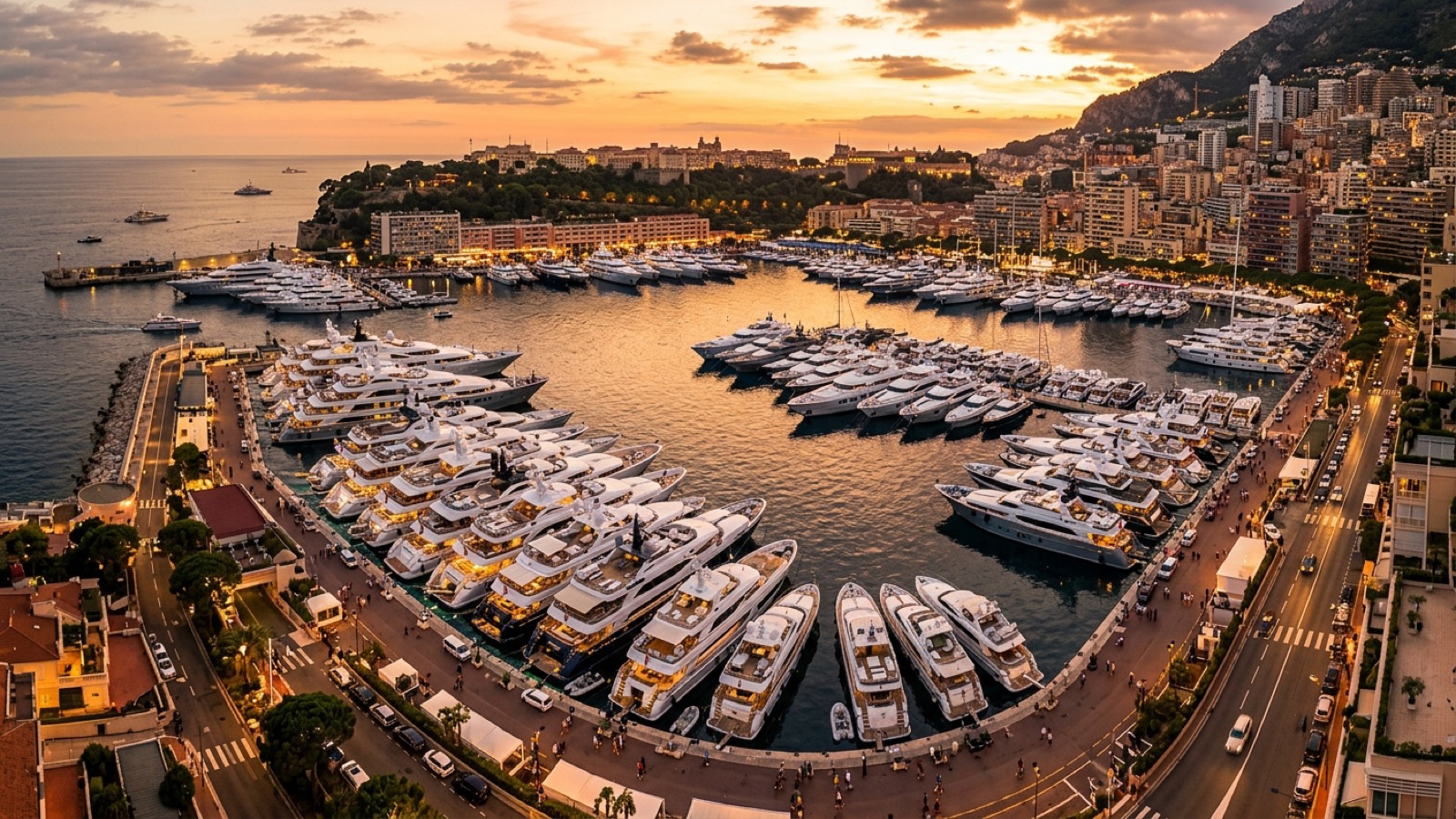
For three decades the Mediterranean has functioned as the world's de facto showroom for the largest privately owned vessels afloat. From the Principality of Monaco to the granite inlets of the Costa Smeralda, a finite ribbon of deep-water quay has absorbed an ever-expanding fleet of motor yachts. In the summer of 2026, that elasticity has finally run out. The arithmetic is no longer subtle: the fleet is growing several times faster than the berths built to hold it, and for the first time the constraint is shaping not only what owners pay, but where, when and whether they cruise at all.
This is not a story about a poor season. Demand for Mediterranean charter and ownership remains conspicuously strong heading into 2026. It is a story about a structural ceiling. The most coveted addresses on the water, Port Hercule, Port Vauban, Marina di Porto Cervo and the old port of Saint-Tropez, are effectively full, operate waiting lists through the peak window, and have done so for several consecutive years. What has changed is the speed at which the gap between hulls and homes is widening, and the consequences that are now flowing into freehold prices, multi-year contracts and the quiet recalibration of cruising itineraries by the people who can afford to ignore almost everything except physics.
The arithmetic of scarcity
Begin with the fleet. As of the start of August 2025 there were 6,174 superyachts over 30 metres in operation worldwide, split between 5,259 motor yachts and 915 sailing yachts. The order book confirms the trajectory rather than questioning it. The 2026 Global Order Book lists 1,093 projects in build or on contract, a 3.9 per cent increase on the prior year, and 2025 alone saw roughly 250 to 300 new vessels delivered, including ten over 100 metres. Brokerage was equally buoyant: some 470 superyachts changed hands in 2025, a 19.8 per cent jump on 2024.
Now set that against the shoreline. The supply of deep-water, full-service berths in the prime Mediterranean clusters has barely moved. New marina capacity is being built, but overwhelmingly outside the established Riviera and Sardinian honeypots, and almost never at the scale required to absorb a fleet expanding by hundreds of hulls a year. The result is a compounding mismatch. Every delivery season adds vessels that will, sooner or later, want a summer home in the same forty-kilometre arc between Monaco and Saint-Tropez, or in the same handful of Sardinian and Balearic enclaves. The quay does not lengthen to meet them.
The squeeze is not uniform across sizes, and this is where many owners are caught out. Industry analysts are blunt that the sub-45-metre segment is the most oversubscribed: it is the fastest-growing part of the delivered fleet, yet it competes for berths that smaller, older yachts already occupy and rarely vacate. Counter-intuitively, the very largest berths, those configured for 80-metre-plus vessels, are in some respects less acutely deficient, because they are fewer, more expensive and serve a smaller cohort of owners who tend to secure tenure years in advance. The pain is most intense in the middle and upper-middle of the market, precisely where most 2026 deliveries land.
The map of the squeeze
Scarcity in the Mediterranean is geographically concentrated. A handful of names account for the overwhelming majority of the pressure, and each operates by its own rules.
Monaco — Port Hercule and Fontvieille
Monaco remains the apex address, and the most structurally constrained. The Principality's two harbours, Port Hercule and the smaller Fontvieille, are state assets: berths there are not sold freehold to private owners but allocated, and the waiting environment is permanent rather than seasonal. Peak-summer berthing for even a modest vessel runs from roughly €700 to €1,200 per day for a yacht in the 20-metre range, and a premium position for a larger yacht in high season can exceed €5,000 per night. During the Grand Prix, supply effectively ceases to exist at any price for those without standing arrangements; the few transient berths that surface trade at multiples of the headline rate and are spoken for a year ahead.
Antibes — Port Vauban and the IYCA "Billionaires' Quay"
Antibes illustrates what happens when scarcity is financialised. Port Vauban is split between a public harbour and the private quay of the International Yacht Club of Antibes, the so-called Quai des Milliardaires, which holds the deepest berths on the Côte d'Azur and can accommodate the largest yachts in the world. Here, tenure is bought rather than rented. Leasehold positions have traded from a few hundred thousand euros for modest berths to well over €10–20 million for 50-metre-plus positions, with terms typically running to 2031 or 2041.
The most instructive recent data point is Bill Gates. His holding company secured two of the marquee positions, a 140-metre berth and a 70-metre berth, for a reported sum of around €63 million (roughly $80 million) on a long lease. When the hydrogen-yacht project tied to those berths unravelled, the spaces returned to the market, a reminder that at the very top, a berth has become an asset class in its own right, traded, repriced and speculated upon independently of the vessel it was meant to serve.
Porto Cervo and the Costa Smeralda
Sardinia's Marina di Porto Cervo is the eastern anchor of the prime cluster and arguably the most fashion-driven. Peak-season berthing for a yacht in the high-teens of metres runs from roughly €500 to €900 per day, and August positions for larger vessels are subject to waiting lists and substantial premiums. Porto Cervo's constraint is partly geographic, the Costa Smeralda is a protected, low-density coastline by design, and partly cultural: the marina's prestige depends on exclusivity, which is itself a disincentive to expand capacity.
Saint-Tropez, Capri, Ibiza and the second tier
Saint-Tropez's old port maintains waiting lists throughout the summer and commands top rates precisely because of its scarcity and its events calendar. Capri, Ibiza and the Amalfi anchorages complete the picture: each is a finite, heritage-protected harbour where berth creation is constrained by planning, archaeology or sheer topography. Owners booking 40- to 50-metre yachts for July and August are now routinely advised to anticipate not only premium pricing but the genuine possibility of being unable to secure a berth in their first-choice port at all.
The economics, port by port
The table below sets out indicative peak-season figures drawn from current market reporting. Day-rates vary by vessel size, length of stay and the precise position within each harbour; freehold and lease figures reflect recent transactions rather than list prices.
| Location | Tenure model | Indicative peak-season cost | Defining constraint |
|---|---|---|---|
| Monaco — Port Hercule | State allocation / transient | €700–€1,200/day (~20m); €5,000+/night for larger yachts | State-owned, permanent waiting list, Grand Prix lock-out |
| Antibes — IYCA (Billionaires' Quay) | Private leasehold for sale | From a few €100k to €10–20M+ for 50m+; ~€63M for the 140m + 70m Gates positions | Deepest Riviera berths, finite and traded as assets |
| Porto Cervo — Marina di Porto Cervo | Seasonal / annual contract | €500–€900/day (~18m); August premiums on larger berths | Protected coastline, exclusivity by design |
| Saint-Tropez — Vieux Port | Seasonal / transient | Top-of-market rates; waitlist all summer | Heritage harbour, events-driven peaks |
| Capri / Ibiza / Amalfi | Transient / anchorage | Premium transient where available; many vessels anchor off | Planning and topographical limits on new berths |
Two patterns emerge. First, the cost of a berth is increasingly decoupled from the cost of operating the yacht itself; in the prime ports a season of berthing and the associated logistics can rival a meaningful fraction of annual running costs. Second, the most valuable thing on offer is no longer a nightly rate at all, it is certainty: a guaranteed position, in a named harbour, on a known date.
What is actually driving the shortage
It is tempting to attribute the squeeze to a single post-pandemic demand spike. The reality is a confluence of structural forces, most of which are accelerating rather than fading.
Fleet growth without commensurate quay
The fundamental driver is the simplest. The global fleet has been expanding at a pace that comfortably outstrips berth creation in the prime cruising grounds. With more than 6,000 yachts over 30 metres now in service and over a thousand projects on the order book, even a conservative read implies several hundred net additions to the chasing pool each year. The Mediterranean's prime arc cannot, and in many cases by design will not, lengthen to match.
The shift to larger, beamier hulls
It is not only that there are more yachts; the average yacht is bigger and, critically, beamier. Modern volume-maximised designs carry far more breadth per metre of length than the hulls the older marinas were dimensioned for. A berth nominally rated for a given length may no longer accommodate a contemporary yacht of that length once beam, tender garages and swim platforms are accounted for. In effect, the usable capacity of legacy harbours is shrinking even as their dimensions stay fixed, a hidden contraction layered on top of the visible shortage.
Planning, heritage and environmental limits
The prime Mediterranean ports are, almost without exception, historic harbours embedded in protected coastlines and dense urban fabric. Extending a quay in Monaco, Antibes or Saint-Tropez is a matter of decades, not seasons, and frequently collides with heritage protection, marine-environmental regulation and local political resistance to further yacht-led development. Where new capacity is approved, it is hard-won and expensive, which feeds straight back into the price of a position.
The refit bottleneck
An often-overlooked dimension is the parallel shortage of refit and yard capacity. As the fleet grows and ages, demand for refit slots, themselves occupying deep-water space for months at a time, competes directly with seasonal berthing. A capacity crisis in the refit sector means yachts spend longer in, or waiting for, yard berths, removing further deep-water positions from the cruising pool and tightening the squeeze at the very ports that double as service hubs.
Berths as financial assets
Finally, scarcity has bred speculation. Where berths can be owned or leased long, as at the IYCA, they have become tradable assets whose value is driven as much by anticipated future scarcity as by current utility. Positions are acquired, held and resold by parties for whom the berth is an investment first and a mooring second. This behaviour is rational, but it removes inventory from owners who simply want somewhere to put their yacht, and it ratchets prices in a self-reinforcing loop.
The Western Mediterranean and the search for relief valves
If the Riviera-to-Sardinia arc is the locked core of the market, the wider Mediterranean is where pressure is now being displaced, and where the more pragmatic owners are quietly repositioning. The Balearics, anchored by Palma de Mallorca, function as the western counterweight: a genuine deep-water service hub with real yard capacity, but one that is itself filling rapidly as overflow demand arrives from the French and Italian rivieras. Palma's prime berths now carry their own waiting dynamics, and the islands' summer anchorages off Ibiza and Formentera are subject to tightening environmental restrictions on where and how large vessels may lie.
To the east, the Greek islands and the Adriatic have absorbed a meaningful share of the cruising fleet, helped by liberalised charter regulation in Greek waters and the sheer abundance of coastline. Yet here the constraint inverts: the cruising grounds are spacious, but full-service superyacht berths, fuel, provisioning and crew logistics at the standard the prime ports take for granted, remain comparatively thin. An owner who relocates east to escape the Riviera squeeze trades a berth problem for a logistics one. The lesson the market is internalising is that there is no free relief valve. Each alternative carries a cost in capacity, in service depth or in the very exclusivity that drew owners to the Mediterranean in the first place.
This displacement is reshaping the geography of value. A decade ago, prestige was concentrated almost entirely in the Monaco-Antibes-Saint-Tropez triangle. Today, the smart-money definition of a good season increasingly includes a credible, well-serviced home port outside that triangle, used as a base from which the marquee harbours are visited rather than inhabited. The triangle retains its glamour; it is simply no longer a place a sane owner relies upon for a guaranteed bed.
The hidden line items: crew, provisioning and logistics
Berth scarcity is rarely a standalone cost. It cascades into the entire shore-side operation of a yacht, and the cascade is expensive. A vessel denied a berth in its preferred port and forced to anchor off, or to base further away, incurs higher tender mileage, longer crew hours, more complex provisioning runs and the logistical friction of moving guests, supplies and staff across greater distances. Provisioning a yacht lying at anchor off Capri is materially harder than provisioning one berthed stern-to in a serviced marina, and the difference is borne by the crew and ultimately by the owner.
The crew dimension compounds this. A tight berth market interacts with an already-stretched market for experienced crew, captains, chief stewardesses and engineers who can manage a complex shore-side operation under constraint. When a yacht's logistics become harder, the premium on the people who can execute them flawlessly rises. The berth shortage, in other words, is not merely a line item on a marina invoice; it is a multiplier on the cost and difficulty of running a large yacht in the Mediterranean at all, and it rewards owners who plan the whole operation, berth, crew, provisioning and itinerary, as a single integrated problem rather than a sequence of separate purchases.
The charter knock-on
The berth shortage does not stay contained within the ownership market; it reshapes charter too. Charter demand for summer 2026 is running hot, with strong booking pressure on the 40- to 50-metre bracket. But a charter is only as good as its itinerary, and an itinerary is only as good as the berths it can secure. Charter managers are increasingly building programmes around berth availability rather than around the guest's first-choice ports, and advising clients to commit six to twelve months ahead for peak-season cruising in the marquee harbours, longer still for itineraries that touch the Monaco Grand Prix, the Cannes Film Festival or the Sardinian August.
The practical consequence is a subtle homogenisation risk: when everyone is routed to the same handful of available berths on the same dates, the exclusivity that justified the charter in the first place erodes. The premium, increasingly, attaches not to the yacht but to the access, the relationships and standing arrangements that put a guest alongside in Porto Cervo on the second weekend of August when the public waiting list closed months earlier.
New supply is coming — but not where it is needed
Capital is responding to the shortage, as it should. A wave of marina development is underway. Marina Livorno in Italy, backed by some €15 million from the Azimut-Benetti group, is scheduled to open in 2026 with 815 berths. In the Caribbean, a new Anguilla marina will offer 118 berths for vessels up to 260 feet alongside a hotel and full yacht services, and comparable projects are advancing from Gibraltar to Kobe.
This is welcome, and over time it will relieve pressure on the global system. But it is important to be clear-eyed about what it does and does not solve. Livorno is a Tuscan service-and-transit hub, not a substitute for a August berth in Porto Cervo. Caribbean and Asia-Pacific capacity addresses other oceans and other seasons. None of it lengthens the quay at Port Hercule, creates a new Billionaires' Quay in Antibes, or expands the old port of Saint-Tropez. The new supply rebalances the periphery; the core scarcity, the prime Mediterranean arc in peak season, is precisely the thing that cannot easily be built more of. For the owners who care about that core, the shortage is a long-term condition to be managed, not a cyclical inconvenience to be waited out.
How sophisticated owners are responding
The owners and family offices who navigate this best treat the berth not as an afterthought to the yacht purchase but as a strategic asset to be secured first and held deliberately. Several patterns are now established practice at the top of the market.
- Secure tenure before the hull. Increasingly, a long-term berth or leasehold position is arranged in parallel with, or even ahead of, a new build or acquisition. A 55-metre yacht with no guaranteed Mediterranean home is a depreciating logistics problem; the same yacht with a named IYCA position is a complete proposition.
- Multi-year and annual contracts over transient. Where freehold is unavailable, multi-season annual contracts lock in both price and certainty, insulating the owner from the spot-market volatility and waiting lists that govern transient berthing.
- Home-port strategy. Choosing a less saturated base, a Ligurian or Tuscan home port, a Balearic anchorage, a Greek hub, and treating the marquee harbours as occasional destinations rather than the permanent address, materially de-risks a season.
- Anchorage and tender-led cruising. A growing cohort simply declines to compete for the scarcest quays, anchoring off Capri, Pampelonne or the Sardinian coast and running guests ashore by tender. For many itineraries this is not a compromise but a deliberate preference for privacy.
- Relationship capital. In a market where the binding constraint is access rather than money, the standing relationships held by an experienced advisor, with harbour masters, marina managers and the small world of berth brokers, are frequently worth more than the marginal euro.
The outlook for 2026 and beyond
There is no near-term resolution to the prime-Mediterranean berth shortage, because its causes are structural and most of them are intensifying. The fleet will keep growing; yachts will keep getting beamier; heritage harbours will not expand at the pace required; the refit bottleneck will persist; and berths in the few places where they can be owned will continue to be treated as appreciating assets. New marinas will open, and they will help, but they will help the periphery first and the core last, if at all.
For owners, the implication is a change of posture. The Mediterranean summer is no longer something one books; it is something one positions for, years ahead, through tenure, relationships and a willingness to think about the shoreline as carefully as the vessel. The yachts that will move freely through the 2026 season and the seasons that follow are not necessarily the largest or the newest. They are the ones whose owners understood, earlier than their peers, that in a finite sea the scarcest luxury is no longer the boat. It is the place to put it.
Secure Your Place on the Water
Obsidian Helm advises a small circle of principals and family offices on berth strategy, tenure and access across the prime Mediterranean ports. If certainty matters more than the spot market, request a confidential conversation with a private advisor.
Request Your InvitationFrequently asked
Why is there a Mediterranean superyacht berth shortage in 2026?
The global fleet of yachts over 30 metres now exceeds 6,000 hulls and is growing by several hundred a year, while the prime Mediterranean harbours, Monaco, Antibes, Porto Cervo and Saint-Tropez, are heritage-constrained and cannot expand at a comparable pace. Beamier modern hulls, a parallel refit-capacity crunch and the treatment of berths as financial assets all tighten the squeeze further.
How much does a superyacht berth cost in Monaco or Porto Cervo in peak season?
Indicative peak-season berthing in Monaco's Port Hercule runs from roughly €700 to €1,200 per day for a yacht around 20 metres, with premium positions for larger yachts exceeding €5,000 per night. Porto Cervo charges roughly €500 to €900 per day for a yacht in the high teens of metres, with substantial August premiums and waiting lists for larger berths.
Can you buy a superyacht berth on the French Riviera?
In Monaco, no, the harbours are state assets and berths are allocated rather than sold freehold. In Antibes, yes: the private IYCA quay, the Quai des Milliardaires, sells long leasehold positions. These have traded from a few hundred thousand euros to well over €10 to €20 million for 50-metre-plus berths, with Bill Gates reportedly paying around €63 million for two marquee positions.
Which Mediterranean berth sizes are hardest to secure?
The sub-45-metre bracket is the most oversubscribed, because it is the fastest-growing part of the delivered fleet and competes for berths that smaller, older yachts rarely vacate. Very large berths above 80 metres are fewer but, in relative terms, somewhat less deficient because their owners tend to secure tenure years in advance.
Will new marina developments solve the shortage?
Only partially. New capacity such as Marina Livorno's 815 berths opening in 2026, and major projects in the Caribbean and Asia-Pacific, will ease pressure on the wider system. But they do not add quay at Port Hercule, the IYCA in Antibes or the old port of Saint-Tropez, so the core peak-season scarcity in the prime Mediterranean arc is expected to persist.