
Estate Management Technology: Running the House as One System
On a property of scale, audio-visual, lighting, security, climate and networking are usually bought from five vendors who never speak to one another. Estate management technology, done properly, is the discipline of making them answer to one architecture instead.
Estate Management Technology, Defined
Ask five integrators what “estate management technology” means and you will get five different quotes for five different systems that do not speak to one another. That is precisely the problem. On a property of scale — a primary residence, a guest house, a staff wing, a pool house, a dock — audio-visual, lighting, security, climate and networking are usually purchased from separate vendors, installed on separate schedules, and left on separate service contracts. The lighting company does not know what the security integrator did to the network. The AV crew’s processor often sits on the same flat network as the nursery camera. Nobody owns the whole.
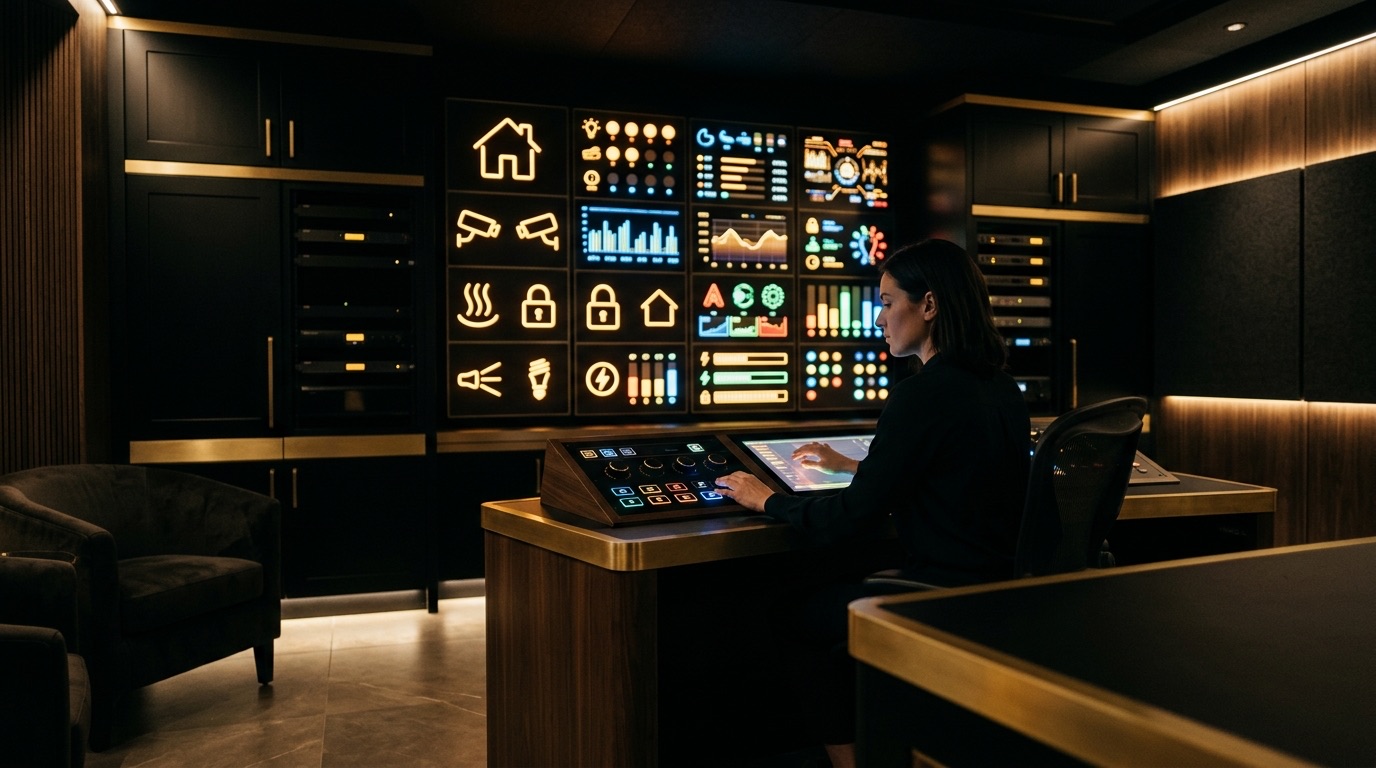
Properly understood, estate management technology is not a shopping list of gadgets; it is the operating layer of the house — one architecture that lighting scenes, climate zones, access control, surveillance, audio-visual distribution and the underlying network all report into, governed by a single set of standards rather than five vendors’ separate habits. For a property above roughly $10 million in value, that distinction stops being a nicety and becomes the difference between a house that behaves predictably and one that quietly accumulates blind spots — unpatched firmware, orphaned installer credentials, a guest network bridged into the family’s private one — for years at a time.
The symptoms of a siloed estate are usually visible long before anyone frames the problem correctly. A lighting scene that stops responding after a firmware update no one authorised. A security app that a former nanny can still open eighteen months after she left. A guest bedroom’s smart speaker with more network reach than the principal’s own laptop. None of these individually reads as a crisis, which is exactly why they persist for years across otherwise well-run households — each vendor assumes the gap is someone else’s responsibility, because on paper, it is.
What It Costs in 2026
Pricing scales with square footage, zone count and the sophistication of the security and AV layers far more than with any single brand choice. The ranges below reflect what is typical across the industry for a professionally executed installation; individual projects move outside them in either direction depending on scope.
| Property Scale | Typical Installed Cost | What’s Included |
|---|---|---|
| 4,000–6,000 sq ft | $60,000–$150,000 | Core lighting, climate and security with a modest AV footprint on one governed network |
| 6,000–10,000 sq ft | $150,000–$400,000 | Full-house AV, integrated shading, perimeter security, guest and staff network zoning |
| 10,000+ sq ft or multi-structure | $400,000–$1M+ | Estate-wide integration across residence, guest house, staff quarters and grounds |
Two costs are routinely underestimated at signing. The first is ongoing maintenance — industry norms run 5 to 10 percent of the installed cost annually, indefinitely, and few owners budget for it at handover. The second is the price of doing nothing: a system installed once and never governed drifts out of a defensible security posture within roughly eighteen months, regardless of how much the initial build cost. Our size-by-size pricing table across every major automation platform lives in our Crestron, Savant and Control4 buyer’s guide, worth reading before any integrator quote is signed.
The Protocol Landscape, Briefly
Underneath every estate system sits a control protocol, and the choice shapes what is possible for a decade. Crestron is the commercial-grade standard for large, complex, staff-run estates that need unlimited customisation. Savant favours a design-led, Apple-like interface with strong energy and power management. Control4 is the pragmatic, widely serviced option with the largest dealer network. Lutron is not a whole-home platform at all but the category’s definitive lighting-and-shading specialist, usually installed beneath one of the three brains above. KNX, the open European standard, remains the native choice for many estates on the Continent. None of these is objectively best — each suits a different estate profile, staffing model and budget, and the decision merits its own analysis rather than a paragraph here. We set out the full head-to-head, with realistic costs and the question integrators rarely answer, in our dedicated platform comparison guide.
What matters for estate management purposes is narrower: whichever protocol an integrator recommends, it must sit inside a governed network architecture, not stand alone as an island only that vendor can reach.
This is also why the protocol conversation, while important, is frequently the wrong first conversation for a family to have. Integrators lead with the brand because that is what they sell; the family’s actual first decision should be who governs the network the brand’s hardware will live on, since that answer holds regardless of which processor ends up in the equipment rack.
Setting Up the Network Correctly
Almost every estate technology failure we are asked to diagnose traces back to one root cause: a flat network, where the security cameras, the guest Wi-Fi, a staff laptop, a smart thermostat and the family’s private devices all share the same broadcast domain. A single compromised light bulb, or one unvetted guest device, then has a direct path to the family’s financial accounts and private files. A correctly designed estate network segments traffic into isolated VLANs from day one:
- Owner and family — private devices and personal accounts, never bridged to any other segment
- Household staff — work devices and estate-management apps, scoped to what each role actually requires
- Guests — internet-only access, time-limited, with no visibility into any other segment
- IoT and building systems — cameras, lighting processors, climate controllers and AV gear, isolated from every other segment and, where possible, from each other
Each segment needs its own credentials, its own firewall rules governing what may talk to what, and continuous monitoring rather than a one-time configuration at install. This is infrastructure-grade networking applied to a residence, and it is precisely the layer most estate technology budgets skip in favour of another touch panel. It is also the layer that determines whether a compromised smart-home device stays a nuisance or becomes a route into the family’s private life.
One Accountable Party, Not Another Installer
The recurring failure across the estates we are asked to review is rarely any single vendor’s workmanship — it is the absence of anyone accountable for the system as a whole. The AV integrator answers for AV. The security company answers for cameras. The network, if anyone owns it at all, is whichever installer configured it last. Obsidian Helm does not compete with any of these trades and installs no hardware. Our mandate is the layer above them: auditing what has already been built, segmenting and governing the network it runs on, supervising every vendor with access to the estate, and remaining the single point of accountability long after the installers have moved to their next project. That mandate extends across the household’s full technology and security posture through our concierge IT and personal cybersecurity practices — both operated fully remotely, worldwide, under NDA.
For a family evaluating a new build, a renovation, or an existing system that has never been independently reviewed, the sequence that works is simple: define the governance and network architecture first, select the automation platform and integrator second, and retain an accountable party who outlives every vendor’s warranty third. Estates that build in this order rarely call us to fix a breach. Estates that build in the opposite order usually do.
Begin With a Private Strategy Session
Before you commission a system — or after your integrators have gone quiet — an independent review of your estate's technology, network and vendors. The $4,999 Private Strategy Session is credited in full toward membership.
Request Your InvitationFrequently asked
What does estate management technology actually include?
It is the operating layer that unifies audio-visual, lighting, security, climate and networking into one governed architecture, rather than five separate vendor systems that never communicate. On a property above roughly $10 million, that unification determines whether the house behaves predictably or quietly accumulates security blind spots over time.
How much does a smart home installer cost in 2026?
Typical installed costs run $60,000 to $150,000 for a 4,000 to 6,000 square foot residence, $150,000 to $400,000 for 6,000 to 10,000 square feet with fuller AV and shading, and $400,000 to $1M or more for a 10,000-plus square foot or multi-structure estate. These are industry-typical ranges; individual projects move outside them depending on scope.
Which home automation protocol is right for a large estate?
There is no single correct answer — Crestron suits staff-run estates needing unlimited customisation, Savant suits design-led residences with energy-management needs, Control4 suits value-conscious projects, and Lutron and KNX serve specialist lighting and European-market roles respectively. Our full platform comparison walks through the decision criteria in detail.
What determines a smart home system's price?
Square footage, the number of automated zones, and the sophistication of the security and AV layers drive cost far more than any single brand choice. Ongoing maintenance, typically 5 to 10 percent of the installed cost annually, is the expense most owners underestimate at handover.
How should a home network be set up for a large estate?
Traffic should be segmented into isolated VLANs for owner and family devices, household staff, guests, and IoT or building systems, each with its own credentials and firewall rules. A flat network, where cameras and family devices share one broadcast domain, is the single most common root cause of estate technology breaches.