What High-Profile Yacht Owners Get Wrong About Privacy
Most owners at this level already know their yacht can be tracked. Very few have actually separated the exposure they're stuck with by law from the exposure their own crew and guests are creating for free.
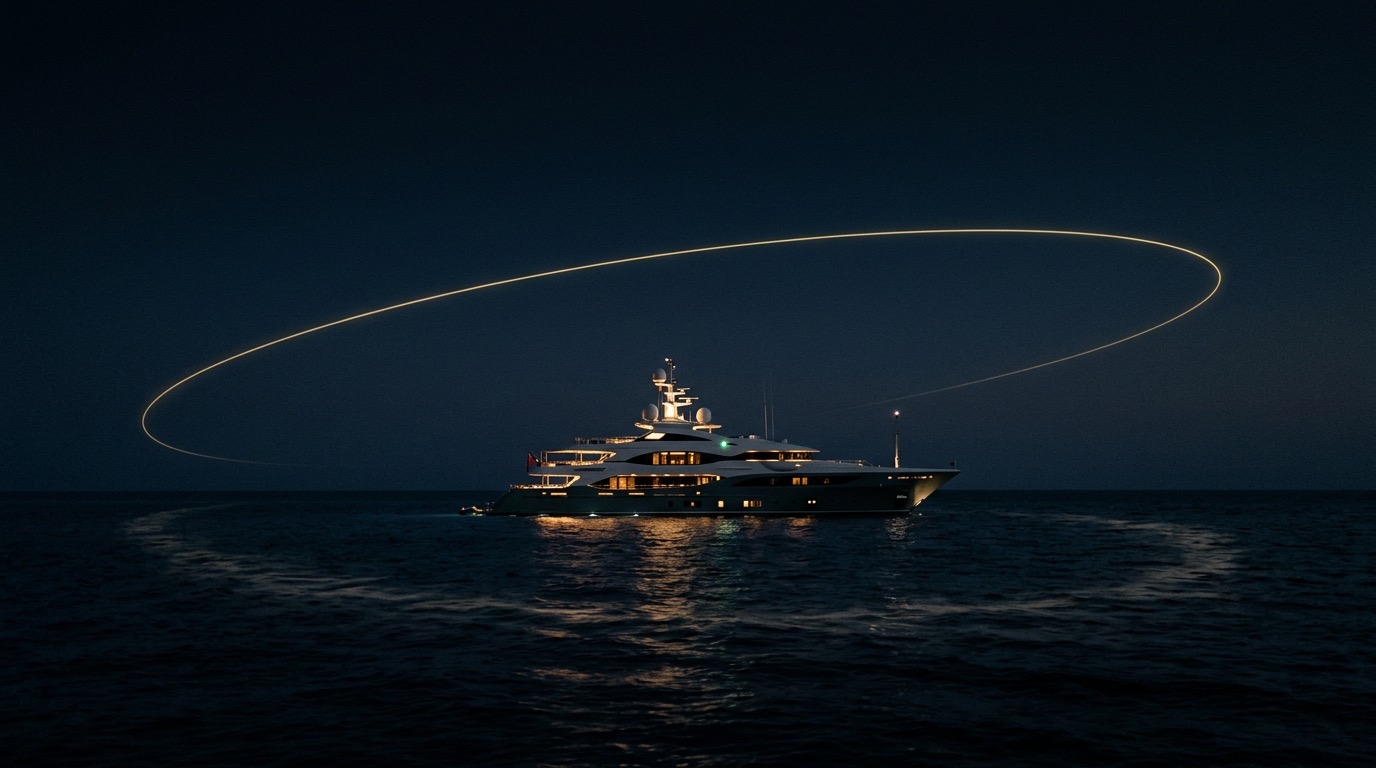
The story is by now familiar enough to be a genre unto itself: a superyacht linked to a well-known owner turns up in the news not because of anything happening aboard, but because a public tracking account, a drone photographer, or a crew member's Instagram story revealed exactly where it was. Jeff Bezos's yacht Koru made headlines in 2022 largely for its size and for the widely reported logistics of its launch in Rotterdam, which required the temporary — and briefly controversial — partial dismantling of a historic bridge to get the vessel out to open water. That story travelled because a hull that size is inherently newsworthy, but it's a useful illustration of a point that has nothing to do with any single owner: a vessel large enough to be worth owning is, by the same physics and the same maritime regulation, large enough to be extremely difficult to keep private.
That's the part high-profile owners consistently underestimate. Yacht privacy isn't primarily a question of who might be watching — it's a question of which exposure vectors are baked into owning and operating a large vessel at all, several of which cannot legally be switched off. Understanding those vectors, and building a real defense framework around the ones you can actually control, is the difference between privacy as an aspiration and privacy as an operating discipline.
The three vectors that expose a yacht
Nearly every privacy incident involving a high-profile vessel traces back to one of three sources, and they behave very differently under the law.
| Vector | Legal status | What actually happens |
|---|---|---|
| AIS transponder tracking | Mandatory under SOLAS for most vessels this size; cannot legally be disabled outside a genuine safety emergency | Position, speed and heading broadcast in the clear, aggregated by public sites like MarineTraffic and VesselFinder in near real time |
| Paparazzi and hobbyist drone photography | Generally lawful from international waters or public airspace, subject to local aviation and privacy rules | Long-lens or drone imagery of the vessel, guests and layout, often published without the owner ever being contacted |
| Crew and guest social-media geotagging | Governed entirely by contract and policy, not public law | A single geotagged photo, story or check-in from a crew member or guest reveals location, itinerary or interior details instantly |
The first vector is a legal fact of ownership. The second is largely outside anyone's control once a vessel is visible from open water or public airspace. The third is the only one that sits fully within an owner's power to prevent — and in our experience, it's also the one most often left completely unaddressed.
Why AIS is the exposure most owners misunderstand
The Safety of Life at Sea convention requires Automatic Identification System transponders on vessels of 300 gross tons or more making international voyages, and on all passenger ships regardless of size. That signal isn't a private feed reserved for coastal authorities — it's broadcast openly, and a global network of coastal and satellite receiving stations, many run by volunteer hobbyists, feeds it directly into public tracking sites. This is precisely the mechanism that made public tracking of sanctioned vessels a widely covered story in 2022, and it works exactly the same way on any large yacht, whatever the owner's profile.
Owners sometimes ask a captain to simply switch the transponder off for privacy. In most jurisdictions and under most flag-state rules, that isn't a legal option outside a genuine safety or security emergency, and doing it anyway creates real collision-risk and regulatory exposure that outweighs whatever privacy is gained. Our companion piece, Yacht Tracking Privacy: The AIS Problem, covers the mechanics of AIS aggregation and the narrow, legitimate options — including flag-state MMSI handling and tender-level Class B behavior — that exist within the rules.
The vector owners can actually close
Drone photography and AIS aggregation are largely environmental risk: reducible at the margins, but not something you can make disappear. Crew and guest digital behavior is different. It's a governance problem, and governance problems have real solutions.
- A written crew digital-hygiene policy, built into the employment contract rather than a verbal request, prohibiting geotagged posts, real-time stories and identifiable interior photography without written owner approval.
- Guest briefings before boarding, treating phone geotagging the way a security team already treats a guest list — as something actively managed, not assumed to be handled.
- Device and network segmentation onboard, so crew and guest devices sit on a separate, monitored network from bridge, navigation and owner systems, with location metadata stripped from anything transiting the vessel's own connectivity.
- A single accountable owner for the policy — usually the captain or chief stew — rather than an assumption that everyone already knows better.
None of this is exotic. It's the same executive-protection discipline UHNW families already apply to residences and travel, applied consistently to a vessel that spends much of its life in public view. We cover the broader version of this framework, jets included, in UHNW Doxxing: Jet & Yacht Tracking Defense.
The AIS signal was never the leak. The geotagged photo almost always was.
What high-profile owners get wrong
The recurring mistake isn't ignorance of AIS or drones — most owners at this level already know both exist. It's misallocating the defense budget toward the vector that's hardest to change (public tracking, public airspace) and away from the one that's actually governable: crew and guest devices. We've reviewed vessels with six-figure security and connectivity spend and no written social-media policy for crew at all — the single cheapest, highest-leverage control in the entire framework, left undone.
The second mistake is treating privacy as a one-time technical fix rather than an ongoing operating discipline that has to be re-briefed every charter, every guest list and every crew change. A policy that existed at delivery and was never revisited again is functionally the same as no policy at all by year three.
Building the framework properly
A real yacht privacy architecture combines what the law actually allows on the tracking side with disciplined governance on the human side: legitimate AIS and flag-state options where they exist, network segmentation that keeps guest and crew connectivity separate from vessel systems, and a written, enforced digital-hygiene policy for everyone who steps aboard. Obsidian Helm builds this assessment into every vessel engagement as part of our Yacht & Jet practice, alongside the wider Concierge IT membership that keeps the policy current as crew and guests change.
Get a Real Privacy and Tracking-Defense Architecture, Not Just a Policy Document
A $4,999 Private Strategy Session assesses your vessel's AIS posture, network segmentation and crew digital-hygiene gaps, and delivers a defense architecture built around what's actually fixable — credited toward membership.
Request Your InvitationFrequently asked
Can a yacht legally turn off its AIS transponder for privacy?
Generally no. SOLAS requires AIS transponders on most vessels of this size making international voyages, and switching it off outside a genuine safety or security emergency isn't a legal option in most jurisdictions or under most flag-state rules.
Is it actually legal for websites to track and publish yacht positions?
Yes. AIS signals are broadcast openly as a maritime safety requirement, and sites like MarineTraffic and VesselFinder simply aggregate that public data from a global network of receiving stations, much of it run by volunteer hobbyists.
What's the single biggest privacy risk high-profile owners overlook?
Crew and guest social-media geotagging. Unlike AIS tracking or drone photography, it's fully within an owner's control to prevent through contract and policy, yet it's the vector most often left with no written rules at all.
Can paparazzi or hobbyists legally photograph a yacht using a drone?
Often yes, from international waters or public airspace and subject to local aviation and privacy rules. It's largely environmental risk that can be reduced at the margins but not eliminated, which is why the defense budget is better spent elsewhere.
What does a real yacht privacy defense framework actually include?
Legitimate AIS and flag-state handling where it exists, network segmentation that separates crew and guest devices from vessel systems, and a written, enforced digital-hygiene policy covering geotagging and onboard photography for everyone who steps aboard.