Following your yacht between the Mediterranean and the Caribbean or the US East Coast is a genuinely different mission than a typical business jet trip. Here is how the four real ultra-long-range aircraft compare on range, cabin comfort for family and staff, and whether owning one even makes financial sense if you only fly it a few times a season.
Most private jet comparison content is written for the wrong mission. Cross-country charter guides compare super-midsize cabins on 2,000-3,000nm domestic hops, which is not what a superyacht owner needs twice a year when the vessel repositions from the Mediterranean to the Caribbean for winter and back again for the summer charter and cruising season. That mission is a genuine ocean crossing, usually with family, close staff or security aboard, often against a headwind, and frequently timed to land within a day or two of the yacht's own arrival.
Only a handful of aircraft in production today are actually built for that job without a fuel stop. This briefing compares the four that come up most often in owner and broker conversations, Gulfstream's G700 and G650ER, Bombardier's Global 7500 and Dassault's Falcon 8X, on the dimensions that actually matter for this specific trip: real transatlantic range under realistic conditions, cabin size for a full traveling party, and whether outright ownership even makes sense if the only real mission is following the yacht a few times a year.
Manufacturer range figures are quoted at long-range cruise speed with a handful of passengers, favorable winds and NBAA IFR reserves already baked in, which is generous compared to how these jets actually fly on a real repositioning day. Westbound legs from the Mediterranean toward the Caribbean or Florida, typically flown in October and November ahead of winter cruising, run directly into the winter jet stream, and a headwind of 80-120 knots is common at cruise altitude. That single factor can cut usable range by several hundred nautical miles versus the brochure number, which is exactly why the true 7,500nm-class aircraft carry a meaningful safety margin that jets rated closer to 6,000nm do not.
Eastbound in spring, from the Caribbean or US East Coast back toward the Mediterranean ahead of the Monaco and Cannes season, the same jet stream becomes a tailwind and shortens flight time by an hour or more on the same city pair. Owners who fly this route twice a year quickly learn that the spring leg is the easy one and the autumn leg is where aircraft selection actually matters.
Gulfstream G700. Gulfstream's current flagship, in service since 2024, rated at roughly 7,500 nautical miles at long-range cruise. It has the tallest and widest cabin cross-section of any purpose-built long-range business jet, standing headroom the full length of the cabin, and a floor plan that typically splits into four to five distinct living areas, so a family, their security detail and the crew can all be aboard without living on top of each other for eight hours. It seats up to 19 and can sleep up to 13 in a full overnight configuration.
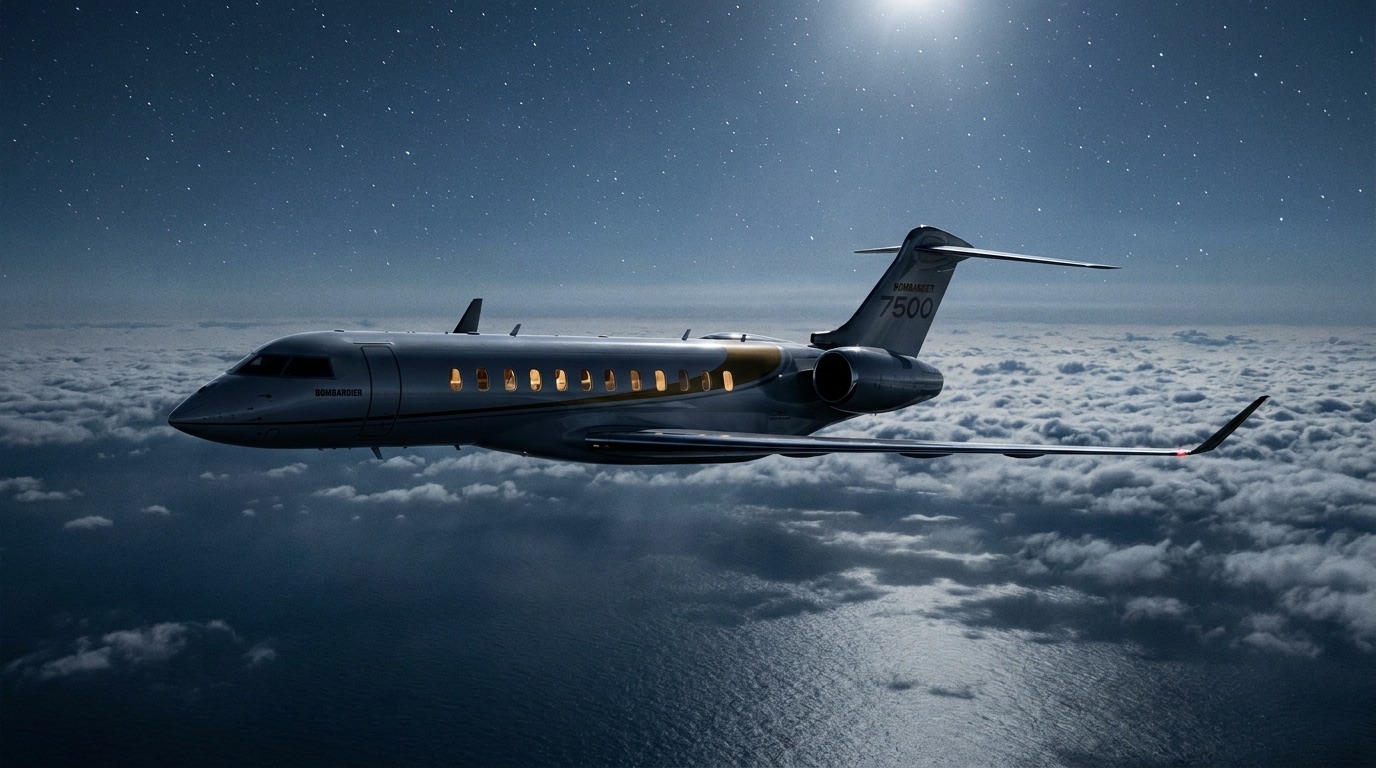
Bombardier Global 7500. The other true flagship in this category, rated at 7,700 nautical miles, the longest published range of the four. Its signature feature is four genuinely separate cabin zones including a dedicated crew rest suite and a full-size bed in the aft stateroom, which matters on a 9-10 hour transatlantic leg when part of the traveling party wants to sleep and part wants to work. Maximum seating is 19, with 8-10 in a comfortable overnight layout.
Dassault Falcon 8X. The shortest-range aircraft of the four at roughly 6,450 nautical miles, but still comfortably covers every Mediterranean-Caribbean city pair an owner is likely to fly, and it holds steep-approach certification that lets it use airports the other three cannot, including London City and Lugano. For owners whose itinerary includes a stop at a shorter or steeper strip near the yacht's cruising grounds, that access matters more than the extra range the other three carry.
Gulfstream G650ER. The extended-range version of Gulfstream's long-serving G650, in production since 2014 and rated at roughly 7,500 nautical miles, essentially matching the G700's range in a smaller-cabin, earlier-generation airframe. Its real advantage is the secondary market: hundreds are in service worldwide, the type is thoroughly proven, and a well-maintained pre-owned G650ER typically costs a fraction of a new G700 while flying the same mission just as reliably.
| Aircraft | Range | Passengers | Nonstop Med-Caribbean capable |
|---|---|---|---|
| Gulfstream G700 | ~7,500 nm | Up to 19 (sleeps 13) | Yes |
| Bombardier Global 7500 | ~7,700 nm | Up to 19 (sleeps 8-10) | Yes |
| Dassault Falcon 8X | ~6,450 nm | Up to 16 (sleeps 4-6) | Yes, with reduced headwind margin |
| Gulfstream G650ER | ~7,500 nm | Up to 19 (sleeps 10) | Yes |
Figures are manufacturer long-range cruise ratings under standard conditions and vary with payload, winds and routing. Confirm current performance against your actual city pair and season with the operator before booking or purchasing.
Nice to Fort Lauderdale, the single most common repositioning pair for owners whose yacht winters in the Bahamas or moves on to the Caribbean, runs roughly 4,300-4,600 nautical miles depending on routing and sits well within reach of all four aircraft, even against a strong autumn headwind. Geneva to St. Maarten, serving owners whose vessel heads to St. Barts, is a similar distance and equally comfortable for the whole group.
The pair that actually separates these aircraft is the longer one: Athens or Mykonos to Miami, closer to 5,600 nautical miles great circle, which starts to erode the margin on the Falcon 8X in a strong winter headwind while remaining a comfortable nonstop for the G700, Global 7500 and G650ER. Owners cruising the eastern Mediterranean who need to close the loop to South Florida in one hop, rather than stopping in the Azores or the Canaries, are exactly the buyers for whom the extra 1,000-1,300 nautical miles of true 7,500nm-plus range earns its keep.
A transatlantic yacht-repositioning flight rarely carries a lean business traveling party. It is usually the owner's family, a nanny or tutor, close personal staff, sometimes a security detail, and occasionally the captain or a senior crew member traveling ahead to prep the vessel. That mix needs distinct zones, not just extra seats: somewhere for children to be children without disturbing a principal on a call, a closed-door stateroom for genuine rest, and a galley that can run a proper meal service across an 8-10 hour crossing.
Full ownership of any aircraft in this class carries fixed costs, crew salaries, hangar, insurance, scheduled maintenance and program enrollment, that typically run into the low seven figures annually before a single hour is flown. That math works cleanly for owners who fly 200-300 hours a year or more across business, family and leisure trips, where the transatlantic yacht legs are simply two or three missions among many. It works poorly for an owner whose only real use case is meeting the yacht each season, since the fixed costs get spread across a handful of flight hours and the effective cost per trip becomes extreme.
For that narrower use case, two paths generally make more sense than ownership. On-demand charter of a heavy-cabin, ultra-long-range aircraft for the specific Med-Caribbean legs means paying only for the hours flown, with no fixed costs between trips, at the price of somewhat less schedule certainty during peak season weeks around Monaco, Fort Lauderdale and Palm Beach boat shows when demand for this aircraft class spikes. A jet card or fractional program covering the G650 or Global class, offered by operators like NetJets and Flexjet among others, splits the difference: a guaranteed number of hours, published peak-day rules, and no aircraft to sell later, in exchange for a per-hour rate above true one-off charter pricing.
The practical rule most brokers use with owners in this exact position: if the transatlantic yacht legs are genuinely the only mission, charter or a jet card almost always beats ownership on total cost. If those legs are additive to an already-active flying schedule, ownership of a G650ER on the pre-owned market, or a new G700 or Global 7500 for owners who want the newest cabin, becomes the more defensible choice.
Whether you're selling a G650ER to move up to a G700, or looking to browse current ultra-long-range inventory before next season's repositioning, our vetted network handles both sides discreetly, under NDA where requested.
Browse Jet Listings List Your JetIndependent guidance. Where we introduce partner brokers or operators, an arrangement may exist — it never changes our advice.
An 8-10 hour transatlantic leg means calls, deal flow and family logins running over the aircraft's onboard connectivity the entire way. Obsidian Helm secures and hardens private jet cabin networks, the same discreet, remote, NDA-covered service we run for the yacht itself, so the flight is not the weak link in your operation.
Yacht, Jet & EstateYes, for aircraft in the ultra-long-range class. City pairs such as Nice to Fort Lauderdale, roughly 4,300-4,600 nautical miles depending on routing, sit comfortably within the rated range of the Gulfstream G700, Bombardier Global 7500, Dassault Falcon 8X and Gulfstream G650ER even after standard IFR fuel reserves. Winter westbound legs against the jet stream eat into that margin, which is where the true 7,500nm-class aircraft show their advantage over jets rated closer to 6,000nm.
The G700 is Gulfstream's current flagship: a longer fuselage, the tallest and widest cabin cross-section in the category, and a higher new-build price. The G650ER is its proven predecessor, in service since 2014, with a deep and liquid pre-owned market and a nearly identical range envelope. Owners buying new gravitate to the G700; owners buying used or on a tighter budget get almost the same mission capability from a G650ER at a fraction of the acquisition cost.
For most owners, no. Full ownership of an ultra-long-range jet only pencils out once total annual flying, not just the transatlantic repositioning legs, reaches roughly 200-300 hours. If your only real mission is following the yacht between the Mediterranean and the Caribbean or US East Coast a few times a season, on-demand charter or a jet card program covering heavy-cabin, ultra-long-range aircraft is almost always the cheaper and more flexible path.
The Dassault Falcon 8X holds steep-approach certification, giving it access to airports like London City and Lugano that the larger-cabin Gulfstream and Bombardier types cannot use. For most Mediterranean yacht hubs, Nice, Geneva, Palma and Athens all take any of the four aircraft without issue, so the Falcon 8X's advantage matters mainly for owners who also want to reach shorter or steeper runways inland.