
Superyacht IT & Cybersecurity for Doha Owners
The Pearl-Qatar's Porto Arabia marina and West Bay's waterfront have become a genuine home base for Gulf superyacht ownership, with Qatari and regional families keeping vessels berthed locally through the mild season and repositioning to the Mediterranean or elsewhere in the Gulf for summer. The vessel's onboard network is usually less protected than the marina it sits in.
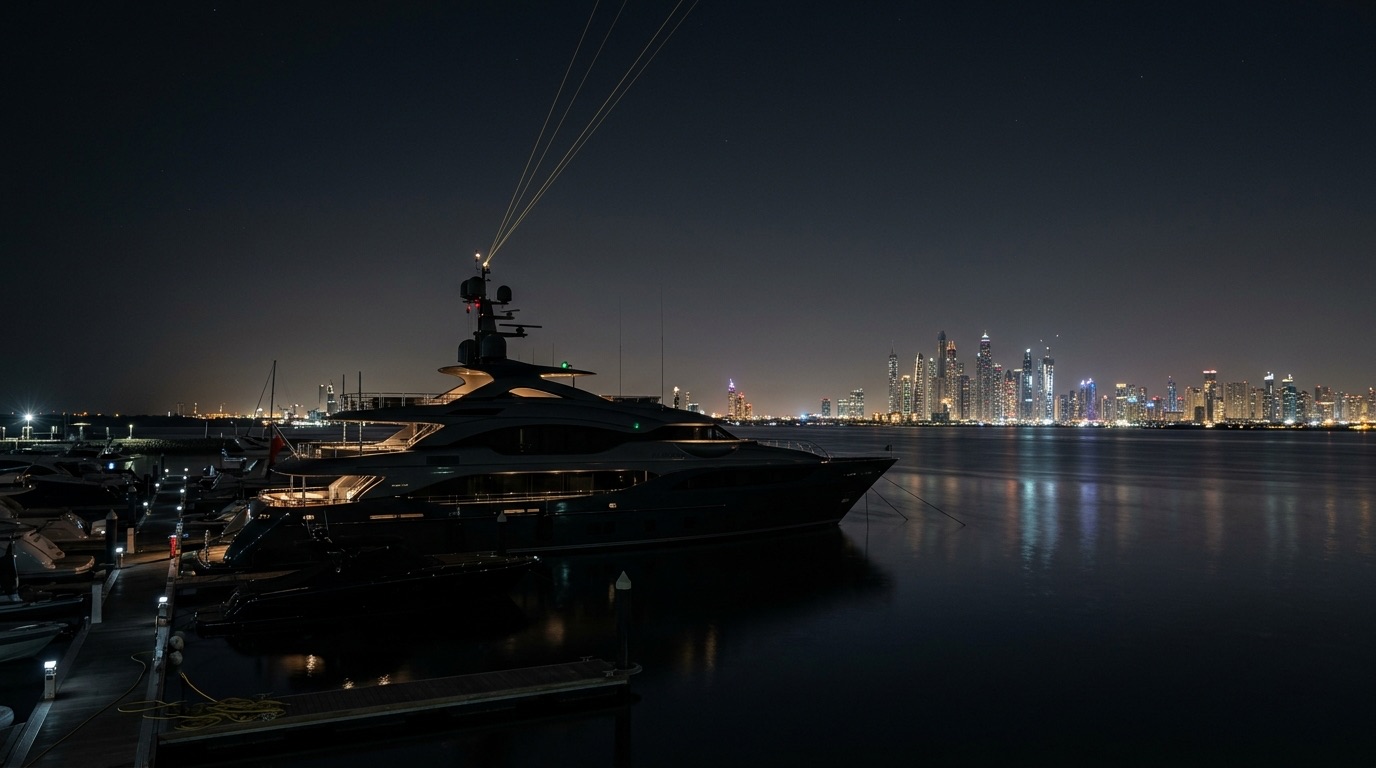
Doha's yacht culture is real, if less discussed than Monaco's or Fort Lauderdale's. The Pearl-Qatar's Porto Arabia development and the West Bay waterfront both host a genuine concentration of Gulf-owned superyachts, many belonging to Qatari families and regional principals whose wealth traces back to LNG and adjacent sovereign enterprise. The pattern is typically seasonal: a vessel based in Doha through the mild months, repositioning to the Mediterranean for summer or joining the broader Gulf winter circuit that also touches Abu Dhabi, Dubai and occasionally the Red Sea. That mobility is precisely what makes onboard IT and cybersecurity a harder problem than it looks.
A vessel that changes cruising ground twice a year accumulates network complexity most owners never see directly. Each marina, each satellite coverage zone, and each set of local crew or contractor devices that connect to the boat's network during a stopover is a potential entry point. AIS transponder data, required for navigational safety, is also broadcast publicly and aggregated by tracking services in the same way ADS-B exposes aircraft — meaning a vessel's location, heading and speed are visible to anyone, at any time it is transmitting, regardless of how discreetly the owner otherwise conducts their affairs.
The onboard network is the real perimeter
Most superyachts in this class carry VSAT connectivity installed by the builder or during a refit, sized for crew operations, entertainment systems and guest Wi-Fi all on the same architecture. That is convenient and, from a security standpoint, exactly the wrong design: navigation and safety systems, crew administration, and a principal's personal devices frequently sit closer together on the network than owners realize. A phishing attempt against a stewardess's tablet or a compromised entertainment system can, on a poorly segmented network, become a path toward the owner's own laptop or the vessel's operational systems.
- Network segmentation onboard — isolated VLANs separating navigation and safety systems, crew administration, guest entertainment, and the owner's personal devices.
- AIS exposure review — assessment of what the vessel broadcasts publicly and where transponder practice can be adjusted within safety and flag-state requirements.
- Multi-jurisdiction connectivity hardening — a consistent security posture that holds whether the vessel is berthed at Porto Arabia, transiting the Gulf, or wintering in the Mediterranean.
- Crew device and contractor access policy — controls for the local technicians, chandlers and marina staff who connect to onboard systems during every stopover.
- Incident response retainer — a named team with a defined SLA, reachable regardless of which time zone or cruising ground the vessel is currently in.
Typical cost ranges
Figures below reflect what is typical for large motor yachts (45–90 metres) based seasonally out of Doha with Mediterranean or wider-Gulf repositioning, framed as industry-representative ranges rather than fixed quotes:
| Service | Typical annual range (US$) | Notes |
|---|---|---|
| VSAT connectivity (multi-band, high-allowance plan) | 80,000 – 300,000 | Scales with vessel size, crew count and entertainment/guest data demand |
| Onboard network segmentation rebuild | 40,000 – 90,000 | One-time build; higher on vessels with older, unsegmented architecture |
| AIS exposure review & transponder practice audit | 8,000 – 20,000 | Technical and flag-state-compliant review, not a registration change |
| Crew & contractor access policy program | 15,000 – 35,000 | Covers onboarding, offboarding and stopover access controls |
| 24/7 incident response retainer | 25,000 – 70,000 | Response SLA typically 15–30 minutes, adjusted for time-zone repositioning |
The repositioning itself is where most gaps appear. A network hardened for Doha operations and then handed off to a Mediterranean-based technician for the summer season, without a consistent policy document and a single accountable team, tends to drift back toward convenience over the following months. Continuity across the seasonal move is as important as the initial build.
Porto Arabia and the realities of a Gulf marina
The Pearl-Qatar's Porto Arabia marina is a working example of how a modern Gulf marina differs from its Mediterranean counterparts: berths sit directly beneath residential towers and retail frontage, meaning a vessel's onboard Wi-Fi and Bluetooth-discoverable systems are within range of thousands of nearby residents and visitors at any given time, not just fellow yacht crews on an isolated pontoon. That proximity makes device discoverability and default-password hygiene on onboard systems — entertainment servers, smart-cabin controls, even crew personal hotspots — a more immediate concern than it would be at a more secluded anchorage.
The handoff between Gulf and Mediterranean cruising grounds is also where satellite coverage itself becomes a variable. Some VSAT plans are contracted with regional coverage limits that were never designed with a Doha-to-Med repositioning in mind, leading to unexpected roaming charges or, worse, a silent drop to a lower-security backup connection somewhere over open water. We build connectivity contracts around the vessel's actual seasonal itinerary from the outset, rather than discovering the coverage gap mid-transit, and we require the same security baseline — segmentation, monitoring, access logging — to travel with the vessel regardless of which satellite beam it happens to be using that week. A policy that only holds in home waters is, in practical terms, no policy at all once the vessel crosses the Suez or rounds into the Red Sea for the season.
Aligned with the aircraft, not separate from it
Most Doha owners with a vessel also maintain private aircraft moving through Hamad International, and treating the two as one security design, rather than two vendor contracts, closes the gap that a device carried between them would otherwise create. Our yacht, jet and estate technology & security page explains how we structure that integration, our private jet hub covers the aviation side specifically, and the personal cybersecurity discipline behind all of it is set out on our cybersecurity page.
A confidential assessment before the next season change
Obsidian Helm advises a limited number of Gulf-based yacht owners and family offices on vessel, aircraft, estate and personal cybersecurity, entirely under NDA. Engagements begin with a $4,999 Private Strategy Session.
Request Your InvitationFrequently asked
What does a superyacht cybersecurity assessment cost for a Doha-based vessel?
A full assessment covering network segmentation, AIS exposure review and crew access policy typically runs $8,000 to $90,000 depending on vessel size and existing architecture. Ongoing connectivity and incident response retainers are priced separately, usually $25,000 to $70,000 a year for large motor yachts. Exact scope is confirmed during the initial Private Strategy Session.
How long does implementation take?
A technical audit and hardening plan typically takes two to three weeks once we have access to the vessel. Full network rebuild, including segmentation and crew access controls, usually takes four to eight weeks depending on whether the vessel is stationary in Doha or already mid-repositioning.
How is this different from the connectivity my management company already provides?
Yacht management companies typically size and install VSAT connectivity for bandwidth and crew operational needs, not security. We assess and rebuild the underlying network architecture, separating navigation, crew, guest and owner traffic, and add exposure review and incident response on top of whatever connectivity plan is already in place.
Can this be arranged without my captain or crew knowing the details?
The captain typically needs to be involved for practical access to the vessel's systems, but the engagement is NDA-bound throughout, and reporting can be structured so that only the owner or a designated family office contact sees the full findings. We routinely work this way with Gulf-based owners who prefer to keep the broader crew unaware of specifics.
Does AIS broadcasting mean my vessel's location is always public?
Yes, whenever the AIS transponder is transmitting, which is required for navigational safety in most waters and cannot simply be switched off without creating a genuine safety and legal issue. What can be adjusted, within flag-state rules, is transponder configuration and reporting practice, which is the kind of review we conduct as part of the exposure assessment rather than a blanket recommendation to go dark.