
Private Jet IT & Cybersecurity for Zurich Principals
For the 16 billionaires and roughly 5,800 UHNW residents of Kusnacht, Zollikon, Kilchberg and Fluntern who fly out of Zurich Airport, the aircraft is the least private room they own unless someone engineers it otherwise.
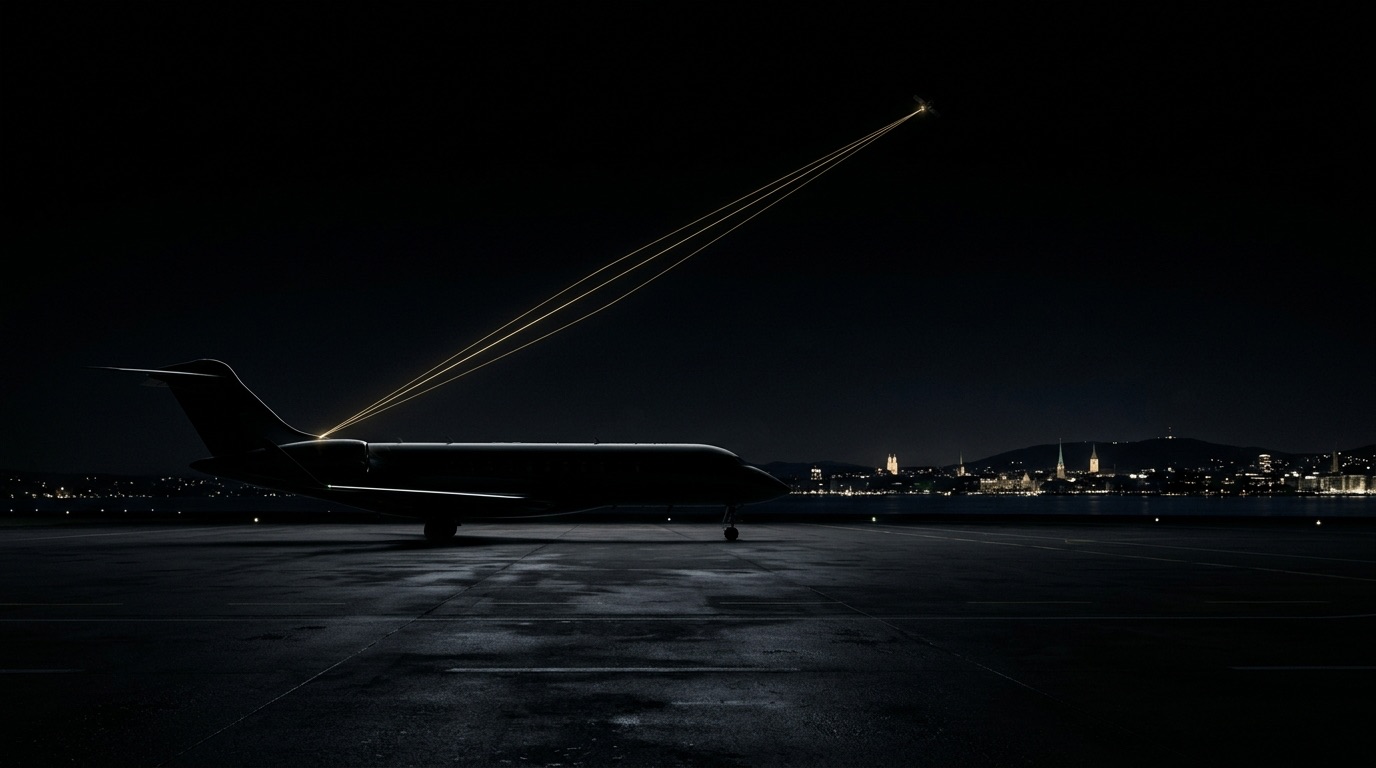
Zurich's private aviation footprint is small by design and large by consequence. Zurich Airport (ZRH) handles the bulk of the canton's business and general aviation traffic, with dedicated FBO handling for the lakeside families of Kusnacht, Zollikon, Kilchberg and Fluntern who make up the densest concentration of private wealth in Switzerland outside Geneva. Roughly 5,800 individuals in the greater Zurich area qualify as UHNW, among them 16 billionaires whose holding structures sit a short drive from the gate. For this community, the jet is not a lifestyle asset. It is a mobile extension of a private bank's back office, and it is treated with less technical rigor than the office it replaces.
That gap matters more in Zurich than almost anywhere else, because the city's entire commercial identity rests on confidentiality. A principal who has spent decades ensuring that a private banking relationship, a family trust structure, or a board seat stays out of public view will often board an aircraft whose cabin Wi-Fi, satellite terminal and crew tablets have never been audited by anyone who understands adversarial threat models. The aircraft's ADS-B transponder broadcasts tail number, position, altitude and speed to any of a dozen free flight-tracking services in real time, turning a jet registered to a holding company into a public breadcrumb trail connecting a Zurich departure to a Geneva board meeting, a Cayman fund closing, or a discreet medical visit abroad.
What actually needs securing on a Zurich-based aircraft
Three systems on a typical Zurich-operated jet create exposure that has nothing to do with the airframe itself:
- Cabin connectivity. Ka-band and Ku-band satellite systems (Gogo, Starlink Aviation, Viasat) route passenger internet through shared infrastructure that, unsegmented, sits on the same network as crew devices, avionics diagnostic ports and any guest who asks for the Wi-Fi password. A single compromised laptop belonging to a guest can become a pivot point into files a principal assumed were air-gapped by altitude alone.
- ADS-B and flight-tracking exposure. Public feeds like Flightradar24 and ADS-B Exchange rebroadcast every unencrypted transponder signal. Registration under a personal name or an obviously linked holding entity, combined with a predictable Zurich-to-somewhere pattern, is enough for a determined journalist, activist, or worse, to establish a movement profile within days.
- Crew and ground-handling devices. FBO Wi-Fi at Zurich, catering coordination apps and crew scheduling software are frequently the weakest link, since they are chosen for operational convenience rather than security posture.
Typical connectivity and cybersecurity investment
Costs vary with aircraft size and mission profile, but the ranges below reflect what family offices in the Zurich area typically budget once they move from ad hoc IT support to a properly engineered aircraft network.
| Service | Typical Annual Range (CHF) | Notes |
|---|---|---|
| Satellite connectivity (Ka-band, mid-cabin jet) | 45,000 - 120,000 | Depends on data volume and hours flown; Starlink Aviation has compressed pricing but not risk |
| Segmented cabin network build-out | 25,000 - 60,000 (one-time) | Separates crew/avionics/guest traffic into isolated VLANs |
| Flight-tracking obfuscation program | 8,000 - 20,000 / year | LADD/BARR-equivalent filing management, registration structuring review |
| 24/7 incident response retainer | 15,000 - 40,000 / year | SLA-backed response, typically 15-30 minutes to first contact |
| Annual penetration test, aircraft + ground systems | 18,000 - 35,000 | Covers cabin network, crew devices, FBO handoff points |
Response-time discipline, not just tooling
A cabin network breach or a spoofed crew device does not wait for business hours in Zug or a callback from a generalist IT vendor in Kloten. The engagements we structure for Zurich clients carry a documented SLA: acknowledgment inside 15 minutes, a qualified engineer engaged within 30, and a resolution path communicated within two hours regardless of time zone or whether the aircraft is on the ground at ZRH or halfway to a stopover in Vienna. This is the same discipline covered in more general terms in our private aviation IT and connectivity overview, and it is what separates a managed aircraft network from a Wi-Fi router installed by the completion center.
Where this fits inside a broader estate
Most Zurich principals we work with do not think of the jet in isolation. It is one node connected to a lakeside residence in Kusnacht or Zollikon, a household staff network, and often a lake or Mediterranean vessel managed remotely. The same segmentation logic, the same incident-response bench, and the same registration-structuring discipline apply across all three, which is why we typically scope aircraft, estate and yacht networks together as a single security perimeter rather than as separate vendor relationships. A principal's broader cybersecurity posture is only as strong as its weakest connected asset, and for a flying family office, the aircraft is frequently that weak point.
Why a generalist Zurich IT provider is the wrong vendor
Most family offices already have an IT relationship, typically a Zurich-based managed service provider that handles email, laptops and the household network competently. That same provider is almost never equipped to threat-model an aircraft. Aviation connectivity involves satellite modem configuration, ARINC and avionics-adjacent data buses that a generalist technician should not touch without airframe-specific training, and a regulatory layer (Swiss FOCA, EASA where relevant) that a household IT contract never anticipates. The result, in practice, is an aircraft where the Wi-Fi works but no one has ever asked who else is on that network, what happens if a crew laptop is lost in an FBO lounge in Dubai, or whether the satellite terminal's firmware has been patched since delivery. Closing that gap requires a team that treats the aircraft as its own security domain, coordinated with, but distinct from, the household and family-office network.
Discretion as a design constraint
Every engineer who touches a Zurich-based aircraft's systems operates under NDA before a single cable is run. We do not publish client names, tail numbers, or case studies with identifying detail, and our documentation is written to survive a data-subject-access request or a family office audit without exposing operational specifics to anyone outside the immediate principal circle. This is not a marketing posture; it is the operating baseline for a jurisdiction where confidentiality is the entire value proposition of private banking, and where a careless vendor relationship is itself a reputational risk.
Engineer the aircraft your privacy already assumes
A Private Strategy Session maps your current aircraft network, registration exposure and connectivity spend against what a properly segmented, NDA-bound program actually costs to run.
Request Your InvitationFrequently asked
How much does it cost to secure a private jet's cabin network in Zurich?
For a mid-cabin to heavy jet operating out of ZRH, expect CHF 25,000-60,000 for the initial segmented network build plus CHF 45,000-120,000 a year in satellite connectivity, depending on data usage and hours flown. A 24/7 incident response retainer typically adds CHF 15,000-40,000 annually on top of that baseline.
Can Zurich-registered aircraft be tracked publicly?
Yes. Standard ADS-B transponders broadcast tail number and position to public flight-tracking sites unless the aircraft is enrolled in privacy programs and its registration is structured to break the obvious link between tail number and principal. We assess and implement both as part of the initial engagement.
How is this different from calling a generalist aviation IT vendor?
Generalist vendors install connectivity; they rarely threat-model it. Our engagements start from an adversarial assumption, segment guest, crew and avionics traffic on separate networks, and carry a documented incident-response SLA rather than a best-effort support line.
How quickly can a program be stood up before a scheduled flight?
A baseline network segmentation and connectivity review can be completed in 2-3 weeks for a single aircraft already based at ZRH. Full registration-structuring and flight-tracking obfuscation work typically takes 4-8 weeks depending on existing ownership structure.
Is everything covered under NDA?
Yes, from the first Private Strategy Session onward. No client names, tail numbers, or identifying case detail are ever published, and engineering staff are contractually bound before any system access is granted.