
Private Jet IT & Cybersecurity for Vancouver Principals
For the 12 billionaires and roughly 5,200 UHNW residents of West Vancouver, Shaughnessy, Point Grey and the British Properties who fly private out of YVR South Terminal, the aircraft's cabin network is usually the least secured system the family owns.
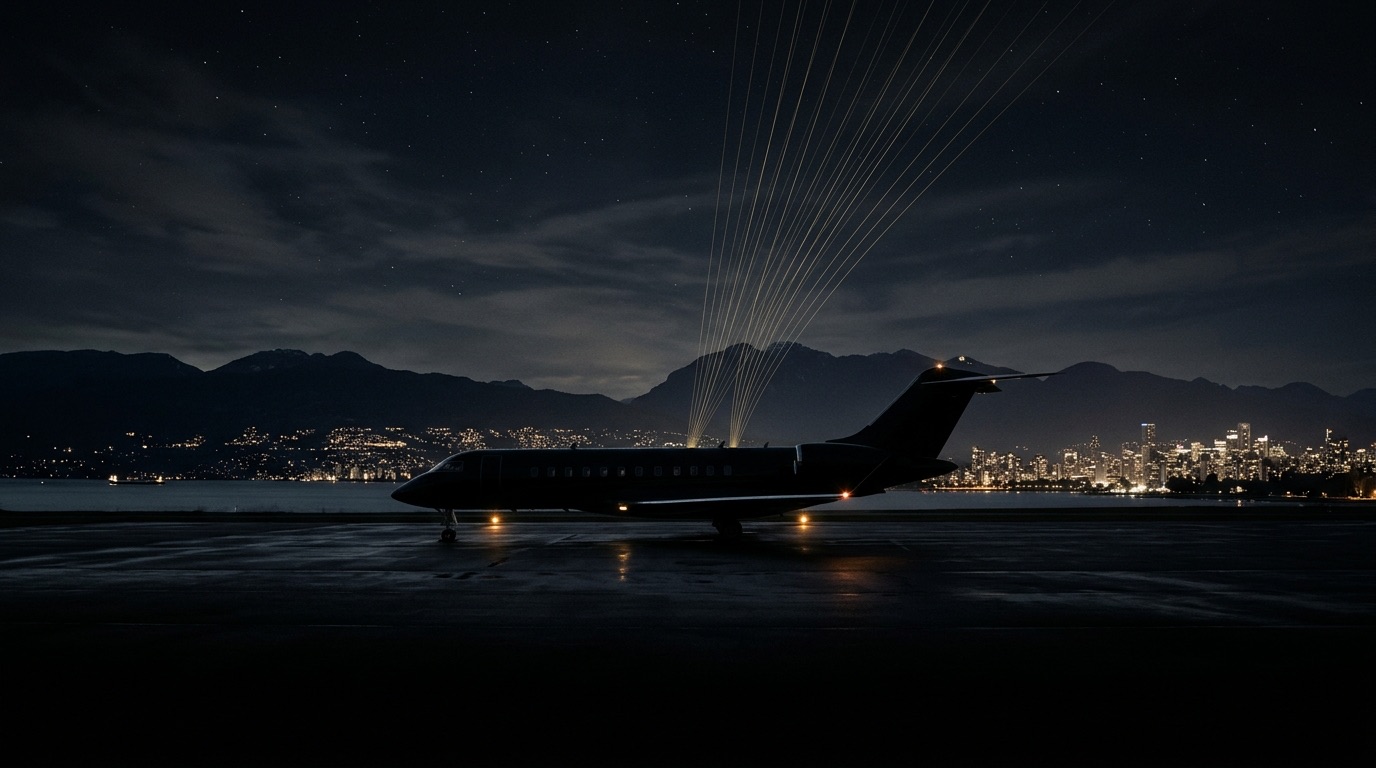
Vancouver's private aviation traffic concentrates at YVR South Terminal and the general aviation ramps around it, serving a UHNW population of roughly 5,200 individuals across West Vancouver, Shaughnessy, Point Grey and the British Properties, among them 12 billionaires whose wealth spans Canadian resource holdings, Pacific Rim trade, real estate and, increasingly, technology. Vancouver's position as a Pacific gateway means its private aviation community moves constantly between Canadian, US and Asian jurisdictions, often on the same aircraft in the same week, which multiplies the number of regulatory environments, ground handlers and connectivity providers touching that aircraft's systems.
That mobility is exactly what makes the cabin network and the aircraft's public tracking footprint a live risk rather than a theoretical one. A Vancouver family with holdings in Hong Kong, Singapore or Vancouver's own resource sector routinely has more to lose from a leaked flight pattern than from almost any other single data point, since flight history alone can expose undisclosed acquisitions, family relocations, or the timing of a liquidity event long before any public filing does.
What actually needs securing on a Vancouver-based aircraft
- Cabin connectivity. Aircraft flying transpacific or cross-border routes typically carry Ka-band satellite systems (Starlink Aviation, Gogo, Viasat) that, left unsegmented, put a guest's or crew member's personal device on the same network as flight-planning data and financial documents being reviewed onboard.
- ADS-B and flight-tracking exposure. Public trackers like Flightradar24 and ADS-B Exchange log every YVR departure in real time. For a family whose business spans multiple continents, a visible pattern of Vancouver-to-Hong Kong-to-Vancouver flights is itself commercially sensitive information, openly available to competitors, journalists and activists alike.
- Cross-border data handling. Aircraft crossing the Canada-US border or continuing to Asia carry devices and data across jurisdictions with materially different privacy and seizure rules, which means a device policy designed for one jurisdiction is often inadequate for the actual mission profile.
Typical connectivity and cybersecurity investment
| Service | Typical Annual Range (CAD) | Notes |
|---|---|---|
| Satellite connectivity (Ka-band, mid-to-heavy cabin) | 60,000 - 160,000 | Higher end reflects transpacific data volume and redundancy |
| Segmented cabin network build-out | 30,000 - 75,000 (one-time) | Isolates guest, crew and avionics traffic on separate VLANs |
| Flight-tracking obfuscation program | 10,000 - 25,000 / year | Privacy program enrollment, registration structuring review |
| 24/7 incident response retainer | 18,000 - 45,000 / year | SLA-backed response across Pacific time zones |
| Annual penetration test, aircraft + ground systems | 20,000 - 40,000 | Covers cabin network, crew devices, cross-border handling points |
The Pacific Rim mission profile in practice
A typical rotation for a Vancouver-based family might run YVR to Hong Kong, on to Singapore for a series of meetings, and back through Tokyo before returning to the British Properties, all inside two weeks. Each leg touches a different regulatory environment for satellite spectrum, a different set of ground handlers with their own Wi-Fi and device-charging kiosks, and a different set of customs authorities with their own appetite for inspecting onboard electronics. A device policy written for a domestic Canadian charter operation simply does not anticipate this, which is why our Vancouver engagements start with a mission-profile review before any hardware or software recommendation is made.
Response-time discipline across time zones
An aircraft that departs YVR at midnight bound for Asia does not stop needing a functioning, secure network the moment it crosses the Pacific. Our Vancouver engagements carry a documented SLA regardless of destination time zone: acknowledgment inside 15 minutes, a qualified engineer engaged within 30, and a resolution path communicated within two hours whether the aircraft is on the ground at YVR or on approach into Hong Kong. This is the same standard set out in our broader private aviation IT and connectivity overview, applied to a mission profile that is genuinely intercontinental rather than regional.
Where this fits inside a broader estate
Vancouver principals frequently hold a West Coast residence, a Pacific Rim business footprint and, in a meaningful number of cases, a vessel moored in Coal Harbour or further up the coast. We scope aircraft, estate and yacht networks as a single connected perimeter rather than three unrelated vendor relationships, because a compromised crew device or a leaked flight pattern rarely stays contained to the system it originated on. A family's overall cybersecurity posture is measured by its weakest connected asset, and for a family that flies transpacific on a regular schedule, the aircraft is very often that asset.
Why cross-border mission profiles need a specialist, not a generalist
A Vancouver family office's existing IT provider is typically well suited to the residence, the office network and day-to-day device support. It is rarely equipped to reason about an aircraft that crosses Canadian, US and Asian jurisdictions in the same rotation, each with different rules on device seizure at borders, different expectations for satellite spectrum licensing, and different norms for how aggressively local authorities may inspect onboard electronics. Treating the aircraft as an extension of the household network, rather than its own security domain with its own threat model, is the single most common gap we find when we take over from a prior provider, and it is the gap that a purely domestic-focused IT contract was never designed to close.
Discretion as a design constraint
Every engineer working on a Vancouver-based aircraft's systems signs an NDA before touching a single device. We do not publish client names, tail numbers or identifying case detail, and documentation is written to withstand scrutiny from a family office audit or a regulatory inquiry without exposing operational specifics beyond the immediate principal circle. For a community whose wealth so often depends on cross-border discretion, this is not an add-on service; it is the baseline the entire engagement is built around.
Engineer the aircraft your cross-border life actually requires
A Private Strategy Session maps your current aircraft network, flight-tracking exposure and cross-border data handling against what a properly segmented, NDA-bound program costs to run.
Request Your InvitationFrequently asked
How much does it cost to secure a private jet's cabin network in Vancouver?
For a mid-to-heavy cabin jet flying transpacific and cross-border routes out of YVR, expect CAD 30,000-75,000 for the initial segmented network build plus CAD 60,000-160,000 a year in satellite connectivity depending on route length and data volume. A 24/7 incident response retainer typically adds CAD 18,000-45,000 annually.
Is it worse to have flight patterns exposed for a family with Asian business interests?
Often, yes. A visible Vancouver-Hong Kong-Vancouver or similar recurring pattern can telegraph acquisitions, relocations or liquidity events well before any public disclosure, making flight-tracking exposure a genuine commercial risk, not just a personal-safety one.
How is this different from a generalist aviation IT vendor?
Generalist vendors install connectivity without threat-modeling it. Our engagements segment guest, crew and avionics traffic from day one, account for the cross-border data handling implications of transpacific routes, and carry a documented incident-response SLA rather than best-effort support.
How quickly can a program be stood up before a scheduled flight?
A baseline network segmentation and connectivity review typically takes 2-3 weeks for an aircraft already based at YVR. Full flight-tracking obfuscation and cross-border device policy work usually takes 4-8 weeks depending on the aircraft's existing ownership and registration structure.
Is everything covered under NDA?
Yes, starting with the first Private Strategy Session. No client names, tail numbers or identifying case detail are ever published, and all engineering staff are contractually bound before any system access is granted.