
Private Jet IT & Cybersecurity in Paris
Paris concentrates roughly 9,800 UHNW residents and 46 billionaires across the 16e, Neuilly-sur-Seine, Passy and the Marais - and nearly all of them route their aircraft through Le Bourget, Europe's busiest business aviation airport. The aircraft that carries a principal out of LBG is now as exposed, and as valuable to secure, as the townhouse they leave behind.
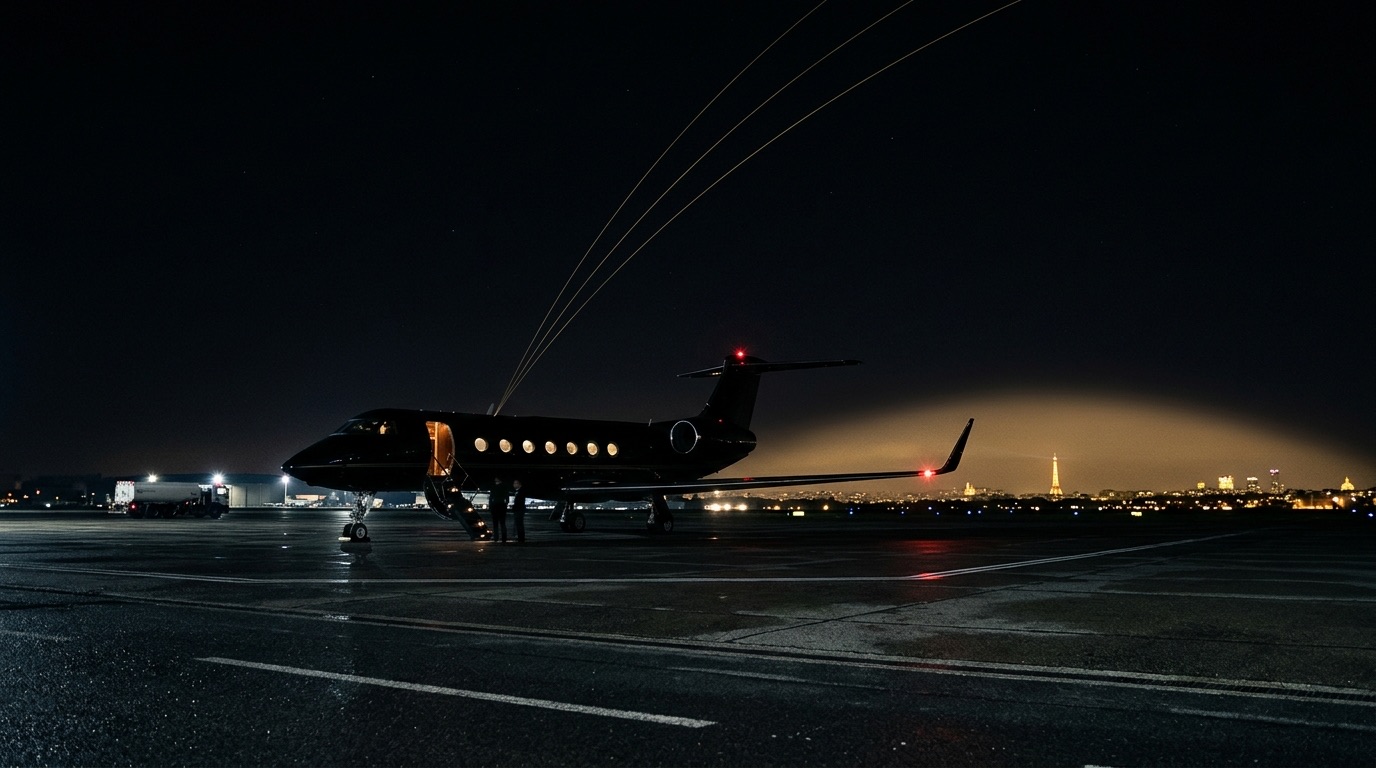
Le Bourget does not look like the busiest business aviation airport in Europe. There is no terminal crush, no queue at security, no departure board flickering with delays - which is precisely the point. LBG handles the arrivals and departures of the principals who live within a twenty-minute drive of it, in the 16e arrondissement, Villa Montmorency, Neuilly-sur-Seine, Passy and the Marais, and it does so with a discretion the household staff on the ground would recognise instantly. What the ramp at Le Bourget does not offer, as a matter of course, is the same standard of technical security the principal expects inside the apartment or the family office. That gap is the subject of this briefing.
Paris is home to an estimated 9,800 UHNW individuals and 46 billionaires, a concentration of private wealth that rivals any city in Europe, much of it multi-generational - family offices, holding structures and industrial fortunes with roots that predate the aircraft entirely. For this population, the private jet is rarely a status object. It is working infrastructure: the vehicle for the Monday board call taken over the Atlantic, the encrypted file review en route to Geneva, the quiet exit when a situation at home requires one. Treating the aircraft's connectivity and data security as an afterthought - as many operators still do - leaves a working extension of the household exposed at exactly the moment it is being used hardest.
Le Bourget: volume, proximity, and what it means for exposure
LBG's position as Europe's leading business aviation airport is not incidental to the risk profile of the aircraft that use it. A field handling this density of high-value movements is also a field under proportionally dense observation - by tracking services, by aggregators that resell ADS-B and flight-plan data, and by parties with a commercial or personal interest in knowing exactly which principal left Paris, for where, and when. A tail number departing LBG for Nice, Geneva or a Gulf state is a matter of public record within minutes on any of several open flight-tracking platforms, correlated automatically with ownership databases that are trivial to cross-reference. The privacy the principal enjoys behind the gates of a 16e residence does not extend, by default, to the aircraft parked forty minutes away.
The practical response is layered, not singular. Registration structuring through appropriately opaque trusts or operating companies reduces the ease of the ownership lookup. Tail-number and ADS-B masking programmes, where the operator and jurisdiction permit them, reduce real-time public visibility. And a disciplined protocol around who is told a departure time - and through what channel - closes the more common leak, which is rarely the aircraft's transponder and almost always a calendar invite, a driver's group chat, or an FBO booking left unencrypted.
The cabin as a network, not an amenity
Modern business jets are flying networks. Satellite connectivity now supports video calls, document review, secure messaging and, increasingly, direct links back into a family office's own systems - the same systems that hold the banking relationships, the succession planning, and the correspondence a principal least wants exposed. Yet cabin Wi-Fi is routinely installed and configured by the same team that fits the seatbelts: capable on hardware, largely unversed in network segmentation, encrypted VPN tunnelling, or the difference between a consumer-grade router and one hardened for a target-rich environment.
The exposure compounds on the ground. FBO Wi-Fi at Le Bourget and comparable fields is convenient and, from a security standpoint, largely unmanaged - a shared network used by crew, ground handlers and other passengers alike, and not a network any principal's device should touch unauthenticated. A properly configured aircraft carries its own independent, encrypted connectivity path that never depends on the field's local network, precisely so that a stopover does not become the weak link in an otherwise well-protected day.
What proper aircraft connectivity costs
Connectivity system economics vary by aircraft category and the bandwidth a principal actually needs in the cabin. The table below reflects the ranges typically seen when specifying or retrofitting a Ka-band or low-earth-orbit system on the mid-size to large-cabin jets common among Paris-based owners, alongside the recurring cost of managing that system securely.
| Item | Typical range | Notes |
|---|---|---|
| Hardware install (Ka-band or LEO terminal) | 85,000 - 450,000 USD | Varies by cabin size, antenna type, and aircraft downtime for install |
| Monthly connectivity plan | 2,500 - 14,000 USD | Unlimited or high-cap plans for a heavily used cabin cost toward the top of the range |
| Managed cyber-secure network overlay | 1,800 - 6,500 USD / month | VPN tunnelling, segmentation, device authentication, monitoring |
| Concierge IT retainer (aircraft + household integration) | from 4,500 USD / month | 24/7 response, incident handling, travel-day support |
| Incident response SLA | 15 - 60 minutes to acknowledge | Scoped against the principal's typical flying cadence and time zones |
Continuity around Paris flying patterns
A Paris-based principal's flying calendar has a rhythm - Geneva for banking meetings, Nice or Antibes for the coast, London for business, further afield for the family office's own portfolio interests - and each leg is a moment when the household's digital perimeter briefly moves with the aircraft. The most robust setups we see integrate the jet's connectivity and device policy with the same continuity plan that governs the Paris residence and the family office itself, so that a principal working from 40,000 feet is operating inside the identical security posture as the one at the desk in Passy - not a diminished, ad-hoc version of it. Our broader private jet ownership and continuity guidance covers the operational side of this in more depth, and it pairs directly with how we approach estate-wide technology across jet, yacht and residence for principals who move between all three.
Cyber risk specific to the Paris UHNW population
Paris's concentration of historic wealth and family offices makes its principals a specific target profile: less likely to be recognised on the street than a public figure, more likely to be identified through data - property records, court filings, aircraft registration, and social graphs built from staff, advisers and family. The aircraft sits at the intersection of several of those data trails at once. A rigorous approach treats the jet's cyber posture as inseparable from the wider cybersecurity programme protecting the residence, the family office and the principal's personal devices - because an attacker rarely needs to breach all three when one, left unmanaged, will do.
What a properly scoped engagement looks like
A private aviation IT and cybersecurity engagement for a Paris-based principal typically begins with an exposure audit - what is currently visible about the aircraft and its movements, what the existing connectivity setup actually permits an outsider to see or access, and where the FBO and crew workflows introduce risk that has nothing to do with the aircraft's own systems. From there, the work is a mix of hardware (secure connectivity, segmented networks, hardened onboard devices), protocol (who is told what, and through which channel, before a departure), and monitoring (a 24/7 point of contact who understands both the technology and the discretion the engagement demands).
None of this is exotic. It is the same discipline already applied to the residence and the office, extended to the one asset that, by design, leaves the perimeter every time it is used.
Extend the household's security to the ramp at Le Bourget
Obsidian Helm audits and secures private aircraft connectivity and cyber posture for Paris-based principals, integrated with residence and family office systems. Begin with a confidential, by-invitation Private Strategy Session.
Request Your InvitationFrequently asked
What does private jet cybersecurity actually cost for a Paris-based owner?
A managed, secure connectivity overlay typically runs 1,800 to 6,500 USD per month on top of the aircraft's existing connectivity plan, with a broader concierge IT retainer covering the aircraft and its integration with residence and family office systems starting from around 4,500 USD per month. Hardware retrofits for the satellite terminal itself sit well outside this and depend on aircraft type and cabin size.
How exposed is a tail number departing Le Bourget?
Highly exposed by default. Open ADS-B tracking platforms and aggregators publish departure and arrival data within minutes, and ownership can often be cross-referenced from public registration records. Mitigations include registration structuring, tail-number masking where the operating jurisdiction permits it, and tight control over who is told departure details and through what channel.
How long does it take to secure an aircraft's connectivity and network?
A full exposure audit and remediation plan typically takes two to four weeks, though the highest-priority items - closing an unmanaged FBO Wi-Fi dependency, segmenting the onboard network, tightening who has visibility into the flight schedule - can often be addressed within the first week.
Is this handled under NDA?
Yes. Every engagement begins under a mutual non-disclosure agreement before any specifics of the aircraft, its registration, or the principal's travel patterns are discussed. Obsidian Helm operates on a by-invitation basis for exactly this reason.
How is this different from what the aircraft management company already provides?
Aircraft management companies are excellent at maintenance, crewing and operations - they are rarely staffed for network security, cyber monitoring, or integrating the aircraft's systems with a principal's residence and family office. Obsidian Helm works alongside the existing management company, adding the technical security layer most operators are not built to provide.