
Private Jet IT & Cybersecurity for Los Angeles Principals
Van Nuys Airport moves more general-aviation traffic than any field in the United States, and it sits fifteen minutes from Beverly Hills, Bel Air and Holmby Hills. For the roughly 20,000 UHNW residents and 56 billionaires on LA's Westside, the aircraft itself is usually better secured than the network running inside it.
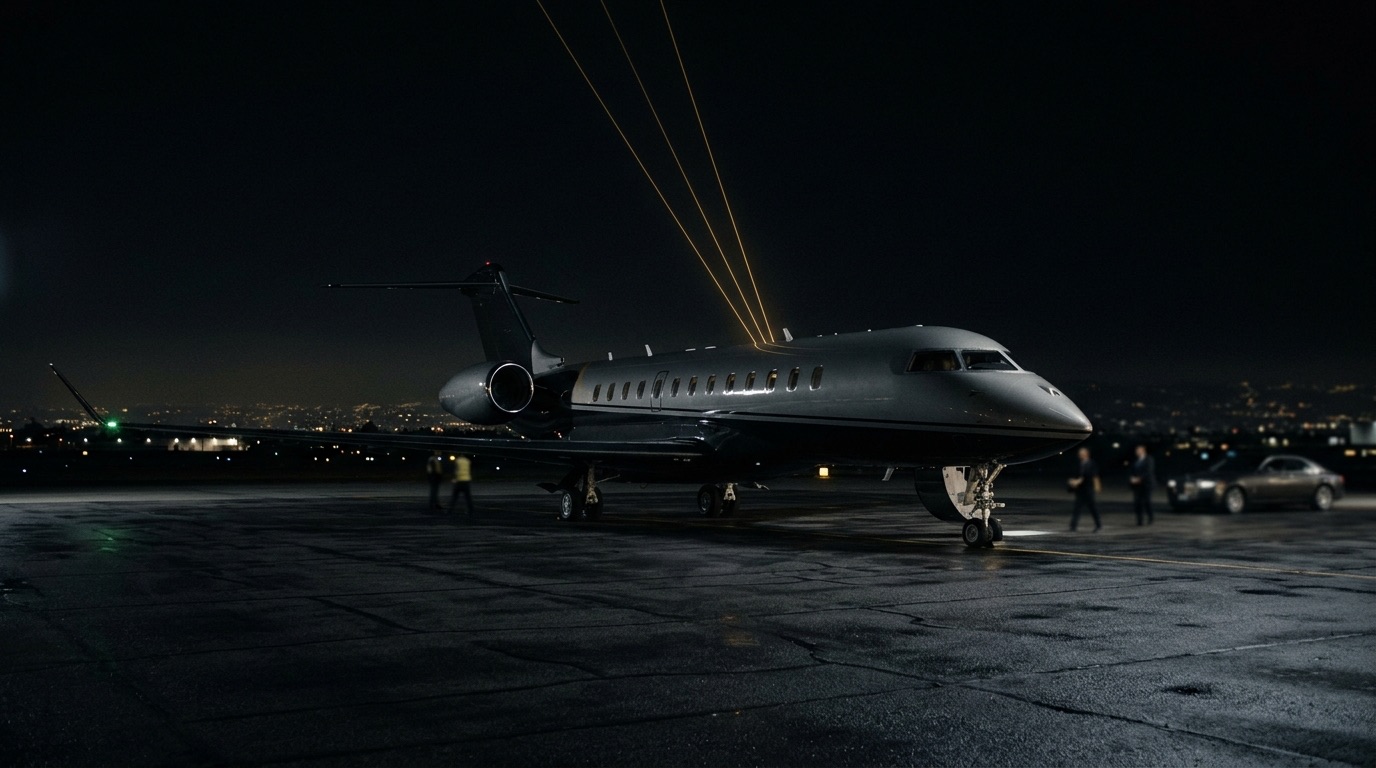
Los Angeles carries one of the densest concentrations of private aircraft ownership on earth, and it runs through a footprint most outsiders never see clearly. Van Nuys Airport (VNY) is the busiest general-aviation field in the United States by operations count, and it sits a fifteen-minute drive from Beverly Hills, Bel Air, Holmby Hills, Brentwood and Pacific Palisades. Burbank's Hollywood Burbank Airport handles a meaningful share of scheduled corporate and fractional traffic for the same neighborhoods, while Santa Monica's municipal field — its runway shortened years ago and now largely limited to turboprops and light aircraft — still functions as a quieter Westside gateway for shorter hops. Between them, the roughly 20,000 UHNW residents and 56 billionaires clustered across the Westside and the Valley have private-aviation infrastructure sitting closer to home than almost anywhere else in the country.
Van Nuys and the Real Shape of LA Private Aviation
VNY's density is precisely what makes it interesting from a security standpoint. Dozens of flight departments, management companies and charter operators share ramp space, fuel providers and FBO lounges, and aircraft based there fly a distinctive mix of short entertainment-industry hops (Aspen, Cabo, Las Vegas) alongside transcontinental and transatlantic legs. That mix matters for connectivity planning: an aircraft that spends most of its life between VNY and Van Nuys-to-Vegas has very different bandwidth needs from one that regularly crosses oceans, and buying the wrong system is one of the most common — and expensive — mistakes flight departments make. Getting the airframe and mission profile right first is the subject of Obsidian Helm's own private jet ownership and cost pillar, which most Beverly Hills and Bel Air owners read before, not after, they sign a connectivity contract.
The Cabin Is Not as Private as It Looks
ADS-B Out, mandatory in nearly all U.S. controlled airspace since January 2020, broadcasts an aircraft's tail number, GPS position, altitude and ground speed in clear, unencrypted text roughly once per second. Public flight-tracking sites and social accounts pick this up automatically, and a tail number tied to a family office is trivially linkable to arrival windows, departure patterns and a home-base airport within minutes of pushback — several well-known Bay Area and LA principals have had their movements republished within moments of wheels-up by accounts built entirely on public ADS-B feeds. FAA privacy filings help: the Limiting Aircraft Data Displayed (LADD) program, which replaced the old Block Aircraft Registration Request system in 2020, and ICAO block-address requests for internationally registered airframes both reduce public visibility. Neither, however, touches the cabin network, the crew's personal devices, or the ACARS datalink still used for maintenance and operational messaging on much of the Gulfstream and Bombardier fleet based at VNY — a protocol aviation-security researchers have repeatedly shown to be susceptible to spoofing and interception because most of it still travels unencrypted.
Connectivity, Priced Correctly for the Mission
Cabin connectivity for a VNY-based aircraft splits into three practical tiers, and the LA mistake is almost always buying one tier above or below what the flight profile actually needs.
| System | Best fit | Typical install cost | Typical monthly cost | Realistic throughput |
|---|---|---|---|---|
| Air-to-ground (e.g. Gogo AVANCE-class) | Light/midsize jets, domestic LA–Aspen–Vegas–Cabo routing | $100K–$180K | $1,500–$3,500/mo | 15–25 Mbps, U.S. coverage only |
| LEO satellite (Starlink Aviation-class) | Cabin-wide streaming, near-global coverage on heavy/large-cabin jets | $150K–$300K | $2,500–$7,500/mo (data tier dependent) | 100–200 Mbps |
| Ka-band GEO satcom (Satcom Direct / JetWave / Viasat-class) | Heavy jets flying transatlantic, transpacific and long-range international | $450K–$1.2M | $4,000–$15,000/mo | 30–100 Mbps shared |
A VNY-based light jet doing entertainment-industry weekend hops rarely justifies a Ka-band install; a heavy jet doing regular Los Angeles–London or Los Angeles–Tokyo legs rarely gets by on air-to-ground alone. The right answer is a mission-matched build, not the most expensive one on the ramp.
What a Properly Secured Aircraft Actually Includes
- A segmented cabin network that isolates owner and family devices, guest devices, and cockpit/avionics data buses onto separate, non-routable VLANs
- Managed device enrollment for crew and family iPads/laptops so a compromised personal device cannot pivot onto the aircraft's connectivity system
- ICAO block-address and LADD filings kept current on every tail the principal or family office actually flies, including chartered and fractional aircraft
- A hardened, monitored VPN for any cabin work traffic that touches deal, legal or family-office systems mid-flight
- Documented incident response for the flight department, not just the family office — most LA cyber incidents affecting aircraft trace back to a crew or vendor account, not the aircraft itself
Why This Gets Missed, Even at VNY
Part of the problem is structural. A single VNY-based aircraft often touches four or five separate vendors — an owner-appointed flight department, a management company handling scheduling and charter, a connectivity provider selling and maintaining the satcom system, and a rotating set of contract crew during peak season. Each vendor optimizes for its own slice of the aircraft; none of them is responsible for the network as a whole. The result, seen repeatedly across Beverly Hills and Bel Air-based fleets, is a cabin Wi-Fi network installed correctly at delivery and never touched again, crew devices added ad hoc with no enrollment policy, and a connectivity contract renewed year after year without anyone reassessing whether the tier still matches how the aircraft is actually flown. Closing that gap requires one party accountable for the whole network, not another vendor adding one more piece to it.
One Continuity Plan Across Jet, Yacht and Estate
For most Westside principals, the aircraft is one leg of a wider security surface that also includes a Marina del Rey or Newport-berthed vessel and one or more residences across Bel Air, Malibu and beyond — and treating each independently is how gaps open between them. Obsidian Helm builds a single continuity architecture across all three, detailed on the yacht, jet and estate technology page, and ties the aircraft's cabin network into the same personal cybersecurity posture — device hardening, dark-web monitoring, family office endpoint management — described on the personal cybersecurity page. An aircraft secured in isolation from the rest of the principal's digital footprint is only half protected.
Your aircraft, secured and connected correctly the first time
Obsidian Helm designs and audits private-aviation IT and cybersecurity for Los Angeles principals and their flight departments, by invitation only. The $4,999 Private Strategy Session maps your current aircraft, route profile and family office exposure into a single, mission-matched plan.
Request Your InvitationFrequently asked
How much does it cost to secure and connect a private jet based at Van Nuys?
For a midsize jet on domestic LA routing, a properly segmented cabin network plus air-to-ground or LEO connectivity typically runs $150,000–$300,000 to install and $2,000–$6,000 a month to operate. Heavy jets flying international legs with Ka-band satcom and full network segmentation run $500,000–$1.2 million installed, with $5,000–$15,000 a month in ongoing connectivity and monitoring costs.
How long does a full aircraft cybersecurity assessment and build take?
An assessment of an existing VNY, Burbank or Santa Monica-based aircraft typically takes two to three weeks, covering the cabin network, crew devices, connectivity contracts and ADS-B/ICAO privacy filings. A full rebuild — new segmentation, new connectivity system, hardened crew device management — generally takes six to twelve weeks depending on aircraft availability for install.
Is this confidential? We don't want a vendor who knows our tail number and schedule.
Every engagement operates under NDA before any tail number, route, or ownership detail is discussed, and Obsidian Helm's own team never publishes case studies, client lists, or identifiable aircraft details. Flight department staff and crew are read in only on the systems they operate, not on the principal's broader security architecture.
What's actually included in a private jet IT engagement, versus a generic IT company?
A generic IT provider will sell and install a connectivity system. Obsidian Helm additionally audits the mission profile against the connectivity tier actually needed, segments the cabin network from cockpit and crew systems, hardens and enrolls every device that touches the aircraft, files and maintains ADS-B/ICAO privacy protections, and ties the aircraft into the principal's wider yacht, estate and personal cybersecurity architecture rather than treating it as an isolated asset.
Can this cover a chartered or fractional aircraft, not just one we own?
Yes. Chartered and fractional aircraft carry the same ADS-B and ACARS exposure as wholly-owned jets, and family offices that fly multiple operators often have the least consistent security posture across their fleet. Obsidian Helm builds a portable device and connectivity policy that travels with the principal regardless of which tail they board.